

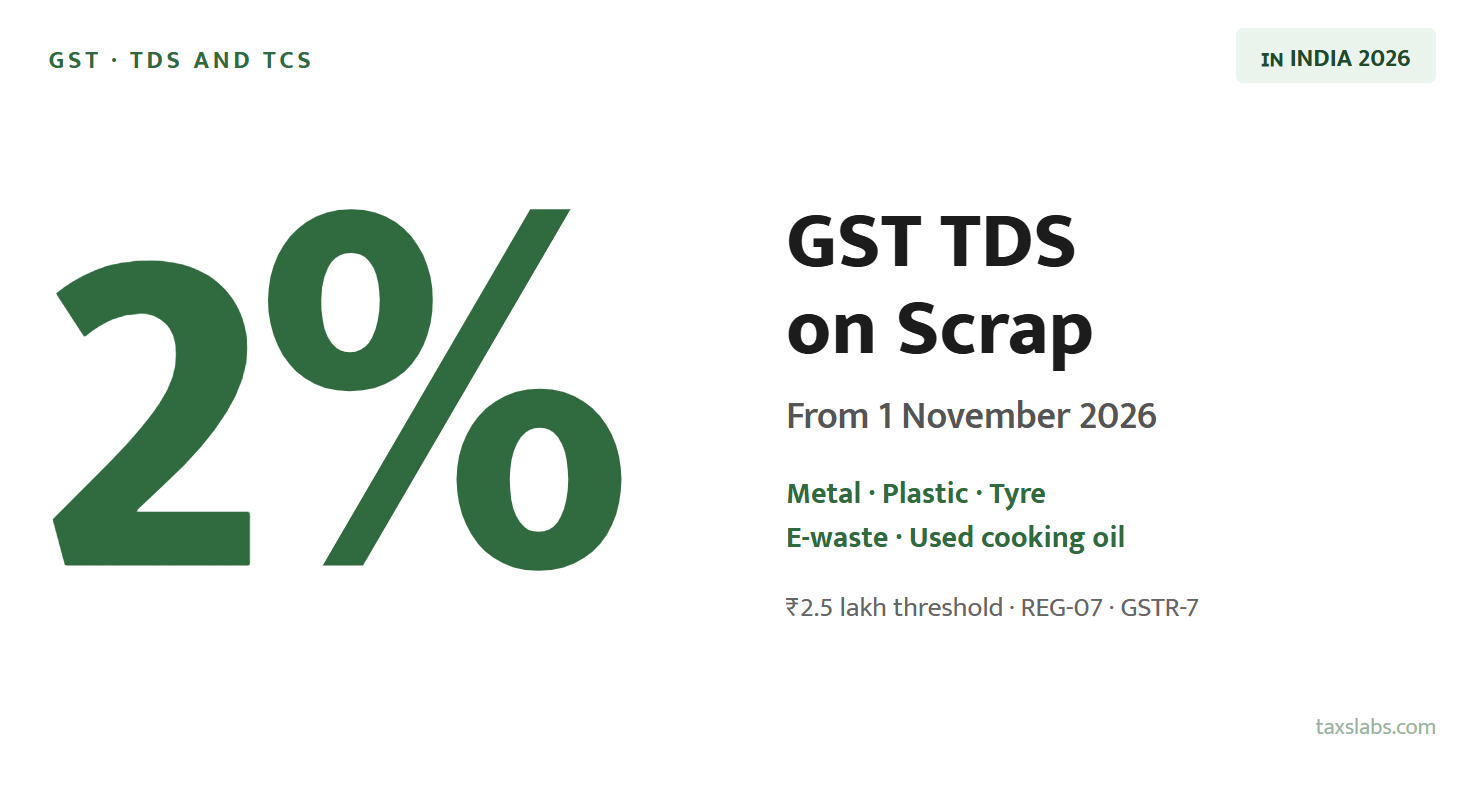
GST TDS on Scrap from 1 November 2026: The Complete Guide to 2% TDS on Metal, Plastic, Tyre, E-Waste and Used Cooking Oil
Until October, only a metal scrap buyer had to worry about deducting tax under GST. That changed on 1 November 2026. GST TDS on scrap now reaches four more trades: used cooking oil, plastic waste, tyre scrap and e-waste. A biodiesel plant buying used oil from a hotel chain, a plastic granule unit buying bales from an aggregator and a tyre pyrolysis unit buying from a fleet operator are now all tax deductors. Each must hold back 2% of the taxable value and file GSTR-7 every month.
This guide explains GST TDS on scrap from the buyer’s desk. It covers who must deduct and the five notified HSN categories. It walks through the ₹2.5 lakh contract test, the inter-State proviso and the line between TDS and reverse charge. You will also find the REG-07 registration route, the GSTR-7 cycle, worked ₹ examples, two client scenarios and the mistakes that lead to interest and penalty.
What Changed on 1 November 2026
The 57th GST Council recommended tighter controls on the recycling chain. On 27 October 2026, CBIC issued three linked notifications, all effective from 1 November 2026. Each handles a different part of the same problem: invoices passed through layers of unregistered collectors and suppliers who disappeared once the tax was due.
| Notification | What it does | Who it affects |
|---|---|---|
| 07/2026-Central Tax | Substitutes clause (d) of Notification 50/2018-CT, so that any registered person receiving the five notified goods from a registered supplier must deduct TDS under Section 51 | Registered buyers |
| 06/2026-Central Tax | Withdraws the registration exemption under Notification 5/2017-CT (for persons making only reverse-charge supplies) from suppliers of these goods | Sellers: collectors, aggregators, dealers |
| 04/2026-Central Tax (Rate) | Adds used cooking oil, plastic scrap, tyre scrap and e-waste to the reverse-charge list when an unregistered person supplies a registered person | Registered buyers dealing with unregistered sellers |
None of this was new for metal. Since 10 October 2024, Notification 25/2024-CT has required registered buyers of metal scrap (Chapters 72 to 81) to deduct GST TDS. Purchases from unregistered metal sellers have also been under reverse charge since then. The November 2026 package copies that metal model and extends it to four more waste streams. If your client already runs a metal scrap TDS process, it now needs a wider HSN list. If your client is a plastic recycler or a biodiesel plant, this will be its first time as a tax deductor.
Who Must Deduct GST TDS on Scrap
Section 51 of the CGST Act was written for government departments, local authorities and PSUs. Notification 50/2018-CT lists the persons who must deduct. Its clause (d), as now substituted, covers “any registered person receiving supplies” of the five notified goods. Four conditions must all be met before GST TDS on scrap applies:
- The buyer is registered under GST. An unregistered buyer has no TDS obligation.
- The seller is registered. If the seller is unregistered, reverse charge applies instead (see below).
- The goods fall in a notified heading: 1518, 3915, 4004, 8549 or Chapters 72 to 81.
- The taxable value under the contract exceeds ₹2,50,000. The value excludes CGST, SGST, IGST and cess shown on the invoice.
The obligation does not depend on the buyer’s size. A small trader who resells bales and a listed tyre company are equally covered. It does not depend on what the buyer does with the scrap either: recycling, reselling or using it as raw material all count. Sellers are not exempt simply because they also deduct TDS themselves. A scrap aggregator in the middle of the chain is usually a deductee on its sales and a deductor on its purchases at the same time.
The inter-State proviso
The first proviso to Section 51(1) switches TDS off in one situation: when the supplier’s location and the place of supply are both in a State or UT other than the one where the buyer is registered. Both conditions must hold together.
- Buyer registered in Delhi, supplier in Haryana, goods delivered in Delhi: place of supply is Delhi, so TDS applies (2% IGST).
- Buyer registered in Delhi, supplier in Haryana, goods delivered in Haryana: both are outside Delhi, so no TDS.
- Buyer and supplier both in Maharashtra: TDS applies (1% CGST + 1% SGST).
Imports of scrap are outside GST TDS because there is no registered supplier in India. Customs duty and IGST are collected at the border.
Goods Covered: The Five Notified Categories
Classification decides everything here. A purchase under the wrong heading is either missed entirely or subjected to a deduction that was never due. The notified goods are defined by reference to the First Schedule to the Customs Tariff Act, 1975.

| Category | Tariff reference | TDS applies from | Typical buyer |
|---|---|---|---|
| Used cooking oil | Heading 1518 | 1 November 2026 | Biodiesel and oleochemical units, UCO aggregators |
| Waste and scrap of plastics | Heading 3915 | 1 November 2026 | Plastic recyclers, granule and flake makers |
| Waste and scrap of tyres | Heading 4004 | 1 November 2026 | Pyrolysis plants, crumb rubber and reclaim units |
| Metal scrap | Chapters 72 to 81 | 10 October 2024 | Steel mills, foundries, non-ferrous smelters, traders |
| Electrical and electronic waste and scrap | Heading 8549 | 1 November 2026 | Authorised e-waste recyclers and dismantlers |
Watch the edges of each heading. Used or retreaded tyres sold for use on vehicles fall under heading 4012, not 4004, so they are outside the TDS net. A second-hand laptop sold as a working device is not e-waste under 8549. Virgin plastic granules are not plastic scrap. When a supplier’s invoice shows an HSN that does not match what is physically delivered, get it corrected before payment. The buyer carries the deduction risk.
GST TDS on Scrap vs Reverse Charge: Which One Applies?
The single most common question from clients this month has been: “Do I pay RCM and deduct TDS?” The answer is no. The two mechanisms apply to different sellers, and one purchase never attracts both.
| Seller status | Who pays the GST | TDS? | What the buyer files |
|---|---|---|---|
| Registered | Seller charges GST on invoice | Yes, 2% if contract value > ₹2.5 lakh | GSTR-7 (TDS) + normal GSTR-3B |
| Unregistered | Buyer pays GST under reverse charge | No | Self-invoice; RCM in GSTR-3B Table 3.1(d) |
Under reverse charge, the buyer pays the full GST in cash, issues a self-invoice and claims ITC on it. Under TDS, the registered seller charges and pays its own GST. The buyer only holds back 2% of the taxable value as an advance tax credited to the seller’s cash ledger. The design is deliberate. Notification 06/2026-CT pushes small collectors to register, and once they register, the transaction moves from RCM to TDS.

For a fuller treatment of self-invoicing and RCM ITC, see our reverse charge mechanism guide.
How to Calculate GST TDS on Scrap: Rate, Base and Timing
Rate and split
The rate is 2% of the taxable value. For an intra-State purchase that is 1% CGST + 1% SGST/UTGST. For an inter-State purchase where TDS applies, it is 2% IGST. The rate does not change with the GST rate on the goods. Scrap taxed at 5% or at 18% attracts the same 2% deduction.
The base: taxable value, not invoice value
The explanation to Section 51(1) excludes the CGST, SGST, UTGST, IGST and cess shown on the invoice. So the deduction is worked out on the pre-tax figure. Income-tax TCS collected by the seller on scrap sales is also not part of the GST taxable value.
The ₹2.5 lakh contract test
The threshold is applied to the total taxable value under a contract, not to each invoice. Three invoices of ₹1,00,000 each under one purchase order add up to ₹3,00,000, so TDS applies to all three. Because the law says “exceeds”, a contract of exactly ₹2,50,000 does not trigger TDS. Rate contracts and open purchase orders need care. Once cumulative supplies cross the line, document the date it was crossed and how earlier payments were treated.
GST TDS on scrap is not the income-tax TCS on scrap
Scrap traders already know one source-tax rule from income tax: the seller collects TCS from the buyer on the sale of scrap (1% under old Section 206C(1), now carried into Section 394 of the Income-tax Act, 2025). GST TDS on scrap runs the other way. Here the buyer deducts from the payment to the seller. The two operate side by side on the same invoice and do not cancel each other out.
| Point | GST TDS on scrap | Income-tax TCS on scrap |
|---|---|---|
| Who acts | Buyer deducts | Seller collects |
| Law | Section 51, CGST Act | Income-tax Act, 2025 (formerly Section 206C(1)) |
| Base | Taxable value excluding GST | Sale consideration as per income-tax rules |
| Return | GSTR-7 monthly | Quarterly TCS statement |
| Credit to | Seller’s GST cash ledger | Buyer’s income-tax credit (Form 26AS/AIS) |
In practice, a scrap invoice can carry GST charged by the seller and income-tax TCS collected by the seller, and then have GST TDS held back by the buyer at the time of payment. Keep the three amounts in separate ledgers. Treat the GST TDS figure as a reduction in the cash paid against the supplier’s balance, not as a discount, so the supplier’s account still closes to zero.
Timing
Deduct at the time of payment or credit to the supplier’s account, whichever is earlier. Deposit the amount by the 10th of the following month through GSTR-7. A November 2026 deduction is therefore due by 10 December 2026.

| Scenario | Taxable value | TDS? | TDS amount |
|---|---|---|---|
| Copper scrap, Pune buyer and Pune seller, one PO | ₹5,00,000 | Yes | ₹10,000 (₹5,000 CGST + ₹5,000 SGST) |
| Used cooking oil, monthly purchase order of ₹2,00,000 from a registered hotel | ₹2,00,000 | No (below threshold) | Nil |
| Plastic bales, one contract, three invoices of ₹1,20,000 | ₹3,60,000 | Yes | ₹7,200 |
| Tyre scrap from an unregistered collector | ₹4,00,000 | No: RCM applies | Nil (buyer pays GST under RCM) |
| E-waste, Gujarat buyer, Rajasthan seller, delivered in Gujarat | ₹6,00,000 | Yes (IGST) | ₹12,000 IGST |
One point clients often get wrong about GST TDS on scrap: the deduction does not reduce the buyer’s input tax credit. In the copper example, the buyer still claims ₹90,000 of ITC (subject to GSTR-2B and the usual conditions). Only the cash paid to the supplier falls by ₹10,000.
Free tools: Reconcile the supplier invoices you will claim ITC on with the GST ITC Reconciliation Tool. Use the GST Calculator to split invoice values into taxable value and tax before working out the 2% deduction.
GST TDS on Scrap Compliance in 7 Steps
Once GST TDS on scrap applies to you, the deductor role comes with its own return and its own late fee. Treat it as a separate compliance stream, not an add-on to GSTR-3B.
- Step 1: Map vendors and HSNs — List every supplier of the five notified goods. Record GST registration status, the registration effective date, State, and the HSN actually supplied. Flag any contract or purchase order likely to exceed ₹2.5 lakh.
- Step 2: Take TDS registration in REG-07 — On the GST portal, apply in FORM GST REG-07 as a tax deductor. Choose 'Others' as the category and enter, for example, 'Used Cooking Oil Dealers' or 'Waste and Scrap of Plastics Dealers'. The certificate is issued in REG-06.
- Step 3: Configure your accounting system — Create a TDS-on-GST liability ledger split into CGST, SGST and IGST. Set the purchase entry to work out 2% on taxable value only, and to stop automatically for unregistered vendors (which go to RCM instead).
- Step 4: Deduct at payment or credit — When you pay the supplier or credit its account, whichever is earlier, hold back 2% of the taxable value once the contract value exceeds ₹2.5 lakh. Check the inter-State proviso before deducting.
- Step 5: Deposit and file GSTR-7 by the 10th — Pay the deducted amount from the electronic cash ledger and file GSTR-7 for the TDS GSTIN by the 10th of the next month, with invoice-wise details for each deductee. File a nil return in months with no deduction.
- Step 6: Share GSTR-7A with suppliers — Once GSTR-7 is filed, the TDS certificate in GSTR-7A is generated on the portal. Download it and send it to each supplier so they can accept the credit.
- Step 7: Reconcile every quarter — Match GSTR-7 deductions with your purchase register and supplier ledgers. Correct any wrong GSTIN or amount through the amendment table in the next GSTR-7.

Video: CA Ashwarya Agarwal walks through TDS and RCM on metal scrap: registration, GSTR-7, payment and refund. The same process now applies to the four new categories.
The Supplier’s Side: Claiming the TDS Credit
For the seller, GST TDS on scrap is a cash-flow issue, not an extra tax. The deducted 2% is an advance payment of the seller’s own GST. The seller recovers it in three steps:
- After the buyer files GSTR-7, the entry appears in the seller’s “TDS and TCS Credit Received” section on the GST portal.
- The seller accepts the entry, or rejects it if the amount or GSTIN is wrong.
- Accepted amounts are credited to the seller’s electronic cash ledger under Section 51(5) and can be used to pay output tax, interest or late fee.
This credit is not ITC and never reaches the electronic credit ledger. A scrap trader on thin margins whose output tax is mostly covered by ITC can end up with a cash ledger balance that keeps growing. In that case, the excess balance can be refunded under Section 54, using Form RFD-01 for an excess balance in the electronic cash ledger. If a buyer deducted TDS by mistake (for example on a non-notified HSN), the refund route under Section 51(8) read with Section 54 applies.
Interest, Late Fee and Penalty
| Default | Consequence | Provision |
|---|---|---|
| TDS deducted but not deposited by the 10th | Interest at 18% p.a. from the due date till payment | Section 51(6) read with Section 50 |
| GSTR-7 filed late (non-nil) | ₹25 CGST + ₹25 SGST per day, capped at ₹1,000 + ₹1,000 per return | Section 47 with Notification 23/2024-CT |
| GSTR-7 filed late (nil deduction) | Late fee waived | Notification 23/2024-CT |
| Failure to deduct, short deduction or non-payment | Penalty of ₹10,000 or the tax not deducted/paid, whichever is higher; amount recoverable through demand proceedings | Section 122(1)(v); Section 51(7) |
Example: A recycler deducts ₹18,000 in November 2026 but deposits it only on 9 January 2027, 30 days late, and files GSTR-7 the same day. Interest = ₹18,000 × 18% × 30/365 = ₹266. Late fee = 30 days × ₹50 = ₹1,500, which is within the ₹2,000 cap. The total cost is ₹1,766, plus the risk of a notice. A simple calendar reminder avoids all of it.
8 Common GST TDS on Scrap Mistakes Buyers Make
Most GST TDS on scrap problems we see in the first month come from ERP settings, not from misunderstanding the law. Check your system against this list.
- Deducting on the invoice total. TDS is on the taxable value. On a ₹5,90,000 invoice, 2% of the total is ₹11,800, which over-deducts by ₹1,800.
- Applying TDS and RCM together. An unregistered seller means RCM; a registered seller means TDS. One purchase never attracts both.
- Testing the threshold per invoice. Splitting one contract into small bills does not take you below ₹2.5 lakh.
- Not taking a separate TDS registration. The regular GSTIN cannot file GSTR-7. REG-07 is needed before the first deduction month closes.
- Using the old HSN list. ERP rules built in 2024 for Chapters 72–81 miss 1518, 3915, 4004 and 8549 unless someone updates them.
- Skipping nil GSTR-7s. Late fee is waived on nil returns, but filing them keeps your compliance record clean and avoids non-filer flags.
- Ignoring the inter-State proviso. Deducting where the supplier’s location and place of supply are both outside your State creates a refund case for the supplier.
- Mismatched GSTIN in GSTR-7. Credit goes to the GSTIN you report. A typo means the supplier sees nothing, and the dispute lands back on you.
Two Client Scenarios
Scenario 1: The biodiesel plant that thought hotels were “too small”
A biodiesel unit in Nashik buys used cooking oil from 14 registered hotels and two aggregators. In the first week of November, the finance team concluded that no single hotel invoice crossed ₹2.5 lakh, so no TDS applied. On review, we found that one hotel group had signed a single annual supply agreement covering all its properties. Its November supplies alone were ₹1.9 lakh, and the contract value for the year was about ₹22 lakh. The aggregators were on open purchase orders running at ₹4–5 lakh a month. The plant took REG-07 registration, deducted 2% on the hotel group and both aggregators from November, and its first GSTR-7, for November, is due by 10 December 2026. The smaller hotels, each on separate low-value orders, stayed outside TDS.
Scenario 2: The plastic recycler with a mixed vendor base
A recycler in Daman buys about 60% of its PET bales from registered aggregators and 40% from small unregistered collectors. Before November, it bought from the collectors without paying GST. From 1 November, it now pays GST under reverse charge on the collectors’ supplies (Notification 04/2026-CT(R)), issues self-invoices and claims the ITC. On the registered aggregators’ supplies above ₹2.5 lakh, it deducts 2% TDS. Two collectors had already registered by the second week of November after Notification 06/2026-CT withdrew their exemption. For each of them, the treatment switched from RCM to TDS on the date the GSTIN became effective. We set up a vendor master field for “registration effective date” to record this.
Key Takeaways
- From 1 November 2026, GST TDS on scrap covers used cooking oil (1518), plastic scrap (3915), tyre scrap (4004), metal scrap (Ch. 72–81) and e-waste (8549) under Notification 07/2026-CT.
- A registered buyer deducts 2% of taxable value when buying from a registered seller under a contract worth more than ₹2.5 lakh.
- An unregistered seller means reverse charge, not TDS (Notification 04/2026-CT(R)).
- Take a separate TDS registration in REG-07 (“Others” + category); file GSTR-7 by the 10th, with invoice-wise details.
- The seller gets the TDS in its cash ledger, not as ITC.
- Late deposit costs 18% interest; failure to deduct invites a penalty of at least ₹10,000.
Frequently Asked Questions on GST TDS on Scrap
What is GST TDS on scrap?
GST TDS on scrap is a 2% deduction under Section 51 of the CGST Act that a registered buyer must make when buying notified scrap or waste from a registered supplier under a contract whose taxable value exceeds ₹2.5 lakh. From 1 November 2026 it covers used cooking oil, plastic scrap, tyre scrap, metal scrap and e-waste.
From when does GST TDS apply to plastic, tyre, e-waste and used cooking oil?
From 1 November 2026, under Notification 07/2026-Central Tax dated 27 October 2026. Metal scrap has been covered since 10 October 2024 under Notification 25/2024-Central Tax.
Is GST TDS on scrap calculated on the invoice value including GST?
No. TDS is calculated on the taxable value only. CGST, SGST, IGST, UTGST and cess shown on the invoice are excluded from the base.
Does the ₹2.5 lakh limit apply per invoice?
No. The ₹2.5 lakh limit applies to the total taxable value under a contract. Several smaller invoices under one contract or purchase order are added together, and TDS applies once the total exceeds ₹2.5 lakh.
Do I deduct TDS if I buy scrap from an unregistered seller?
No. If the seller is unregistered, the registered buyer pays GST under reverse charge instead. TDS applies only when both buyer and seller are registered.
Do I need a separate GST registration to deduct TDS on scrap?
Yes. A tax deductor must obtain a separate registration by applying in FORM GST REG-07. For the new categories, select 'Others' and specify the category, such as Waste and Scrap of Plastics Dealers.
What is the due date for GSTR-7 for scrap TDS?
GSTR-7 is due by the 10th of the month following the month of deduction. For example, TDS deducted in November 2026 must be paid and reported by 10 December 2026.
How does the scrap seller claim the TDS deducted by the buyer?
The seller accepts the entry in the TDS and TCS Credit Received section on the GST portal after the buyer files GSTR-7. The amount is then credited to the seller's electronic cash ledger and can be used to pay output tax. It is not input tax credit.
Conclusion
GST TDS on scrap is no longer a metal-industry rule. From 1 November 2026, every registered business buying used cooking oil, plastic waste, tyre scrap, metal scrap or e-waste from a registered supplier must test each contract against the ₹2.5 lakh threshold. Above it, the buyer deducts 2% of the taxable value and files GSTR-7 by the 10th. Purchases from unregistered sellers move to reverse charge instead. The work is mostly set-up: correct HSN tagging, a separate REG-07 registration and a clean vendor master. Once those are in place, the monthly cycle is routine.
For the wider GST framework, read our complete GST guide and the 57th GST Council decisions that led to this change. Browse more updates in our GST topic hub.
Setting up GST TDS on scrap for a client? Start with a clean ITC position using our free GST ITC Reconciliation Tool, or send us your question.
Official sources: GST Portal – GSTN advisories · GSTR-7 FAQs (tutorial.gst.gov.in) · CBIC – GST notifications
