

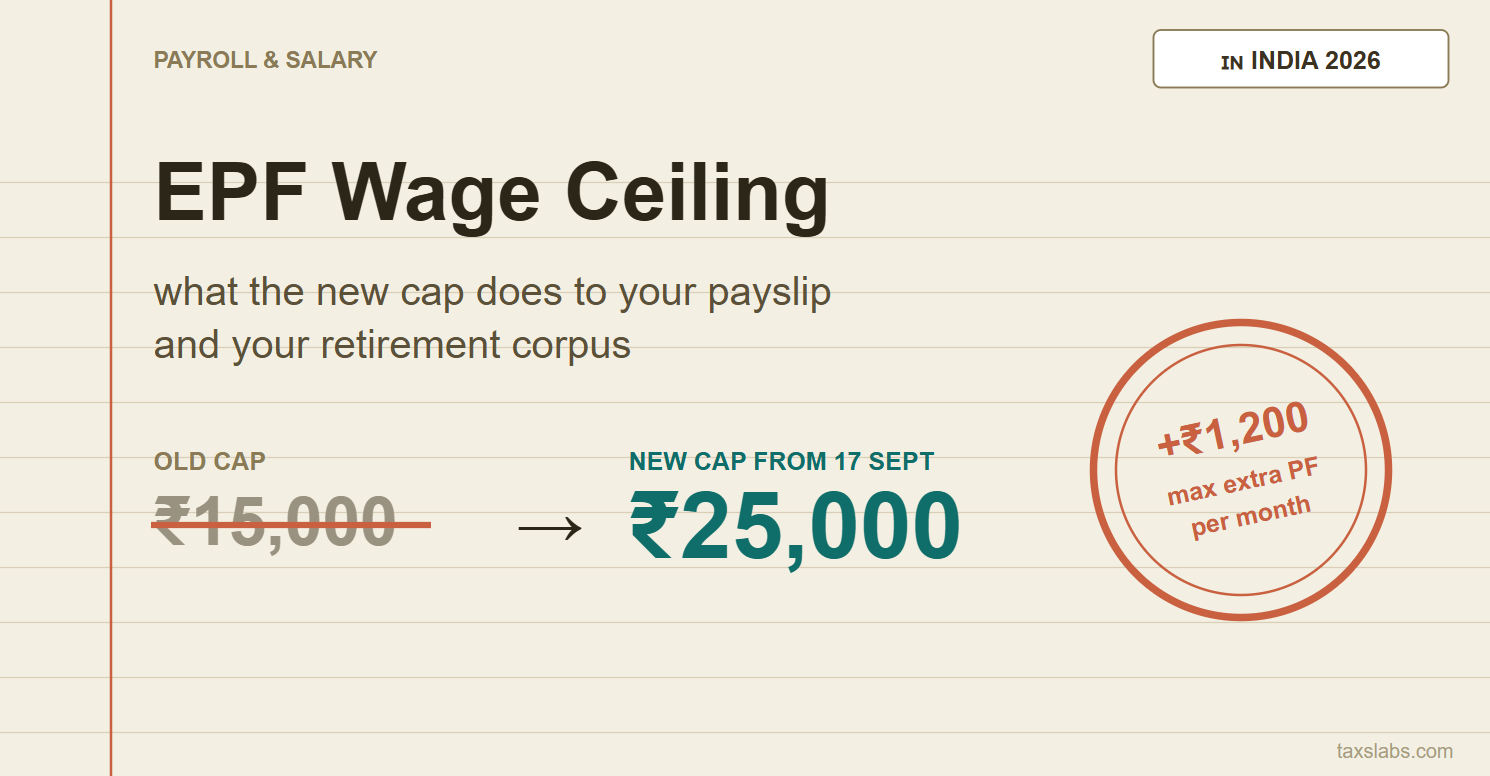
EPF Wage Ceiling ₹25,000: What the 2026 Change Does to Your Take-Home Pay and Retirement
For twelve years, one number quietly decided whether millions of Indian workers got a provident fund at all: ₹15,000. That number changed on 17 September 2026. The EPF wage ceiling is now ₹25,000 a month, and if your wages sit anywhere near that line, your payslip, your pension and your retirement corpus are all about to move.
Most coverage so far has focused on the headline, the 51 lakh workers who come under mandatory cover. This guide takes the employee’s side of the desk instead. You will see exactly how the new EPF wage ceiling changes your monthly deduction, where your employer’s 12% now goes, what happens to your EPS pension and EDLI insurance, how much bigger your corpus could be at retirement, and which questions are still waiting for an EPFO circular. By the end, you will know which of four employee profiles you fit, what your October payslip should look like, and what to check before it lands.
What the New EPF Wage Ceiling Rule Actually Says
On 16 September 2026, the Union Cabinet approved the Labour Ministry’s proposal to raise the wage ceiling for mandatory EPFO coverage from ₹15,000 to ₹25,000 per month. The very next day, the Ministry published Gazette notification S.O. 5109(E), which notifies ₹25,000 per month as the wage ceiling for the purposes of Chapter III of the Code on Social Security, 2020, with effect from the date of its publication. In practice, that means the new EPF wage ceiling has applied since 17 September 2026.
The government expects more than 51 lakh additional employees to come within mandatory coverage. It has also estimated annual outgo of about ₹11,339 crore, against existing budgetary support of about ₹10,250 crore, and roughly ₹56,696 crore over five years. Most of that money funds the government’s own contribution to the pension scheme, which we cover later.
Notice, however, what the EPF wage ceiling notification did not change. The contribution rates are still 12% from you and 12% from your employer (10% for certain notified classes of establishments). EPS still receives 8.33% of wages up to the ceiling. In short, the percentages stayed the same, and only the base they apply to moved.
From ₹6,500 to ₹15,000 to ₹25,000: a short history
The EPF wage ceiling has only been revised a handful of times, and each revision came late. It sat at ₹6,500 from 2004 until 2014. It then jumped to ₹15,000 from 1 September 2014. After that, it stayed frozen for twelve years while salaries, minimum wages and living costs kept rising.
The frozen EPF wage ceiling had a real cost. By 2026, several states had minimum wages close to ₹15,000. As a result, a fresh graduate joining at ₹16,000 could legally be treated as an excluded employee, with no provident fund, no pension and no insurance. In January 2026, the Supreme Court directed the Centre and EPFO to decide on revising the ceiling within four months. The ₹25,000 figure is the answer to that direction.
| Period | EPF wage ceiling (per month) | Maximum mandatory employee PF | Maximum EPS contribution |
|---|---|---|---|
| 2004 to 31 Aug 2014 | ₹6,500 | ₹780 | ₹541 |
| 1 Sept 2014 to 16 Sept 2026 | ₹15,000 | ₹1,800 | ₹1,250 |
| From 17 Sept 2026 | ₹25,000 | ₹3,000 | ₹2,083 |
Why the legal home is now the Code on Social Security
If you last read about PF rules a few years ago, you may be looking for the old EPF Act, 1952. That framework has been replaced. The Code on Social Security, 2020 came into force on 21 November 2025. Then, on 29 June 2026, the Labour Ministry notified the EPF Scheme, 2026, the EPS, 2026 and the EDLI Scheme, 2026, which replaced the 1952, 1995 and 1976 schemes.
The new EPF wage ceiling is notified under Section 2(89) of the Code. This matters for one very practical reason. Under the Code, “wages” has a specific definition, and it is not the same as the “basic” figure your HR team may be used to. We return to this in the take-home section, because it is the single most overlooked part of the change.
Coverage vs Contribution: the Two Jobs the EPF Wage Ceiling Does
Much of the confusion around this change comes from treating the EPF wage ceiling as one rule. In fact, it does two separate jobs. Once you separate the two jobs of the EPF wage ceiling, almost every “will my PF go up?” question answers itself.
Job 1: deciding who must join
The first job is a gatekeeper test at the time of joining. If a new employee in a covered establishment has wages up to the ceiling, membership is compulsory. If wages are above it, and the person has never been a member before, they can be an excluded employee.
Before 17 September 2026, the EPF wage ceiling set this gate at ₹15,000. Now it stands at ₹25,000. Consequently, anyone joining a covered employer with wages between ₹15,001 and ₹25,000 is now a compulsory member from day one. This is where the 51 lakh estimate comes from.
Job 2: capping the mandatory contribution base
The second job is a ceiling on the wages on which contributions are compulsory. If your wages are ₹40,000, your employer must contribute only on ₹25,000 unless both of you agree to contribute on the higher amount. The same EPF wage ceiling also caps the EPS share, because EPS takes 8.33% of wages up to the ceiling, not of your full wages.
This second job of the EPF wage ceiling is the one that changes payslips for people who are already members. If your employer used to calculate PF on “₹15,000 or actual wages, whichever is lower”, that formula now reads “₹25,000 or actual wages, whichever is lower”. The percentage is the same, but the base is bigger.

Who Is Affected by the EPF Wage Ceiling Change: Four Employee Profiles
Every salaried employee in a covered establishment falls into one of four EPF wage ceiling profiles. Your profile decides whether the new EPF wage ceiling changes your take-home pay, your pension, both, or neither. Find yours below before you read the numbers.
Profile A: the new joiner earning ₹15,001 to ₹25,000
This is the group the revised EPF wage ceiling was written for. If you join a covered employer on or after 17 September 2026 with wages in this band, you must be enrolled. You get a UAN, EPF deductions start with your first salary, your employer contributes 12%, and you get pension and EDLI insurance cover. Under the old ₹15,000 EPF wage ceiling, many employers would have offered you a “PF-free” salary instead.
Profile B: the existing member whose PF is capped
You are already a member, your wages are above ₹15,000, and your payslip has shown exactly ₹1,800 as employee PF for years. That flat figure tells you your employer restricts contributions to the statutory ceiling. For you, the EPF wage ceiling change means a higher deduction, rising by up to ₹1,200 a month, and a correspondingly larger employer contribution.
Profile C: the member who already contributes on full wages
Many large employers calculate PF on actual wages, whatever the ceiling. If your basic is ₹60,000 and your PF deduction is ₹7,200, you are in this group. Your total deduction does not change. What changes is the split of your employer’s share: more goes to EPS, less to your EPF account. We explain why that matters below.
Profile D: the excluded employee above ₹25,000
If you joined with wages above the relevant ceiling and have never been an EPF member, you remain outside mandatory cover. The EPF wage ceiling moving to ₹25,000 does not pull you in, unless your wages at joining were at or below ₹25,000. You can still join voluntarily with your employer’s agreement.
| Profile | Typical signal on payslip | Take-home impact | Retirement impact |
|---|---|---|---|
| A: New joiner, ₹15,001 to ₹25,000 | PF line appears for the first time | Falls by 12% of wages | New EPF corpus, pension and insurance |
| B: Capped existing member | Employee PF fixed at ₹1,800 | Falls by up to ₹1,200 a month | Larger EPF corpus and pension base |
| C: Full-wage contributor | PF equals 12% of full basic | No change | Pension base up; EPF account grows slightly slower |
| D: Excluded employee above ₹25,000 | No PF line at all | No change | No change unless voluntary |
EPF Wage Ceiling ₹25,000 and Your Take-Home Salary: the Payslip Math
This is the part most employees feel first. If your employer applies the new EPF wage ceiling to your October salary, the PF line on your payslip will change. Fortunately, you do not need a payroll system to predict it. Five steps will get you the answer.
How to calculate your new PF deduction in five steps
- Find your “wages” under the Code. Start with basic pay plus dearness allowance plus any retaining allowance. Then check the 50% rule: if your excluded allowances (HRA, conveyance, special allowance and similar) exceed half of your total remuneration, the excess is added back to wages.
- Identify your profile. Use the four profiles above. If you are in Profile C or D, your employee deduction does not change and you can skip to the EPS section.
- Apply the ceiling. Take the lower of your wages and ₹25,000. This is your statutory contribution base.
- Multiply by 12%. The result is your new monthly employee PF. Your employer contributes the same 12% on the same base.
- Subtract your old deduction. The difference is the monthly reduction in take-home pay, before any tax effect.
Here is how the EPF wage ceiling works across common wage levels for a Profile B employee whose employer caps PF at the ceiling:
| Monthly wages (Code definition) | Employee PF at ₹15,000 cap | Employee PF at ₹25,000 cap | Monthly take-home change | Annual take-home change |
|---|---|---|---|---|
| ₹16,000 | ₹1,800 | ₹1,920 | −₹120 | −₹1,440 |
| ₹18,000 | ₹1,800 | ₹2,160 | −₹360 | −₹4,320 |
| ₹20,000 | ₹1,800 | ₹2,400 | −₹600 | −₹7,200 |
| ₹22,000 | ₹1,800 | ₹2,640 | −₹840 | −₹10,080 |
| ₹25,000 | ₹1,800 | ₹3,000 | −₹1,200 | −₹14,400 |
| ₹30,000 and above | ₹1,800 | ₹3,000 | −₹1,200 | −₹14,400 |

For a Profile A new joiner, the EPF wage ceiling arithmetic is simpler but steeper. Previously there was no deduction at all, so the entire 12% is new. At wages of ₹20,000, that means ₹2,400 a month less in hand. Nevertheless, it is not money lost. It sits in your own EPF account, and your employer adds a matching 12% on top.
Run your own numbers: Enter your revised PF deduction into the free take-home salary calculator to see your new monthly in-hand pay after PF and tax under both regimes.
The 50% wage rule catch that the old ceiling was hiding
Here is a detail almost nobody has noticed. The Code’s definition of wages, with its 50% add-back, has applied since November 2025. For a capped employee, though, it rarely mattered. Whether your Code wages were ₹18,000 or ₹22,000, the ₹15,000 ceiling flattened both to the same ₹1,800.
With the EPF wage ceiling at ₹25,000, that flattening disappears for a large band of salaries. Take Anjali, whose monthly gross is ₹45,000 with a basic of ₹18,000. Her allowances make up 60% of her pay, so the 50% rule lifts her Code wages to ₹22,500. Under the new EPF wage ceiling, her employee PF becomes ₹2,700, not the ₹2,160 she would get on basic alone. If your salary is heavily loaded with allowances, read our explainer on the 50% wage rule under the new Labour Codes before assuming a figure.
Video: a short news explainer on how the ₹25,000 ceiling changes PF deductions and take-home pay (NDTV Profit).
Where Your Employer’s 12% Goes Now: EPF Account vs EPS Pension
Your own 12% goes entirely into your EPF account. Your employer’s 12%, by contrast, is split. First, 8.33% of wages up to the ceiling goes to the Employees’ Pension Scheme. Then, whatever is left of the employer’s 12% goes into your EPF account. Separately, the Central Government contributes 1.16% of wages up to the ceiling towards EPS, which is where most of the ₹11,339 crore annual outgo comes from.
Because the EPS share is tied to the EPF wage ceiling, raising the EPF wage ceiling automatically pushes more of your employer’s money into the pension pot. At the old ₹15,000 cap, the maximum EPS diversion was ₹1,250 a month. At ₹25,000, it rises to about ₹2,083.

Why full-wage contributors see their EPF account grow a little slower
For Profile C employees, this is the surprise of the reform. Take Vikram, whose basic is ₹60,000 and whose employer contributes 12% on the full amount, or ₹7,200 a month. Under the old ceiling, ₹1,250 went to EPS and ₹5,950 to his EPF account. Under the new EPF wage ceiling, ₹2,083 goes to EPS and only ₹5,117 to his EPF account.
His take-home is unchanged. However, his withdrawable EPF balance now grows by ₹833 a month less than before. Over 25 years at 8.25%, that difference compounds to roughly ₹7.9 lakh less in his EPF account. In exchange, he builds a larger pension entitlement. Whether that trade suits him depends on how much he values a lifelong monthly pension over a lump sum, and on the final EPS 2026 computation rules.
Retirement Impact: How Much Bigger Your EPF Corpus Gets Under the EPF Wage Ceiling
The lower take-home pay from the new EPF wage ceiling is visible every month. The benefit, on the other hand, is invisible until it compounds. For a Profile B employee with wages at or above the ₹25,000 EPF wage ceiling, the monthly credit to the EPF account rises from ₹2,350 (₹1,800 own + ₹550 employer) to ₹3,917 (₹3,000 own + ₹917 employer). That is ₹1,567 more every month.
The table below projects both scenarios. It assumes the 8.25% rate EPFO has notified for FY 2025-26 holds constant, contributions stay flat at the ceiling, interest is credited annually and nothing is withdrawn. Real outcomes will differ, because rates are declared every year and salaries rarely stay flat, but the gap is what matters.
| Years of contribution | EPF corpus at ₹15,000 cap | EPF corpus at ₹25,000 cap | Extra corpus from the new ceiling |
|---|---|---|---|
| 10 years | ₹4.32 lakh | ₹7.20 lakh | ₹2.88 lakh |
| 20 years | ₹13.86 lakh | ₹23.10 lakh | ₹9.24 lakh |
| 25 years | ₹22.34 lakh | ₹37.24 lakh | ₹14.90 lakh |
| 30 years | ₹34.94 lakh | ₹58.24 lakh | ₹23.30 lakh |
Illustrative projection only. Figures exclude EPS, assume a constant 8.25% rate and are not a guarantee of future returns.
Case study: Priya’s ₹1,200 a month becomes ₹14.9 lakh
For a Profile A new joiner, the effect is even more stark, because the comparison is against zero. Rohit, who joins at ₹20,000, will have ₹3,134 credited to his EPF account every month (₹2,400 own plus ₹734 employer). Over 25 years at 8.25%, that is roughly ₹29.8 lakh he would simply not have had under the old EPF wage ceiling. To compare this with other long-term options, see our breakdown of EPF vs PPF.
EPS Pension Under the New EPF Wage Ceiling
The Employees’ Pension Scheme works differently from EPF. There is no account balance that grows with interest. Instead, you earn a defined monthly pension based on two things: your pensionable salary and your pensionable service. The long-standing formula, carried into EPS 2026, is:
Monthly pension = Pensionable salary × Pensionable service ÷ 70
Pensionable salary is broadly the average of your wages over the last 60 months before exit, capped at the EPF wage ceiling. Under the old ₹15,000 cap, the theoretical maximum pension for 35 years of service was ₹7,500 a month. At ₹25,000, the same arithmetic gives ₹12,500.
| Pensionable service | Pension at ₹15,000 pensionable salary | Pension at ₹25,000 pensionable salary |
|---|---|---|
| 20 years | ₹4,286 | ₹7,143 |
| 25 years | ₹5,357 | ₹8,929 |
| 30 years | ₹6,429 | ₹10,714 |
| 35 years | ₹7,500 | ₹12,500 |
The pro-rata question nobody can answer yet
The table above is the ceiling of the possible, not a forecast. In 2014, when the EPF wage ceiling rose from ₹6,500 to ₹15,000, service before and after 1 September 2014 was treated separately, with the older period valued at the older ceiling. A similar split for service before and after 17 September 2026 is likely, but it has not been confirmed. Until EPFO spells it out, treat any calculator that applies ₹25,000 to your entire career as optimistic.
Two further rules still apply. You need at least 10 years of eligible service for a monthly pension; otherwise, you receive a withdrawal benefit. In addition, EPS membership has its own eligibility conditions, so employees who were kept out of EPS under the post-2014 rules should not assume the new EPF wage ceiling automatically enrols them. Check the EPS column of your passbook.
EDLI Insurance: What Changes and What Does Not
Every EPF member is automatically covered under the Employees’ Deposit Linked Insurance Scheme. If a member dies while in service, the nominee receives a lump sum. You pay nothing for this cover; the employer contributes 0.5% of wages, historically capped at ₹75 a month, which is 0.5% of the old ₹15,000 ceiling.
For Profile A new joiners, the gain is clear: life cover that did not exist before, currently ranging from about ₹2.5 lakh to ₹7 lakh depending on wages and balance. For existing members, the picture is less settled. The EDLI benefit formula references average wages capped at the ceiling, so a higher EPF wage ceiling could, in principle, lift the calculated benefit. However, no change to the ₹7 lakh maximum has been announced. Until the scheme is amended or EPFO clarifies, do not count on a higher payout.
The Tax Angle: New Regime, Old Regime and Section 123
A higher PF deduction does not automatically mean lower tax. Whether it does depends on the regime you file under for Tax Year 2026-27, the first year under the Income-tax Act, 2025.
If you are in the new regime (the default)
Under the default regime in Section 202 of the 2025 Act (formerly Section 115BAC), your own EPF contribution is not deductible. The extra ₹1,200 a month is therefore a pure cash-flow change with no tax offset. That said, most employees in the ₹15,000 to ₹25,000 wage band have taxable income well within the rebate range of the new regime, where tax is nil up to ₹12 lakh of taxable income, so for them the question is academic.
If you are in the old regime
Your employee EPF contribution qualifies for deduction under Section 123 of the 2025 Act, which replaced Section 80C. The overall limit remains ₹1.5 lakh a year, shared with PPF, life insurance, ELSS, home-loan principal and the rest of Schedule XV. The higher EPF deduction, up to ₹36,000 a year at the new EPF wage ceiling, simply fills more of that limit. If you already exhaust ₹1.5 lakh through other instruments, there is no extra tax saving at all.
| Item | Tax treatment | Relevance to the new ceiling |
|---|---|---|
| Your own EPF contribution | Deductible under Section 123 in old regime only | Up to ₹36,000 a year now counts towards the ₹1.5 lakh limit |
| Employer contribution | Exempt within the ₹7.5 lakh aggregate limit for employer PF, NPS and superannuation | ₹36,000 a year is far below the limit |
| Interest on EPF | Taxable only on employee contributions above ₹2.5 lakh a year | Not triggered at ₹36,000 a year |
| Withdrawal after 5 years’ continuous service | Generally tax-free | Unchanged |
Not sure which regime wins now? A bigger PF deduction under the EPF wage ceiling can tilt a close call. Compare both instantly with the old vs new tax regime calculator, and see the full picture in our Income Tax Guide.
Can You Opt Out? Exclusion, Existing Members and Voluntary Contributions
This is the most common question from employees who see their take-home fall. The short answer is that the EPF wage ceiling decides who may stay out, and the room to do so has narrowed.
- New joiners with wages up to ₹25,000 cannot opt out. Membership is compulsory once the establishment is covered.
- Existing members cannot stop contributing mid-employment simply because they would prefer more cash in hand. Once in the fund, you stay in.
- New joiners above ₹25,000 who have never been members can still be treated as excluded employees. A previous PF membership, even a small one from an earlier job, generally removes this option.
- Voluntary Provident Fund (VPF) remains available if you want to contribute more than 12%. Your employer is not obliged to match the extra amount.
- Contributions above the ceiling on your actual wages are possible where you and your employer jointly opt for them, subject to the EPF Scheme, 2026.
What your employer cannot lawfully do is restructure your salary to push your Code wages under a threshold. The 50% rule was designed precisely to stop that. For the wider background on how the Codes reshape salary structures, read our guide to the new Labour Codes 2026.
What Is Still Unclear Until EPFO Issues Its Circular
The Gazette notification settles the new EPF wage ceiling figure and its date. However, the operational detail will come through an EPFO implementation circular and ECR portal changes, which were still awaited when this guide was written. Until then, treat these six points as open:
- September 2026 payroll. Since the change took effect mid-month, employers may apply it from 17 September on a pro-rata basis, or from the October wage month. Either way, EPFO’s approach will decide the final figure.
- People who joined before 17 September in the ₹15,001 to ₹25,000 band as excluded employees. Whether they must now be enrolled is not yet stated.
- EPS pro-rata computation for service before and after the change.
- EPS eligibility for members who were kept out of EPS under the post-2014 rules.
- The EDLI contribution cap of ₹75 and the ₹7 lakh maximum benefit.
- ECR validation on the employer portal, which determines when revised deductions can actually be deposited.
Your Action Plan for the Next Three Payslips
The EPF wage ceiling change is not something you need to act on dramatically. Nevertheless, a little attention now saves confusion later. Work through the checklist below between now and your December 2026 salary.

Most of these EPF wage ceiling steps take minutes. The member portal checks matter most, because incomplete KYC is still the biggest reason EPFO claims get delayed. Log in through the official EPFO member portal and confirm your details. For a refresher on how the fund, interest and withdrawals work end to end, read our complete EPF guide.
Key Takeaways
- The EPF wage ceiling rose from ₹15,000 to ₹25,000 a month via S.O. 5109(E), effective 17 September 2026, the first change in twelve years.
- Contribution rates are unchanged at 12% + 12%; only the wage base moved.
- New joiners earning ₹15,001 to ₹25,000 are now compulsory members with PF, pension and insurance.
- Capped existing members lose up to ₹1,200 a month in take-home but gain up to ₹1,567 a month in EPF credits.
- EPS diversion rises to about ₹2,083, so full-wage contributors see a smaller EPF account credit but a bigger pension base.
- “Wages” means the Code definition with the 50% add-back, which now bites for many allowance-heavy salaries.
- Pro-rata pension rules, pre-September joiners and EDLI limits still await EPFO’s circular.
Frequently Asked Questions About the EPF Wage Ceiling
What is the new EPF wage ceiling in 2026?
The EPF wage ceiling is ₹25,000 per month from 17 September 2026, up from ₹15,000. It was notified by Gazette notification S.O. 5109(E) under Section 2(89) of the Code on Social Security, 2020, after the Union Cabinet approved the change on 16 September 2026.
From which date is the ₹25,000 EPF wage ceiling effective?
The new ceiling applies from 17 September 2026, the date the notification was published in the Official Gazette. Because that falls mid-month, some employers may apply it from the October 2026 wage month, depending on EPFO’s implementation circular.
Will PF be deducted if my salary is ₹20,000 a month?
If you join a covered establishment on or after 17 September 2026 and your wages under the Code are ₹20,000, EPF membership is compulsory. Your employee deduction would be 12% of ₹20,000, which is ₹2,400 a month, and your employer would contribute the same amount.
How much will my take-home salary reduce under the new EPF wage ceiling?
For an existing member whose employer restricts PF to the ceiling, the employee deduction rises from ₹1,800 to 12% of wages up to ₹25,000. The maximum increase is ₹1,200 a month, or ₹14,400 a year, at wages of ₹25,000 or more.
Can I opt out of EPF after the wage ceiling increase?
Existing members cannot opt out mid-employment, and new joiners with wages up to ₹25,000 must be enrolled. Only a first-time joiner with wages above ₹25,000 who has never been an EPF member can be treated as an excluded employee.
Does the new EPF wage ceiling increase my EPS pension?
It raises the maximum pensionable salary from ₹15,000 to ₹25,000, so the theoretical maximum pension for 35 years of service rises from ₹7,500 to ₹12,500 a month. The actual gain depends on how EPFO treats service before 17 September 2026, which has not yet been confirmed.
Is the extra PF deduction eligible for a tax deduction?
Only under the old tax regime, where your own EPF contribution qualifies under Section 123 of the Income-tax Act, 2025 within the combined ₹1.5 lakh limit. Under the default new regime, employee PF contributions are not deductible.
What changes if my employer already deducts PF on my full basic salary?
Your total PF deduction stays the same. However, the EPS share of your employer’s contribution rises from ₹1,250 to about ₹2,083 a month, so less goes into your EPF account and more goes towards your pension.
Conclusion: Treat the New EPF Wage Ceiling as a Forced Raise to Your Future Self
The move to a ₹25,000 EPF wage ceiling is, at its core, a correction. For twelve years, the ₹15,000 line had drifted so far below real wages that it was keeping young, entry-level employees out of the one retirement system designed for them. The revised EPF wage ceiling closes that gap for another cohort of workers.
For you, the effect depends on your profile. A new joiner gains a PF account, a pension and life cover where there was none. A capped member gives up up to ₹1,200 of monthly take-home and, in return, builds a corpus that could be ₹15 lakh or more larger over a working life. A full-wage contributor keeps the same deduction but shifts a slice of employer money from lump sum to pension. In every case, the change rewards the patient saver over the impatient spender.
So read your October payslip carefully, check your passbook, update your KYC, and revisit your tax regime. Above all, watch for the EPFO circular, because it will settle the pro-rata and transition questions this guide has flagged. When it arrives, TaxSlabs will update this page with the confirmed position. Meanwhile, use the free take-home salary calculator to plan your new monthly budget, and if you have a question we have not answered, write to us.
Disclaimer: This content is for information and education only and does not constitute professional, tax, legal, or investment advice. Consult a qualified professional before acting. Projections are illustrative, assume a constant interest rate, and are not a guarantee of future returns. Official sources: the Cabinet decision on the EPFO wage ceiling, the EPFO official website, and the Income Tax e-filing portal.
