
GST Updates September 2026: What Changed, What Paused and What the 7 October Council May Bring
A year ago this month, GST 2.0 replaced the old four-rate structure with two main slabs of 5% and 18%. Twelve months later, the headline rates are settled, but the system around them keeps moving. Some changes arrive quietly as portal advisories, some are announced and then paused, and some come from outside GST law altogether but still land on your invoices.
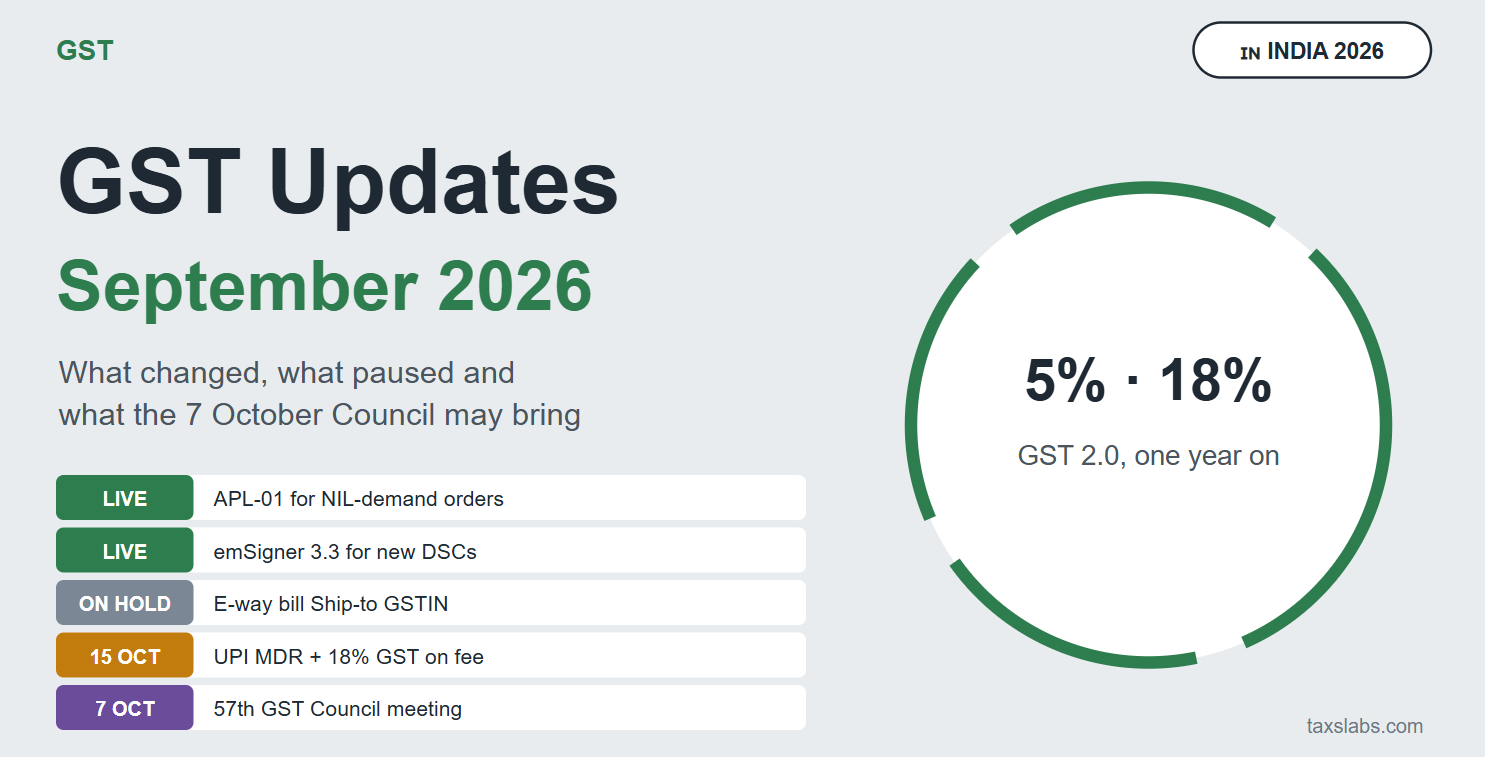
This roundup of GST updates September 2026 covers what actually changed between late July and the end of September, and what is scheduled next. You will learn about the new right to appeal orders that show a NIL demand, the emSigner 3.3 requirement for new DSC tokens, the e-way bill changes that are on hold, the UPI MDR that brings 18% GST onto merchant fees from 15 October, and what to expect from the 57th GST Council meeting on 7 October 2026. Each update ends with what, if anything, your business should do about it.
GST 2.0 One Year On: The Backdrop to This Month’s Changes
The 56th GST Council meeting in September 2025 recommended the most significant rate reform since GST began. From 22 September 2025, most goods and services moved into two main slabs, 5% and 18%, with a higher rate of 40% reserved for a short list of luxury and demerit goods. The 12% and 28% slabs largely disappeared.
Consequently, 2026 has been a year of process catch-up rather than rate change. Businesses re-mapped their product catalogues, updated billing software and restarted invoice series for the new financial year. Our guide to GST compliance in 2026 covers those rate and invoicing changes, and our overview of GST changes in 2026 explains the Finance Act amendments. This article picks up where those guides leave off, with the updates of the last two months.
The Finance Minister summed up the mood herself in September: “GST 2.0 has the process element still not done.” That remark is the best lens for reading the GST updates September 2026 has produced. Almost every one of them is about process, not rates.
GST Updates September 2026 at a Glance
The timeline below shows each update in order, from the e-way bill deferral at the end of July to the input tax credit deadline at the end of November.

| Date | Update | Status | Who it affects |
|---|---|---|---|
| 29 July 2026 | E-way bill Ship-to GSTIN and voluntary closure put on hold (Advisory 668) | On hold | Consignors, transporters, ERP teams |
| 1–15 August 2026 | Officer review of AATO amendments filed in July | Completed | Taxpayers who amended FY 2025-26 turnover |
| 7 September 2026 | APL-01 enabled against orders showing NIL or zero demand | Live | Taxpayers who paid before an adverse order |
| 17 September 2026 | Finance Minister: October Council to focus only on process reforms | Signal | All taxpayers |
| 21 September 2026 | emSigner 3.3 required for DSC tokens issued from this date | Live | Anyone signing on the GST portal with a new DSC |
| 7 October 2026 | 57th GST Council meeting, New Delhi | Scheduled | All taxpayers |
| 15 October 2026 | MDR on UPI merchant payments above ₹2,000, with 18% GST on the fee | Scheduled | Merchants accepting UPI |
The 57th GST Council Meeting: Moved to 7 October, Focused on Process
The 57th meeting of the GST Council was originally set for 12 September 2026. It was rescheduled because India hosted the BRICS Leaders’ Summit on 12 and 13 September, and the Council will now meet on 7 October 2026 in New Delhi, with the officers’ meeting on 5 and 6 October.
What the Finance Minister has said
Speaking on 17 September, Finance Minister Nirmala Sitharaman ruled out rate discussions. “That meeting will focus only on process reforms,” she said, declining to name the specific items because the Council had not yet discussed them. For businesses, the practical message is clear: do not change prices or tax codes in anticipation of this meeting.
What may be on the agenda
Reports ahead of the meeting point to three process themes:
- Invoice filing and matching between suppliers and recipients, building on the Invoice Management System.
- Input tax credit disputes, especially cases where eligibility turns on a supplier’s filing.
- Simpler registration for small businesses whose monthly output tax on B2B supplies does not exceed ₹2.5 lakh, the category already served by the simplified route under Rule 14A.
Separately, press reports on 24 September said the Council would take up the question of GST on UPI merchant discount rates “at an opportune time”, although it is not clear whether this will happen on 7 October.
How to prepare before and after 7 October
Before the meeting, there is little to do beyond keeping your records current. After it, read the official press release rather than summaries, note which recommendations need a notification or a law amendment, and wait for CBIC to fix the effective dates. Process changes, such as new IMS actions or registration steps, usually arrive first as portal advisories, sometimes weeks after the meeting. Consequently, the right response to the GST updates September 2026 points towards is to watch closely and change systems only when the dates are notified.
Important: A Council recommendation is not law. It takes effect only when CBIC issues the notification, amendment or circular that implements it, and the effective date is usually later than the meeting. Treat anything announced on 7 October as a plan until you see the notification.
Appeals Against NIL-Demand Orders: A Long-Standing Gap Closed
This is the most practically useful of the GST updates September 2026 has delivered. On 7 September 2026, GSTN issued an advisory enabling taxpayers to file an appeal in Form GST APL-01 against demand orders where the demand amount shows as NIL or zero.
The problem it fixes
Many taxpayers pay a disputed amount voluntarily, often through Form DRC-03, before the adjudicating officer issues the final order. The order then confirms the liability but shows a NIL demand, because the tax has already been paid. Until now, the portal’s validation blocked an appeal against such an order, even though the taxpayer still disagreed with the finding, for example on classification or place of supply, and wanted the money back.
How to file now
According to the advisory, taxpayers can go to Services, then User Services, then My Applications, choose “Appeal to Appellate Authority” and file APL-01 against the order. The usual time limit applies: three months from the date the order was communicated, with a further one month allowed by the appellate authority for sufficient cause.
The following video walks through filing APL-01 online. The screens are the same whether the order shows a demand or, now, a NIL amount.
Expert Insight: The change does not revive appeals that are already time-barred. If an order showing NIL demand was communicated more than four months ago, the appeal window has probably closed. Review recent orders first, and for older ones take advice on whether any other remedy is available.
emSigner 3.3 for New DSC Tokens From 21 September 2026
GSTN has advised that users with DSC USB tokens issued on or after 21 September 2026 must use emSigner version 3.3 to sign on the GST portal. The installer is available from the DSC section of the GST portal’s help pages.
Existing DSCs are not affected. According to the advisory, certificates stored on tokens issued before 21 September 2026 remain usable until they expire. However, the new version has its own system requirements, including a 64-bit operating system and Java 1.8, so check the machine that your team uses for filing, not only the token.
Pro Tip: Directors and authorised signatories often renew DSCs just before a deadline. If a DSC renewal is due before GSTR-9 or a registration amendment, install emSigner 3.3 on the filing computer in advance so that a new token does not fail on the day you need it.
E-Way Bill Changes: Announced, Postponed, Then Put on Hold
Earlier in 2026, GSTN announced two significant e-way bill changes: a mandatory Ship-to GSTIN field for bill-to/ship-to transactions, and a voluntary closure facility for e-way bills. The go-live was first set for 15 June 2026 and then moved to 1 August 2026.
On 29 July 2026, GSTN’s Advisory 668 put the proposed enhancements, including the related API changes, on hold until further notice. No new date has been announced.
For businesses, the practical point is simple: keep your existing e-way bill process unchanged. If your ERP vendor has already built the new fields, keep that build ready but disabled. When a revised date is announced, there will be a new advisory, and it is worth testing again in the sandbox before switching over.
UPI MDR and GST From 15 October 2026: What Merchants Will Pay
Strictly speaking, the merchant discount rate is a payments decision, not a GST change. Nevertheless, it creates a new GST cost for many merchants, so it belongs among the GST updates September 2026 has brought to the surface.

What changes on 15 October
According to reports of the NPCI framework, from 15 October 2026:
- UPI payments to merchants above ₹2,000 attract an MDR of 0.4%, capped at ₹300 per transaction.
- Payments of ₹2,000 or less continue at zero MDR. NPCI says these make up about 96% of merchant transactions.
- Merchants receiving up to ₹1 lakh a month through UPI are not liable to MDR.
- A concessional flat MDR of ₹5 applies to payments above ₹2,000 in railways, telecom, insurance and fuel.
Where GST applies
GST at 18% applies to the MDR itself, which is a fee for a payment service. It does not apply to the value of the sale. So on a ₹10,000 UPI payment, the MDR is ₹40 and the GST is ₹7.20, not ₹1,800. NPCI has also pointed out that GST-registered merchants can claim input tax credit on the GST charged on MDR, which reduces the real cost to the fee alone.
In practice, the MDR and its GST are usually deducted from settlements by the bank or payment aggregator, which then issues a monthly tax invoice. To claim the credit, the merchant’s GSTIN must be registered with the payment provider, and the provider must report the invoice so that it appears in GSTR-2B. Merchants who have never given their GSTIN to their UPI provider should do so before 15 October, otherwise the invoices may be issued without it and the credit may be lost.
Reports on 24 September suggested the GST Council may look at the GST on UPI MDR at a future meeting. Until any change is notified, plan on 18%.
Free tool: Make sure the GST on MDR invoices from your bank or payment aggregator flows into your ITC. Check it monthly with the TaxSlabs GST ITC Reconciliation Tool.
Earlier 2026 Changes That Still Catch People
Not every useful update is new. Several changes from earlier in 2026 are still producing errors and notices, so they are worth revisiting alongside this month’s news.
System-computed interest in GSTR-3B
From the February 2026 return period, interest in Table 5.1 of GSTR-3B is computed by the system and is not editable. After calculation issues surfaced, GSTN added a “re-compute interest” option. If your interest figure looks wrong, use that option before filing rather than paying the difference and hoping to adjust it later.
AATO amendments for FY 2025-26
The portal allowed taxpayers to amend their aggregate annual turnover (AATO) for FY 2025-26 between 1 and 31 July 2026, with officers reviewing changes from 1 to 15 August. AATO drives several obligations, including e-invoicing applicability, so check that the figure now shown on your dashboard is correct.
The three-year bar on old returns
Returns are permanently barred three years after their due dates. In October 2026, that bar reaches the September 2023 returns. Our calendar of tax due dates for October 2026 lists the exact dates by return type.

How to Read GST Updates: Advisory, Notification, Circular or Council Recommendation?
Part of the confusion around the GST updates September 2026 has produced comes from mixing up different kinds of announcement. Each carries a different weight, and knowing which one you are looking at tells you whether you must act now.
| Type | Issued by | What it does | Example this season |
|---|---|---|---|
| GSTN advisory | GST Network | Explains or changes how the portal works; effective from the date stated | APL-01 for NIL-demand orders; emSigner 3.3; Advisory 668 on e-way bills |
| Notification | CBIC (Central Tax / Central Tax Rate) | Changes rates, rules, due dates or exemptions; has legal force | Implementation of Council decisions once notified |
| Circular | CBIC | Clarifies how the law should be applied; binding on officers | Clarifications that usually follow a Council meeting |
| Council recommendation | GST Council | Proposes changes; not law until notified | Whatever the 57th meeting recommends on 7 October |
| Ministerial or press statement | Government or its agencies | Signals direction; no legal effect by itself | The 17 September remark on process reforms; reports on GST on UPI MDR |
As a rule, act on advisories and notifications from their stated dates, prepare for Council recommendations, and only watch press statements. When a message on social media says “new GST rule from tomorrow”, check which of these five categories it belongs to before changing anything in your books.
Deadlines the GST Updates September 2026 Lead Into
The next three months carry two of the most important annual GST dates, and both connect directly to this month’s updates.
- 30 November 2026: last date to claim ITC for FY 2025-26. Under Section 16(4) of the CGST Act, input tax credit for invoices of FY 2025-26 must be claimed by 30 November 2026 or the date you file the annual return, whichever is earlier. The same date is the practical limit for correcting FY 2025-26 details in GSTR-1.
- 31 December 2026: GSTR-9 and GSTR-9C for FY 2025-26. The annual return and, where applicable, the reconciliation statement are due by the end of the year. Our GSTR-9 annual return filing guide explains the tables that most often cause trouble.
In addition, the Supreme Court’s recent view on supplier defaults and recipient credit, covered in our guide to Section 16(2)(c) and ITC, matters for any credit you are still reconciling before 30 November.
What the GST Updates September 2026 Mean for Your Type of Business
Not every update touches every business. The following quick guide sorts them by the kind of taxpayer most affected.
Small retailers and restaurants
The UPI MDR is the update that matters most. If most of your UPI payments are below ₹2,000, or you receive less than ₹1 lakh a month through UPI, you are largely outside the new charge. If not, expect a monthly MDR invoice from your bank or payment aggregator and make sure it reaches your accountant, so the GST on it can be claimed as input tax credit.
Manufacturers and traders moving goods
The e-way bill deferral is good news in the short term, because it means no system change this quarter. However, the Ship-to GSTIN requirement is likely to return, so keep your customer and consignee masters clean, with correct GSTINs for every delivery location. Manufacturers with open disputes should also review any recent order showing a NIL demand, since an appeal may now be possible.
Service providers and professionals
Most service businesses will feel the updates through their tools rather than their tax. A new DSC token needs emSigner 3.3, and year-end ITC reconciliation before 30 November matters as much for services as for goods. Professionals collecting fees above ₹2,000 through UPI should also check whether they cross the ₹1 lakh monthly threshold for MDR.
Tax practitioners
For practitioners, the season’s priorities are clear: scan client orders from the last four months for NIL-demand appeals, update emSigner across office machines, warn clients not to act on rumours about the 7 October Council, and start FY 2025-26 ITC reconciliations early. The GSTR-1 preparation tool can also help clients correct FY 2025-26 invoice details before the 30 November cut-off.
Three Businesses, Three Updates
The following illustrative examples show how the GST updates September 2026 brings play out in ordinary businesses.
Case 1: A Surat textile shop and UPI MDR
Kesar Fabrics receives about ₹12 lakh a month through UPI. Of that, roughly ₹8 lakh comes from payments above ₹2,000. From 15 October, its MDR on those payments is about ₹3,200 a month at 0.4%, plus GST of ₹576. Because the shop is GST-registered, it claims the ₹576 as input tax credit, so its real cost is the ₹3,200 fee. The owner has asked the accountant to make sure the bank’s monthly MDR invoice is booked and reconciled.
Case 2: A Pune manufacturer’s NIL-demand order
Arohi Components paid ₹6.8 lakh through DRC-03 in June 2026 to avoid interest while it contested a classification issue. The order issued in August confirmed the classification and showed a NIL demand. Until 7 September, the portal would not accept its appeal. The company has now filed APL-01 within the three-month window, because the classification will also affect its tax on future supplies.
Case 3: A CA firm renewing a client’s DSC
A small CA practice renewed a client director’s DSC on 25 September to file a registration amendment. The first signing attempt failed. After installing emSigner 3.3 from the GST portal, the signature worked. The firm has since updated emSigner on every office machine, ahead of the GSTR-9 season.

Key Takeaways
- The 57th GST Council meets on 7 October 2026 and, according to the Finance Minister, will focus only on process reforms, not rates.
- Since 7 September 2026, taxpayers can file APL-01 against orders that show a NIL or zero demand because tax was paid earlier.
- DSC tokens issued from 21 September 2026 need emSigner 3.3; existing DSCs keep working until expiry.
- The e-way bill Ship-to GSTIN field and voluntary closure are on hold under Advisory 668; keep your current process.
- From 15 October 2026, UPI merchant payments above ₹2,000 attract 0.4% MDR capped at ₹300, with 18% GST on the fee and ITC available to registered merchants.
- Claim or correct FY 2025-26 ITC by 30 November 2026, and file GSTR-9 and GSTR-9C by 31 December 2026.
Frequently Asked Questions
When is the 57th GST Council meeting?
The 57th GST Council meeting is scheduled for 7 October 2026 in New Delhi. It was moved from 12 September 2026 because India hosted the BRICS Leaders’ Summit on 12 and 13 September.
Will GST rates change at the October 2026 Council meeting?
The Finance Minister said on 17 September 2026 that the meeting will focus only on process reforms. Rate changes are therefore not expected, and any recommendation takes effect only after CBIC notifies it.
Can I appeal a GST order that shows NIL demand?
Yes. Since 7 September 2026, the GST portal allows an appeal in Form APL-01 against an order showing a NIL or zero demand where tax was paid before the order. The normal three-month time limit from the date of communication applies.
Do I need emSigner 3.3 for my existing DSC?
No. emSigner 3.3 is required for DSC tokens issued on or after 21 September 2026. DSCs on tokens issued before that date continue to work until they expire.
Is the Ship-to GSTIN field mandatory in e-way bills now?
No. GSTN Advisory 668 dated 29 July 2026 put the mandatory Ship-to GSTIN field, the voluntary closure facility and related API changes on hold until further notice.
Is GST charged on UPI payments above ₹2,000?
No. GST is not charged on the payment itself. From 15 October 2026, merchants pay an MDR of 0.4% on UPI payments above ₹2,000, capped at ₹300, and GST at 18% applies only to that MDR fee.
Can merchants claim ITC on GST paid on UPI MDR?
Yes. A GST-registered merchant can claim input tax credit on the GST charged on MDR, subject to the normal conditions, including a valid invoice and the supplier’s reporting.
What is the last date to claim ITC for FY 2025-26?
Input tax credit for FY 2025-26 must be claimed by 30 November 2026 or the date of filing the annual return for FY 2025-26, whichever is earlier.
Conclusion: A Process Year, Not a Rate Year
The GST updates September 2026 produced share one theme: after the rate reform of GST 2.0, the work now is in the plumbing. A long-standing appeal gap has been closed, a signing tool has been upgraded, an e-way bill change has been paused, and a payments decision has created a small but real GST cost for UPI merchants. The 7 October Council, by the Finance Minister’s own account, will continue in the same direction.
For most businesses, the action list is short: check recent NIL-demand orders for appeals, update emSigner before your next DSC renewal, leave e-way bill processes as they are, budget for UPI MDR and claim the ITC on it, and finish FY 2025-26 credit reconciliation before 30 November. For the full picture, see our complete GST Guide and the latest posts in our GST topic hub.
For official references, see the GST portal news and updates, the GSTN advisory on re-computation of interest in GSTR-3B, and the GST Council meetings page.
Disclaimer: This content is for information and education only and does not constitute professional, tax, legal, or investment advice. Consult a qualified professional before acting.