

Tax Audit Under Section 44AB: Applicability, Limits, Forms and the 30 September 2026 Deadline
Every September, chartered accountants across India field the same phone call: “My turnover crossed one crore — do I need an audit?” The honest answer is that turnover alone rarely settles it. A tax audit under Section 44AB can be triggered by your receipts, by your cash mix, by a presumptive scheme you left three years ago, or by a profit percentage that looks perfectly reasonable to you.
This guide walks through every gate in order. You will learn the exact thresholds for FY 2025-26, why the 5% cash test means something different in Section 44AB than it does in Section 44AD, which of Forms 3CA and 3CB applies to you, what Section 271B actually costs, and what changes when Section 63 of the Income-tax Act, 2025 takes over next year.
What a Tax Audit Under Section 44AB Actually Is
A tax audit under Section 44AB is an examination of a taxpayer’s books of account by a practising chartered accountant, who then reports prescribed particulars to the Income Tax Department in a standard format. It exists so that the department receives consistent, verified information about business and professional income without having to examine every taxpayer itself.
What it is not
Three misunderstandings cause a surprising amount of anxiety every year:
- It is not an investigation. You appoint the auditor. The department has not selected you for anything. Scrutiny assessment, survey and search are entirely separate processes.
- It is not the same as a statutory audit. A company is audited under the Companies Act, 2013 regardless of turnover. That does not automatically mean a tax audit applies, and a tax audit does not replace the statutory one.
- It does not create tax liability. The audit is a verification and disclosure exercise. Your tax is computed by the same rules either way. What it can do is surface discrepancies that invite questions later.
What the auditor actually certifies
The chartered accountant reports whether the books give a true and fair view, whether the prescribed particulars are correct, and where they are not, qualifies the report. The substantive detail sits in Form 3CD, a statement of particulars running to 44 clauses covering everything from depreciation and payments to related parties, to disallowances under Section 40 and Section 43B, to a break-up of GST on expenditure.
Expert Insight. Read Form 3CD as a disclosure schedule rather than a certificate. Almost every clause asks a question the Assessing Officer could otherwise only discover through scrutiny. A qualification honestly recorded is far cheaper than a clean report contradicted by your own GST filings two years later.
Who Must Get Audited for AY 2026-27: The Five Gates
Section 44AB does not contain one test. It contains several, and you only need to fail one of them. Work through the gates in order rather than stopping at the first number you recognise.
Gate 1 — Business turnover, Section 44AB(a)
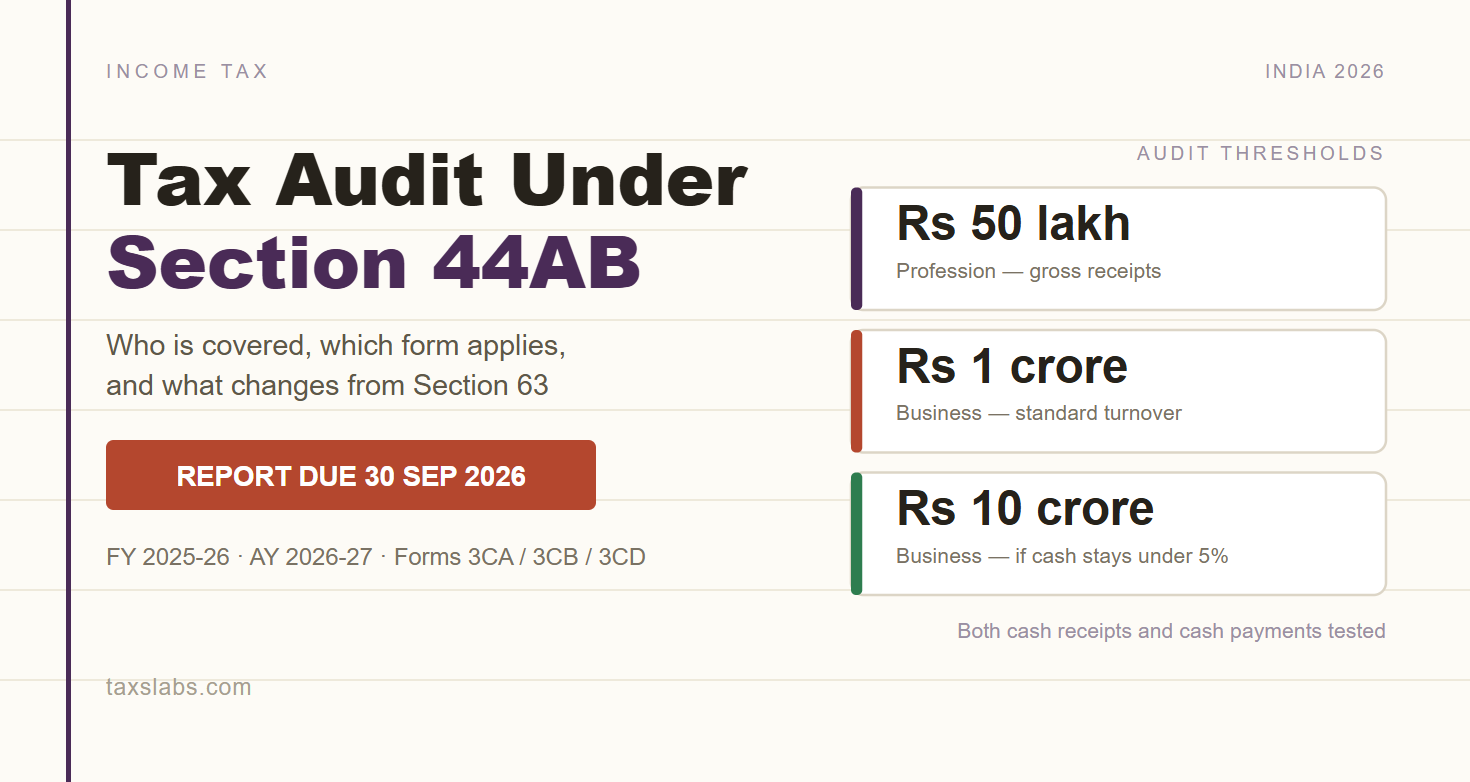
Audit applies where total sales, turnover or gross receipts in the previous year exceed ₹1 crore. This lifts to ₹10 crore where the cash conditions in the proviso are satisfied — both of them, which the next section examines in detail.
Gate 2 — Professional receipts, Section 44AB(b)
Audit applies where gross receipts from a profession exceed ₹50 lakh. There is no enhanced threshold for professionals. A consultant billing entirely through bank transfer, with not a rupee of cash, crosses into audit at ₹50 lakh exactly as a cash-heavy practice does. This asymmetry surprises a great many freelancers and consultants in their first big year.
Gate 3 — Presumptive opt-out, Section 44AB(e)
Where a taxpayer had opted into Section 44AD and subsequently declares profit lower than the deemed rate, and total income exceeds the basic exemption limit, audit applies regardless of turnover. This gate has nothing to do with crossing ₹1 crore.
Gate 4 — Professionals below the presumptive rate, Section 44AB(d)
A professional eligible for Section 44ADA who declares income below 50% of gross receipts, while total income exceeds the basic exemption limit, must get audited.
Gate 5 — Other specified cases
Certain taxpayers are covered by their own provisions, including those declaring income below the deemed rate under Section 44AE for goods carriages, and non-residents under specific presumptive regimes.

| Category | Standard threshold | Enhanced threshold | Provision |
|---|---|---|---|
| Business | ₹1 crore | ₹10 crore, if both cash tests met | Section 44AB(a) |
| Profession | ₹50 lakh | None available | Section 44AB(b) |
| Presumptive opt-out (business) | No turnover test | Not applicable | Section 44AB(e) |
| Professional below 50% | No turnover test | Not applicable | Section 44AB(d) |
The basic exemption limit referred to in Gates 3 and 4 is ₹4,00,000 under the new regime for AY 2026-27, and ₹2,50,000 under the old regime for individuals below 60. If you are still deciding between regimes, our old versus new tax regime calculator works through the comparison for your numbers.
The Cash Tests Are Not the Same: The Asymmetry Nobody Explains
Here is the single most misunderstood point in this entire area, and the one that produces the most expensive September surprises.
Three separate provisions offer an enhanced limit conditional on a 5% cash test. They do not test the same thing.
- Section 44AB(a), the ₹10 crore audit threshold: tests cash receipts AND cash payments. Both must be within 5% of the respective totals. Fail either side and you drop back to ₹1 crore.
- Section 44AD, the ₹3 crore presumptive limit: tests cash receipts only. The payment side is not examined at all.
- Section 44ADA, the ₹75 lakh professional presumptive limit: also tests receipts only.

Client scenario. A Ludhiana auto-components trader recorded turnover of ₹2.6 crore in FY 2025-26. Customer collections were almost entirely digital — cash receipts came to just 3.8%. But the firm paid a large part of its labour and freight in cash, so cash payments ran at 22% of total payments.
The proprietor’s reading was that “we are a 96% digital business, so we are inside the ₹10 crore limit.” He was half right. He qualified comfortably for the ₹3 crore presumptive ceiling under Section 44AD, which never looks at payments. He failed Section 44AB(a) outright, because that proviso requires both sides. His audit threshold stayed at ₹1 crore, and at ₹2.6 crore turnover the audit was mandatory. He learned this on 22 September.
What counts as cash
This is narrower than most people assume, and it works against you. For the Section 44AB proviso, a payment or receipt by cheque or bank draft that is not account payee is treated as cash. A bearer cheque does not help you pass the test. Account payee cheques, drafts, and electronic modes through a bank account are the safe categories.
Pro Tip. Track the two cash ratios monthly rather than computing them in September. A business hovering near ₹1 crore has a genuine planning opportunity: shifting the last few cash-settled vendor payments to bank transfer during the year can be the difference between an audit and no audit. Attempting the same reclassification after 31 March is not planning, it is rewriting records.
Measuring Turnover Correctly Before You Panic
Before assuming a tax audit under Section 44AB applies, confirm the number you are testing is actually turnover as the Act measures it.
What goes in and what stays out
- Include: sales of goods and services, commission earned, and other operating receipts.
- Exclude: trade discounts allowed, and sales returns.
- Generally exclude: capital receipts such as sale proceeds of fixed assets, and non-operating income such as interest on deposits.
The GST question
Where GST is collected separately and credited to a distinct liability account rather than routed through the profit and loss account, it is not part of turnover. Where a business records gross billing inclusive of GST in its sales account, the reported figure will be inflated. Reconciling this properly can move a borderline business from the wrong side of ₹1 crore to the right side, so it is worth doing before the panic rather than after.
Derivatives and speculative transactions
Turnover for futures and options is not the contract value. The accepted approach is to aggregate favourable and unfavourable differences on settled contracts, along with premium received on options written. For intraday equity, which is speculative, turnover is likewise measured on differences. A trader with ₹9 crore of contract value can have turnover well below ₹1 crore on this basis. We cover the computation in detail in our guide to tax on F&O and intraday trading.
Common error. Testing the wrong figure in either direction is costly. Using gross contract value for F&O leads traders into audits they never needed. Using net banking credits instead of billed sales leads businesses to miss audits they did need. Test the audited or finalised sales figure from the books, not a bank statement total.
Crossing the threshold part-way through the year
The test is applied to the full previous year, not to the date you crossed the line. A business that reached ₹1 crore in January 2026 is audited for the whole of FY 2025-26, not for the final quarter. There is no proportionate or part-year relief.
This matters most for businesses in their first strong year. A firm that turned over ₹40 lakh in FY 2024-25 and ₹1.15 crore in FY 2025-26 has an audit obligation it has never had before, an auditor it may not yet have appointed, and books that were probably maintained informally for the first half of the year. That combination is the single most common reason a first-time audit runs late.
Presumptive Taxation and the Five-Year Trap
Sections 44AD and 44ADA let eligible taxpayers declare a deemed percentage of receipts as income, skip detailed books, and avoid audit. They are genuinely useful. They also carry a lock-in that catches people years later.
| Feature | Section 44AD | Section 44ADA |
|---|---|---|
| Who can use it | Resident individuals, HUFs and partnership firms (not LLPs) in eligible business | Resident specified professionals under Section 44AA(1) |
| Base limit | ₹2 crore | ₹50 lakh |
| Enhanced limit | ₹3 crore, cash receipts within 5% | ₹75 lakh, cash receipts within 5% |
| Deemed income | 8% of turnover, 6% on digital receipts | 50% of gross receipts |
| Lock-in | Five years | No explicit lock-in |
How the trap springs
Once you declare under Section 44AD, you are expected to continue for five consecutive years. Declare below the deemed rate within that window and Section 44AD(4) locks you out of the scheme for the following five assessment years. During those years, if your total income exceeds the basic exemption limit, you must maintain books and get audited under Section 44AB — whatever your turnover is.
Client scenario. Vikram runs a small electronics retail business in Nashik. He opted into Section 44AD, declaring 8% deemed income on turnover of about ₹90 lakh. In a difficult year his actual margin fell to roughly 3%, and paying tax on 8% of turnover felt indefensible, so he declared the real figure.
That single decision took him out of Section 44AD until AY 2032-33. His turnover never came close to ₹1 crore again, but because his total income kept exceeding ₹4 lakh, he became liable to a tax audit under Section 44AB every year for five years — roughly ₹15,000 to ₹25,000 a year in professional fees, plus full books of account, in a business too small to want either.
Pro Tip. Treat opting into Section 44AD as a five-year commitment, not a year-by-year convenience. If your real margin sits close to or below 8%, the scheme may cost more tax than it saves in compliance. Run the comparison before you opt in, because the exit is what is expensive. Section 44ADA has no equivalent statutory lock-in, though declaring below 50% produces the same audit outcome for that year.
If you are choosing between forms for your return, our comparison of ITR-1 versus ITR-4 covers how presumptive income is reported in practice.
Forms 3CA, 3CB and 3CD: Which One Applies to You
There are three forms, but you use exactly two of them: one report form, plus Form 3CD.
Form 3CA or Form 3CB
- Form 3CA — where the accounts are already required to be audited under another law. Companies audited under the Companies Act, 2013 fall here, as do co-operative societies and others with a statutory audit requirement.
- Form 3CB — where no other law requires an audit. Most proprietorships, partnership firms and individual professionals fall here. In Form 3CB the chartered accountant also expresses the true and fair view opinion on the accounts themselves.
Form 3CD, the 44-clause statement
Form 3CD accompanies either report and carries the substance. Clauses that consistently cause delay:
- Clause 44 — total expenditure broken up between registered and unregistered GST suppliers, exempt supplies and composition dealers. This requires expenditure-level GST tagging that many accounting systems simply do not maintain during the year.
- Clause 34 — TDS compliance, reconciled against the returns actually filed.
- Clause 26 — payments covered by Section 43B, allowable only on actual payment.
- Clause 21 — disallowances and personal expenditure.
Expert Insight — Clause 44 is where September stalls. Nearly every delayed audit we hear about stalls on the same two items: the Clause 44 GST expenditure break-up, and the reconciliation of turnover in the books against turnover reported in GSTR-1 and GSTR-3B. Both are backward-looking data problems that no amount of auditor availability can accelerate. Reconcile your GST position first, then hand over the books. Pull your filed return summaries directly from gst.gov.in rather than working from internal reports, and check any rate or classification question against the circulars on cbic.gov.in. Our free GST ITC reconciliation tool handles the purchase-side comparison in the browser.
Books of account come first, under Section 44AA
An audit presupposes something to audit. Section 44AA requires specified professionals to maintain prescribed books once gross receipts exceed ₹1,50,000 in any of the three preceding years, and requires other businesses and professionals to maintain books enabling computation of income once income exceeds ₹2,50,000 or turnover exceeds ₹25,00,000.
Those thresholds sit far below the audit limits, which catches people out in both directions. A consultant billing ₹30 lakh has no audit obligation but does have a statutory duty to maintain books. Equally, a taxpayer who kept no books cannot simply reconstruct them in September and present them for audit — the auditor is certifying records maintained during the year, and Form 3CD asks directly whether the prescribed books were kept and where.
The prescribed records are to be preserved for six years from the end of the relevant assessment year. The current statutory text of every provision discussed here is available on incometaxindia.gov.in.
UDIN
Every audit report must carry a valid Unique Document Identification Number generated by the chartered accountant on the ICAI portal. A report uploaded without a UDIN, or with the UDIN not updated within the permitted window, is treated as invalid. Confirm this with your auditor rather than assuming.
Reconcile before the auditor arrives
Match your purchase register against GSTR-2B and close the gaps that hold up Clause 44.
Due Dates and the Filing Sequence That Trips People Up
For AY 2026-27, the report is due one month before the corresponding return.
| Case | Audit report due | Income tax return due |
|---|---|---|
| General Section 44AB cases | 30 September 2026 | 31 October 2026 |
| Transfer pricing cases (Form 3CEB) | 31 October 2026 | 30 November 2026 |
| Non-audit business and profession | Not applicable | 31 August 2026 |
| Salaried and other non-audit | Not applicable | 31 July 2026 |
The sequence, and why it matters
The audit is not a single upload. It runs in order, and each step depends on the last:
- Books closed and reconciliations completed.
- Auditor completes the audit and generates the UDIN.
- Auditor uploads Form 3CA or 3CB with Form 3CD from their own e-filing login.
- The taxpayer accepts the report from their own login, using a valid digital signature.
- Only then can the audited return be filed by 31 October 2026.
The acceptance step is where deadlines die. A report uploaded on 30 September but not accepted by the taxpayer is not a furnished report. Two failures recur every year: an expired digital signature certificate that nobody tested, and an authorised signatory who is travelling and unreachable. Both are avoidable in August and unfixable on 30 September.
For the full month’s obligations alongside the audit, see our calendar of tax due dates in September 2026, which sets the audit deadline against the GST and advance tax dates falling in the same weeks.
Section 63 and Form 26: What Changes From Tax Year 2026-27
The Income-tax Act, 2025 came into force on 1 April 2026. It does not apply to the audit you are completing now.
The Income Tax Department has confirmed that the audit report for FY 2025-26, relating to AY 2026-27, is governed by the Income-tax Act, 1961 and filed in Forms 3CA, 3CB and 3CD, even though the filing physically happens after 1 April 2026. Filing this year’s audit on the new form would be wrong.

What arrives next year
- Section 63 of the Income-tax Act, 2025 becomes the audit provision, replacing Section 44AB.
- Form 26, prescribed under Rule 47 of the Income-tax Rules, 2026, consolidates Forms 3CA, 3CB and 3CD into a single structured report.
- Thresholds are unchanged. The ₹1 crore, ₹10 crore and ₹50 lakh limits and the cash conditions all continue.
The one change that is not cosmetic
Most of this is renumbering. One substantive change is worth flagging now, because it widens the net.
Under Section 44AB(e), the low-profit audit trigger fires only where the taxpayer had actually opted into Section 44AD at some point and then fell short of the deemed rate. A business that never opted in, and simply declares a thin profit, is outside that clause.
Under Section 63, the trigger looks at the declared profit level itself, whether or not the taxpayer ever opted in. Small businesses running genuine low margins, who have never touched presumptive taxation, may find themselves inside the audit net from Tax Year 2026-27. That is a real, checkable change rather than a form swap, and it is worth modelling before the year is over.
For the wider picture of what the new statute alters, see our guide to the Income-tax Act 2025.
Section 271B: What a Missed Tax Audit Under Section 44AB Costs
Failing to get the accounts audited, or failing to furnish the report by the due date, attracts a penalty under Section 271B: 0.5% of total sales, turnover or gross receipts, subject to a maximum of ₹1,50,000.
| Turnover | 0.5% of turnover | Penalty payable |
|---|---|---|
| ₹1.2 crore | ₹60,000 | ₹60,000 |
| ₹2.5 crore | ₹1,25,000 | ₹1,25,000 |
| ₹4 crore | ₹2,00,000 | ₹1,50,000 (capped) |
| ₹15 crore | ₹7,50,000 | ₹1,50,000 (capped) |
The reasonable cause relief
The penalty is discretionary rather than automatic. Section 273B provides that no penalty shall be imposed where the taxpayer proves reasonable cause for the failure. Causes accepted in practice have included serious illness of the taxpayer, the death or sudden departure of the accountant holding the records, seizure of books of account, and genuine labour disputes preventing access to records.
Ordinary delay, pressure of work, and “the CA was busy” are not reasonable cause. Neither is a late start.
The cost nobody puts in the table
The bigger consequence is usually sequencing, not penalty. Because the return cannot be filed until the report is accepted, a delayed audit pushes the return past 31 October and into belated territory. That brings a fee under Section 234F, interest under Section 234A, and — for a loss-making business, which is often exactly the business that delayed — the loss of the right to carry forward business losses. That carry-forward can be worth several times the ₹1,50,000 cap.
A Practical Preparation Checklist
Work backwards from 30 September. The audit itself is quick; the reconciliations are not.
Three to four weeks out
- Close the books for FY 2025-26 and finalise the trial balance.
- Reconcile turnover in the books against GSTR-1 and GSTR-3B for the full year, and document every difference.
- Reconcile TDS credits against Form 26AS and the annual information statement.
- Compute the two cash ratios and record the working, whichever side of the threshold you land on.
Two weeks out
- Prepare the Clause 44 GST expenditure break-up by supplier category.
- List Section 43B items and confirm which were actually paid before the due date.
- Compile related party transactions, loans accepted and repaid, and cash transactions above the specified limits.
- Verify that the digital signature certificate of the authorised signatory is valid past 31 October.
Final week
- Auditor uploads Form 3CA or 3CB with Form 3CD and a valid UDIN.
- Taxpayer logs in and accepts the report. Do not leave this to the last day.
- Begin the return computation, which can now proceed toward 31 October.

Key Takeaways
- Turnover is one gate among several. A tax audit under Section 44AB can be triggered by receipts, by cash mix, or by a low declared profit with no turnover test at all.
- Business: ₹1 crore, rising to ₹10 crore only where cash receipts and cash payments are each within 5%.
- Profession: ₹50 lakh flat. No enhanced threshold exists, however digital the practice.
- The cash tests are asymmetric. Section 44AB tests both sides; Sections 44AD and 44ADA test receipts only. Qualifying for one says nothing about the other.
- Non-account-payee cheques count as cash for the Section 44AB proviso.
- Section 44AD carries a five-year lock-in. Leaving early can mean mandatory audit for five years at any turnover.
- Form 3CA where another law already requires an audit, Form 3CB where it does not — with Form 3CD and a valid UDIN in both cases.
- Report by 30 September 2026, return by 31 October 2026, and the report must be accepted by the taxpayer before the return can be filed.
- Section 271B costs 0.5% of turnover, capped at ₹1,50,000, with reasonable-cause relief under Section 273B — but the lost loss carry-forward usually costs more.
- From Tax Year 2026-27, Section 63 and Form 26 take over, with the same thresholds but a wider low-profit trigger.
Frequently Asked Questions
What is the tax audit limit under Section 44AB for AY 2026-27?
For a business, tax audit applies where total sales, turnover or gross receipts exceed Rs 1 crore. That threshold rises to Rs 10 crore where cash receipts do not exceed 5 percent of total receipts and cash payments do not exceed 5 percent of total payments, both conditions being satisfied together. For a profession, audit applies where gross receipts exceed Rs 50 lakh, and no enhanced threshold is available regardless of how digital the practice is.
Does tax audit apply if my business made a loss?
Yes. Tax audit under Section 44AB is triggered by turnover or gross receipts, not by profit. If your turnover crosses the applicable threshold, the audit is required whether you made a profit or a loss. Separately, a loss or low profit can itself trigger an audit under Section 44AB(d) or 44AB(e) where you declare income below the presumptive rate and your total income exceeds the basic exemption limit.
What is the difference between Form 3CA and Form 3CB?
Form 3CA is used where the accounts are already required to be audited under another law, such as a company audited under the Companies Act, 2013. Form 3CB is used where there is no such other statutory audit requirement, which covers most proprietorships, partnership firms and professionals. Form 3CD, the detailed statement of particulars, accompanies either form. The two are never used together.
Is the tax audit due date for AY 2026-27 the same as the ITR due date?
No. The tax audit report is due one month before the return. For AY 2026-27 the report in Form 3CA or 3CB with Form 3CD is due by 30 September 2026, and the audited income tax return is due by 31 October 2026. Transfer pricing cases work to 31 October 2026 for the report and 30 November 2026 for the return.
Do the Rs 10 crore and Rs 3 crore cash tests work the same way?
No, and this is a common and costly assumption. The Rs 10 crore enhanced audit threshold under Section 44AB tests both cash receipts and cash payments against a 5 percent cap. The Rs 3 crore presumptive limit under Section 44AD and the Rs 75 lakh limit under Section 44ADA test only the receipts side. A business can therefore qualify for the presumptive limit while still failing the audit test and remaining on the Rs 1 crore threshold.
What is the penalty for not filing the tax audit report on time?
Section 271B allows the Assessing Officer to levy a penalty of 0.5 percent of total sales, turnover or gross receipts, subject to a maximum of Rs 1,50,000. The penalty is discretionary rather than automatic, and Section 273B provides relief where the taxpayer proves reasonable cause for the failure. Reasonable cause has been accepted in situations such as serious illness, the death of the accountant handling the records, and seizure of books, but not for ordinary delay or negligence.
Will Form 3CD be replaced by Form 26?
Yes, but not for this year. From Tax Year 2026-27 the tax audit provision moves to Section 63 of the Income-tax Act, 2025 and reporting moves to a single Form 26 prescribed under Rule 47 of the Income-tax Rules, 2026, consolidating the existing Forms 3CA, 3CB and 3CD. For FY 2025-26 and AY 2026-27 the old Act and the old forms continue, even though the report is filed after 1 April 2026.
Does a tax audit mean the Income Tax Department is investigating me?
No. A tax audit under Section 44AB is a routine compliance certification carried out by a chartered accountant you appoint, not an enquiry initiated by the department. It is entirely distinct from a scrutiny assessment, a survey or a search. The audit does not create any additional tax liability by itself, although discrepancies disclosed in Form 3CD can attract follow-up questions.
Conclusion
A tax audit under Section 44AB is not difficult to comply with. It is difficult to predict, because the statute contains several independent gates and the tests that look identical across sections are not identical at all. The businesses that get caught out are rarely careless. They are usually the ones who checked a single number and stopped.
Three habits remove most of the risk. Track both cash ratios monthly rather than reconstructing them in September. Treat any move into or out of presumptive taxation as a five-year decision. And reconcile your GST and TDS positions before the auditor asks, because those reconciliations, not the audit opinion, are what consume the calendar.
Then start early. Almost every horror story about a tax audit under Section 44AB traces back to the same root cause: books handed over in the third week of September, for a deadline on the thirtieth, in a month when every auditor in India is already full.
Disclaimer: This content is for information and education only and does not constitute professional, tax, legal, or investment advice. Consult a qualified professional before acting. Thresholds, forms, due dates and penalty provisions are subject to change by the Finance Act, CBDT notification or portal update; verify the current position on incometax.gov.in and incometaxindia.gov.in before filing. Applicability depends on your specific facts.


Pingback: Tax Audit for Companies 2026: Complete Guide & 7 Mistakes