

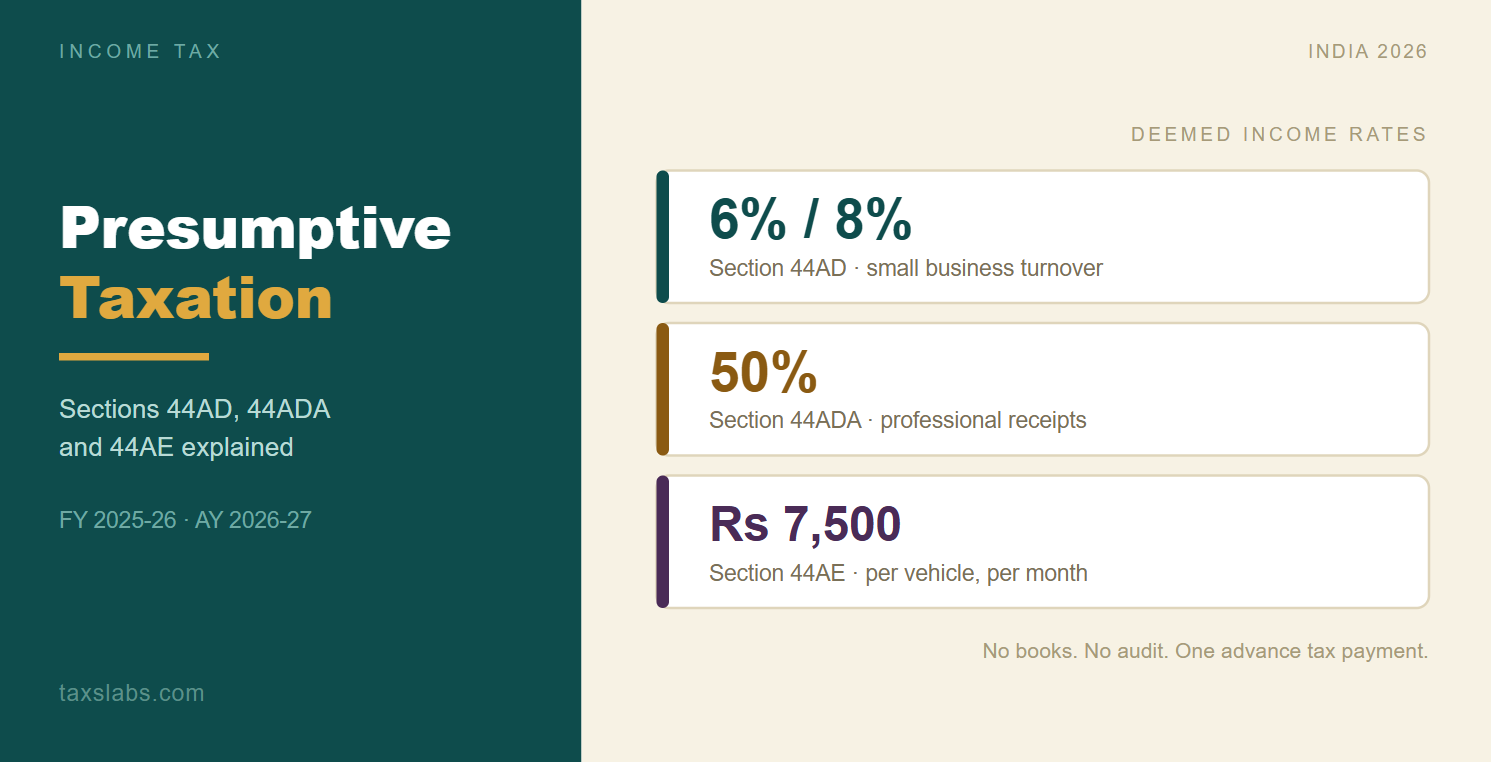
Presumptive Taxation Under Sections 44AD, 44ADA and 44AE: Limits, Rates and the Five-Year Trap
Ask most small business owners why they use presumptive taxation and the answer is the same: no books, no audit, one simple return. All true. What almost nobody works out in advance is the second question — whether the scheme actually leaves them with more money.
For a consultant billing ₹40 lakh with barely any overheads, it usually does. For a retailer running a genuine 3% margin, it can quietly double the tax bill. And for anyone who opts into Section 44AD and later changes their mind, there is a five-year penalty most people discover only when it is far too late to avoid. This guide covers every rate, limit and condition for FY 2025-26, the maths that decides whether the scheme is worth using, and what happens when Section 58 takes over next year.
What Presumptive Taxation Actually Does
Presumptive taxation replaces the ordinary computation of profit with a statutory assumption. Instead of recording every sale and every expense and arriving at a real figure, you declare a fixed percentage of turnover as income and pay tax on that.
In exchange, three obligations fall away:
- Detailed books of account under Section 44AA are not required for the presumptive business.
- Tax audit under Section 44AB does not apply, provided you stay inside the conditions.
- Quarterly advance tax collapses into a single payment on 15 March.
What you give up
The trade is real, and it runs both ways. Under any of the presumptive schemes, deductions under Sections 30 to 38 are deemed to have been allowed already. Rent, repairs, salaries, fuel, insurance, depreciation — none of it can be claimed on top. Depreciation in particular is treated as having been claimed, so the written down value of your assets keeps reducing even though you never took the deduction.
Deductions under Chapter VI-A, including Sections 80C to 80U, are unaffected where the old regime applies. Partnership firms opting for Section 44AE can still deduct interest and remuneration paid to partners.
Expert Insight. The depreciation point is the one that compounds. Five years inside a presumptive scheme means five years of notional depreciation on your plant and vehicles, reducing the written down value each year, with no deduction ever taken against income. When you eventually sell those assets or exit the scheme, you are working from a much lower base than you might expect. For asset-heavy businesses this quietly erodes the apparent benefit.
The Three Schemes Side by Side
Three separate provisions govern presumptive taxation in India, and they are not variations on a theme. They compute income in completely different ways.

| Feature | Section 44AD | Section 44ADA | Section 44AE |
|---|---|---|---|
| For whom | Eligible small business | Specified professionals | Goods carriage operators |
| Deemed income | 6% digital, 8% otherwise | 50% of gross receipts | ₹1,000 per tonne (heavy) or ₹7,500 per vehicle |
| Base ceiling | ₹2 crore | ₹50 lakh | 10 vehicles |
| Enhanced ceiling | ₹3 crore | ₹75 lakh | Not applicable |
| Condition for enhancement | Cash receipts within 5% | Cash receipts within 5% | Not applicable |
| Lock-in on exit | Five years | None | None |
| Who is eligible | Resident individual, HUF, firm (not LLP) | Resident individual, firm (not LLP) | Individual, HUF, firm (not LLP or company) |
Pro Tip — the 5% test measures receipts only. The enhanced ceilings of ₹3 crore and ₹75 lakh depend on cash receipts staying within 5%. The payment side is never examined. That is the opposite of the ₹10 crore enhanced audit threshold under Section 44AB, which tests both receipts and payments. Qualifying for one tells you nothing about the other — a point covered in detail in our guide to tax audit under Section 44AB.
Section 44AD: Small Business, 6% or 8%
Section 44AD is the workhorse of Indian presumptive taxation, used by traders, retailers, small manufacturers and service businesses across the country.
The two rates
- 6% of turnover received through account payee cheque, bank draft, electronic clearing or other prescribed electronic modes, provided the money is received by the return filing due date.
- 8% of turnover in all other cases, which in practice means cash.
The split is applied to the turnover itself, not chosen wholesale. A business with ₹80 lakh received digitally and ₹20 lakh in cash declares 6% on the first and 8% on the second.
Who cannot use it
Eligibility is narrower than most people assume. Section 44AD is unavailable to:
- Limited liability partnerships and companies — only resident individuals, HUFs and partnership firms qualify.
- Professionals covered by Section 44AA(1), who belong under Section 44ADA instead.
- Commission or brokerage income — an insurance agent or a commission agent cannot use the scheme.
- Agency business.
- Goods carriage operators already covered by Section 44AE.
- Non-residents, and anyone who has claimed a deduction under Sections 10AA or 80-IA to 80RRB in the year.
Registration on the Udyam portal at msme.gov.in has no bearing either way — being a recognised micro or small enterprise neither qualifies you for presumptive taxation nor disqualifies you. The two regimes are independent.
Common error. Commission and brokerage exclusion catches a lot of people. Insurance agents, mutual fund distributors, real estate brokers and travel agents earning commission are outside Section 44AD entirely, however small the turnover. Filing ITR-4 with commission income declared under 44AD is one of the more frequent causes of a defective return notice.
Your GST turnover and your presumptive turnover must agree
This is the most common trigger for a notice on an otherwise clean presumptive return. The turnover you declare under Section 44AD is matched against the outward supplies you reported in your GST returns for the same period. A gap between the two invites a question, and the burden of explaining it falls on you.
Differences are often perfectly legitimate — GST turnover includes exempt and non-GST supplies differently, treats advances and credit notes on its own timing, and covers all registrations under one PAN. But an unexplained gap looks like suppressed sales. Pull your annual outward supply summary from gst.gov.in, reconcile it against the turnover you intend to declare, and keep the working. Businesses using presumptive taxation are not exempt from this simply because they keep no formal books.
A worked example
Client scenario. Meena runs a garment wholesale business in Surat. FY 2025-26 turnover is ₹1.4 crore, of which ₹1.32 crore came through bank transfers and ₹8 lakh in cash. Cash receipts are 5.7% of turnover, which is above 5%, so her ceiling stays at ₹2 crore rather than ₹3 crore — still comfortably enough to qualify.
Her deemed income is 6% of ₹1.32 crore (₹7,92,000) plus 8% of ₹8 lakh (₹64,000), giving ₹8,56,000. That is her business income, with no further expense deduction. She keeps no formal books for the business, needs no audit, and pays her whole advance tax by 15 March.
Section 44ADA: Professionals and the Flat 50%
Section 44ADA applies to resident individuals and partnership firms carrying on a profession specified under Section 44AA(1). The rate is a flat 50% of gross receipts, with no digital-versus-cash split.
Which professions qualify
The specified list covers legal, medical, engineering, architectural, accountancy, technical consultancy and interior decoration, along with notified professions including company secretaries, authorised representatives and film artists.
Software development and IT consulting have been treated as technical consultancy on the strength of consistent tribunal decisions and departmental practice, which makes a large population of independent developers and consultants eligible. Eligibility turns on the nature of the work, not the job title. Someone genuinely providing technical consultancy qualifies; someone reselling licences or running a trading operation belongs under Section 44AD.
Why 50% is less harsh than it looks
A 50% deemed rate next to 6% for business appears punitive until you consider the cost structure. A consultant, doctor or architect typically has low overheads — a laptop, some software, professional fees, perhaps a small office. Real margins of 60% to 75% are common. Declaring 50% often means declaring less than the true profit, entirely lawfully.
Client scenario. Arjun is an independent UX consultant in Pune with gross receipts of ₹68 lakh in FY 2025-26, of which 97% arrived through NEFT and UPI. Cash receipts are well inside 5%, so the ₹75 lakh ceiling applies and he remains eligible.
He declares ₹34 lakh as income under Section 44ADA. His actual expenses — software subscriptions, a co-working desk, travel and an accountant — come to about ₹9 lakh, so his real profit is nearer ₹59 lakh. Declaring 50% saves him tax on roughly ₹25 lakh of genuine profit, plus the cost and effort of maintaining books. For his profile, presumptive taxation is straightforwardly the better answer.
Pro Tip. The mirror image is equally true. A professional running a clinic or studio with staff salaries, heavy equipment and rent may have a real margin well below 50%. For them, declaring 50% means paying tax on profit that does not exist. Compute both figures before deciding — the scheme is optional, and it is only a benefit when the deemed rate sits below your actual margin.
Section 44AE: Transport, Counted by Vehicle
Section 44AE works on a completely different principle. It ignores turnover altogether and computes income per vehicle, per month.
| Vehicle type | Presumptive income | Basis |
|---|---|---|
| Heavy goods vehicle (gross vehicle weight above 12,000 kg) | ₹1,000 per tonne of gross vehicle weight | Per month or part of a month owned |
| Any other goods carriage | ₹7,500 per vehicle | Per month or part of a month owned |
Eligibility requires that the taxpayer does not own more than ten goods carriages at any time during the year. Owning an eleventh vehicle for a single day takes you out of the scheme for the whole year. Ownership is what counts, including vehicles taken on hire purchase or instalments.
Where actual income from a vehicle is higher than the presumptive figure, the higher amount must be declared.
Client scenario. A transport operator in Nagpur owns three vehicles through FY 2025-26: two light goods carriages and one heavy vehicle with a gross vehicle weight of 16 tonnes. The light vehicles give 2 × ₹7,500 × 12 = ₹1,80,000. The heavy vehicle gives 16 × ₹1,000 × 12 = ₹1,92,000. Total presumptive income is ₹3,72,000, with no deduction for fuel, drivers, insurance or maintenance, and no books required.
The Five-Year Lock-In That Catches People Out
This is the single most consequential rule in presumptive taxation, and the one least understood before it bites.
Once you declare income under Section 44AD, you are expected to continue for five consecutive years. If you declare profit below the deemed rate inside that window, Section 44AD(4) bars you from the scheme for the following five assessment years. During those years, if your total income exceeds the basic exemption limit, you must maintain regular books of account and get a tax audit under Section 44AB — at any turnover at all.

When the lock-in does not apply
Two important exceptions save a lot of unnecessary worry:
- Crossing the ceiling is not opting out. If turnover simply exceeds ₹2 crore or ₹3 crore, you become ineligible rather than having exited. Section 44AD(4) does not apply, and you may return to the scheme in a later year when turnover falls back within the limit.
- Income below the exemption limit. The mandatory audit consequence only operates where total income exceeds the basic exemption limit, which is ₹4,00,000 under the new regime for AY 2026-27.
Section 44ADA has no equivalent lock-in
Professionals are treated more leniently. Section 44ADA carries no statutory five-year commitment, so a professional may move in and out year by year. The catch is that declaring below 50% while total income exceeds the exemption limit still triggers an audit for that year under Section 44AB(d) — the practical outcome is similar for a single year, but there is no five-year exile.
The decision that costs the most. A proprietor facing one genuinely bad year must choose between paying tax on profit never earned, or declaring the truth and accepting five years of books and audit. Neither is comfortable. What makes it worse is that the choice usually arrives without warning, because nobody explained the lock-in when they opted in three years earlier.
Does Presumptive Taxation Actually Save You Money?
The compliance saving is real but modest — typically ₹15,000 to ₹25,000 a year in accounting and audit fees for a small business. The tax difference can be far larger in either direction.
The test is simple: compare your real margin against the deemed rate.
| Business profile | Turnover | Real profit | Deemed income at 6% | Better route |
|---|---|---|---|---|
| Electronics retail, thin margin | ₹1.8 crore | ₹6,00,000 (3.3%) | ₹10,80,000 | Regular books |
| Service business, healthy margin | ₹90 lakh | ₹14,00,000 (15.6%) | ₹5,40,000 | Presumptive |
| Trading, average margin | ₹1.2 crore | ₹7,50,000 (6.3%) | ₹7,20,000 | Roughly neutral |
The pattern is consistent. High-turnover, low-margin businesses — retail, distribution, commodity trading — are usually worse off under presumptive taxation, sometimes dramatically. Low-turnover, high-margin work — consulting, services, professional practice — is usually better off.
Client scenario. The electronics retailer in the first row is a real pattern we see constantly. On ₹1.8 crore turnover with a 3.3% margin, actual profit is ₹6 lakh. Declaring 6% under Section 44AD means declaring ₹10.8 lakh — tax on ₹4.8 lakh of profit that was never earned. Even after allowing roughly ₹20,000 of audit and accounting cost, keeping books leaves him substantially better off. He opted into the scheme because a neighbour told him it was simpler, which it is, and cheaper, which it was not.
Run the numbers before you decide
Compare your tax under each route, and work out the single advance tax payment due on 15 March.
Advance Tax: One Payment, by 15 March
One of the quieter advantages of presumptive taxation is a completely different advance tax timetable.
Taxpayers under any of the three schemes are exempt from the ordinary four-instalment schedule. The entire advance tax liability falls due in a single instalment by 15 March of the financial year.
| Due date | Regular taxpayer | Presumptive taxpayer |
|---|---|---|
| 15 June | 15% cumulative | Nil |
| 15 September | 45% cumulative | Nil |
| 15 December | 75% cumulative | Nil |
| 15 March | 100% cumulative | 100% in one payment |
The obligation arises where estimated tax liability for the year is ₹10,000 or more. Miss the date or pay short and interest applies on the shortfall computed from 15 March.
Pro Tip — a cash flow benefit with a cash flow risk. Deferring the whole liability to March is genuinely useful for seasonal businesses, transport operators and consultants with irregular collections. It also means a single large outflow at the end of the year, in the same month as most other year-end commitments. Set the money aside as it is earned rather than finding it in March. For how the regular instalment schedule works by contrast, see our guide to advance tax for FY 2026-27.
Filing: ITR-4 and Its Own Eligibility Limits
Presumptive income is normally reported in ITR-4 (Sugam), a short return requiring far less disclosure than ITR-3. But being presumptive is not by itself enough — ITR-4 carries independent conditions.
You are pushed out of ITR-4 and into ITR-3 if any of the following apply:
- Total income exceeds ₹50 lakh.
- You have capital gains beyond the limited relaxation permitted.
- You own more than one house property.
- You have losses to carry forward or brought forward.
- You are a director in a company, or hold unlisted equity shares.
- You have foreign assets or foreign income.
- You are a non-resident or not ordinarily resident.
Filing ITR-4 when you were not eligible commonly produces a defective return notice under Section 139(9). The presumptive income itself remains valid — only the form is wrong — but the correction costs time in the middle of filing season. Our comparison of ITR-1 versus ITR-4 works through the selection in more detail.
Expert Insight. The capital gains condition trips up more presumptive taxpayers each year, because so many small business owners now hold mutual funds and listed shares. One redemption producing a taxable gain moves you out of Sugam. Check your capital gains statement before choosing the form, not after the return is rejected.
Section 58: What Changes From Tax Year 2026-27
The Income-tax Act, 2025 came into force on 1 April 2026. It does not affect the return you are filing for FY 2025-26, which remains governed by Sections 44AD, 44ADA and 44AE of the Income-tax Act, 1961.

From Tax Year 2026-27, the three provisions are consolidated into a single Section 58, which uses a serial-number table to distinguish general business, goods carriage operation and specified professions. The substance is carried forward:
- Rates unchanged — 6% and 8%, 50%, and the per-vehicle amounts all continue.
- Limits unchanged — ₹2 crore and ₹3 crore, ₹50 lakh and ₹75 lakh, ten vehicles.
- No fresh election required. Existing opt-in status carries over automatically.
- The lock-in clock does not reset. A taxpayer three years into a Section 44AD commitment on 31 March 2026 is three years in on 1 April 2026, not starting again.
The reorganisation is structural rather than substantive here, unlike the audit provision, where Section 63 genuinely widens one trigger. For the broader picture of what the new statute changes, see our guide to the Income-tax Act 2025.
Six Costly Presumptive Taxation Mistakes
These are the errors we see most often in practice, and every one of them is avoidable with a single check before you commit to presumptive taxation.
1. Opting in without running the margin comparison
The most expensive mistake of all. Simplicity is not the same as saving. Compare the tax on deemed income against tax on real profit plus compliance cost, every year.
2. Declaring commission income under Section 44AD
Commission and brokerage are excluded outright. Insurance agents, distributors and brokers must compute income normally.
3. Assuming the cash test covers payments
The enhanced ceilings look only at receipts. A business paying heavily in cash still qualifies for ₹3 crore under Section 44AD — but will fail the Section 44AB test if it ever needs the ₹10 crore audit threshold.
4. Forgetting that depreciation is deemed claimed
The written down value of assets reduces every year inside the scheme, even though no deduction was taken. This matters on exit and on sale.
5. Missing the 15 March advance tax payment
There is only one date. Missing it means interest on the entire liability, not on a quarter of it.
6. Treating Section 44AD entry as reversible
It is a five-year commitment. Model a bad year before you opt in, not after one arrives.

Key Takeaways
- Three schemes, three logics. Section 44AD taxes a percentage of turnover, Section 44ADA a flat 50% of receipts, Section 44AE a fixed amount per vehicle per month.
- Limits for FY 2025-26: ₹2 crore rising to ₹3 crore under 44AD, ₹50 lakh rising to ₹75 lakh under 44ADA, and a ten-vehicle cap under 44AE.
- The enhanced limits test cash receipts only, never payments — the reverse of the Section 44AB audit threshold.
- LLPs and companies are excluded from all three schemes, as are commission, brokerage and agency income under Section 44AD.
- Section 44AD carries a five-year lock-in. Declaring below the deemed rate bars the scheme for five assessment years and forces books and audit at any turnover.
- Crossing the turnover ceiling is not opting out — that is ineligibility, and the lock-in does not apply.
- No deductions under Sections 30 to 38, and depreciation is treated as already claimed.
- Advance tax is one payment by 15 March, not four instalments.
- ITR-4 has its own conditions — capital gains, a second house property or income above ₹50 lakh push you into ITR-3.
- Section 58 takes over from Tax Year 2026-27 with unchanged rates and limits, no re-election, and no reset of the lock-in clock.
Frequently Asked Questions
What is presumptive taxation and who can use it?
Presumptive taxation lets eligible taxpayers declare a fixed percentage of turnover or receipts as taxable income instead of computing actual profit, in exchange for being relieved from maintaining detailed books of account and from tax audit. Section 44AD covers eligible small businesses, Section 44ADA covers specified professionals listed under Section 44AA(1), and Section 44AE covers goods carriage operators owning up to ten vehicles. Resident individuals, Hindu Undivided Families and partnership firms may use these schemes, but limited liability partnerships and companies cannot.
What are the turnover limits for Sections 44AD and 44ADA in FY 2025-26?
Section 44AD applies where turnover is within Rs 2 crore, rising to Rs 3 crore where cash receipts do not exceed 5 percent of total turnover. Section 44ADA applies where gross receipts are within Rs 50 lakh, rising to Rs 75 lakh on the same 5 percent cash receipts condition. In both cases only the receipts side is tested; the payment side is not examined at all.
What is the five-year lock-in under Section 44AD?
Once you declare income under Section 44AD, you are expected to continue for five consecutive years. If you declare profit below the deemed rate within that window, Section 44AD(4) bars you from the scheme for the following five assessment years. During those years, if your total income exceeds the basic exemption limit, you must maintain regular books of account and get a tax audit under Section 44AB regardless of turnover. The lock-in does not apply where you simply become ineligible by crossing the turnover ceiling.
Is presumptive taxation always cheaper than maintaining books?
No. The scheme saves money only when your actual profit margin is at or above the deemed rate. A retailer earning a genuine 3 percent margin who declares 6 percent under Section 44AD pays tax on profit never earned, which can easily exceed the compliance cost the scheme was meant to save. Compare the tax on deemed income against the tax on actual profit plus accounting and audit fees before opting in.
When is advance tax due for presumptive taxpayers?
Presumptive taxpayers are exempt from the usual four quarterly instalments and pay the entire advance tax liability in one instalment by 15 March of the financial year. If that single payment is missed or falls short, interest applies on the shortfall computed from the 15 March date. The obligation arises where the estimated tax liability for the year is Rs 10,000 or more.
Is a software developer or IT consultant eligible for Section 44ADA?
Generally yes. Software development and information technology consulting have been treated as technical consultancy within the professions specified under Section 44AA(1), based on consistent tribunal decisions and departmental practice. Eligibility turns on the nature of the work rather than the job title, so a person providing genuine technical consultancy qualifies while someone merely reselling software or running a trading operation would fall under Section 44AD instead.
Can I claim business expenses under presumptive taxation?
No. Deductions under Sections 30 to 38, covering rent, repairs, depreciation and other business expenditure, are deemed to have already been allowed in arriving at the presumptive income. Depreciation is treated as having been claimed, and the written down value of assets is reduced accordingly. Deductions under Chapter VI-A, such as Sections 80C to 80U, remain available where the old regime applies, and partnership firms under Section 44AE may still deduct interest and remuneration paid to partners.
Does the Income-tax Act 2025 change presumptive taxation?
Structurally yes, substantively no. From Tax Year 2026-27, Sections 44AD, 44ADA and 44AE are consolidated into a single Section 58 of the Income-tax Act, 2025, which uses a serial-number table to distinguish general business, goods carriage and specified professions. The rates, turnover limits and conditions carry forward unchanged, no fresh election is required, and the five-year lock-in clock continues running across the change of statute rather than resetting.
Conclusion
Presumptive taxation is one of the few genuinely simplifying provisions in Indian tax law. Used deliberately, it trades a full audit and a year of bookkeeping for one advance tax payment and a short return. Used casually, because someone said it was easier, it can tax profit that was never earned and lock a business into five years of the very compliance it was trying to escape.
The whole decision reduces to one comparison. Work out your real margin. If it comfortably exceeds the deemed rate, the scheme is a clear benefit. If it sits below, the compliance saving will not cover the extra tax. And if your margin swings from year to year, understand that Section 44AD asks you to commit for five years before you find out.
Check the position once a year rather than once. Turnover grows, margins shift, and the scheme that suited a ₹40 lakh consultancy may not suit the same practice at ₹80 lakh. Every rate and limit above is stated for FY 2025-26 and should be verified against the current position on the official portal before you file.
Disclaimer: This content is for information and education only and does not constitute professional, tax, legal, or investment advice. Consult a qualified professional before acting. Rates, turnover limits, eligibility conditions and due dates are subject to change by the Finance Act, CBDT notification or portal update; verify the current position on incometax.gov.in and incometaxindia.gov.in before filing. Eligibility depends on your specific facts.