

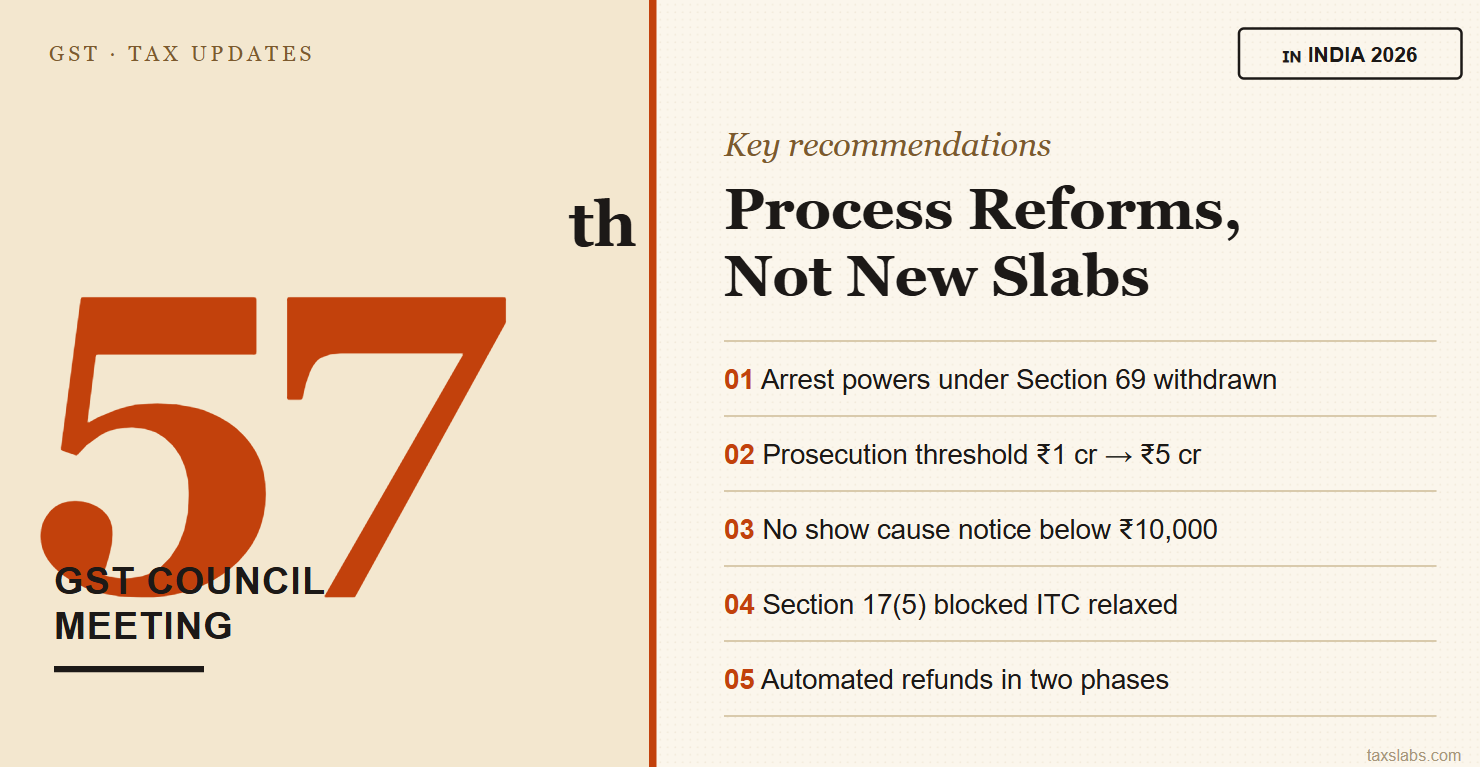
57th GST Council Meeting 2026: Key Recommendations, What Changes and What You Should Do Now
The 57th GST Council meeting, held in New Delhi on 8 October 2026, did something unusual. It left the rate slabs alone and went after the friction that eats up a finance team’s month: arrest powers, small-value notices, blocked credit, slow refunds and transit harassment. If the 56th meeting was about how much tax you pay, the 57th GST Council meeting is about how painful it is to pay it.
In this guide, you will see every major recommendation from the official release, what it changes in the CGST Act, CGST Rules and IGST Act, worked ₹ examples, the dates already announced, and a seven-step plan for what to do before the notifications arrive. One caution runs through the whole piece: these are recommendations. Nothing here is law until CBIC notifies it or Parliament amends the Act.
57th GST Council Meeting at a Glance: Date, Chair and Focus
The Council met under the chairpersonship of Union Finance and Corporate Affairs Minister Nirmala Sitharaman. Chief Ministers of eight States, two Deputy Chief Ministers, and the Finance Ministers of the States and Union Territories with legislatures took part, along with the Revenue Secretary and the CBIC Chairman. The meeting had been rescheduled before it finally took place on 8 October.
The official PIB press release on the 57th GST Council meeting groups the outcome into three blocks: process reforms (registration, returns, refunds, dispute resolution), other major reforms (ITC flow, exports, ease of doing business), and changes or clarifications on rates. CBIC followed it up with FAQs the next day.
| Particular | Detail |
|---|---|
| Meeting | 57th meeting of the GST Council |
| Date and venue | 8 October 2026, New Delhi |
| Chaired by | Union Finance Minister Nirmala Sitharaman |
| Main theme | Process reforms: registration, returns, refunds, adjudication |
| Slab changes | None; only targeted rate changes and clarifications |
| Dates announced | 1 Nov 2026 (input-service ITC refund), 1 Apr 2027 (capital-goods ITC refund), April 2027 return (correction mechanism) |
| Legal status | Recommendations; effective only through notifications, circulars or Act amendments |
Why this meeting is about process, not slabs
The 56th meeting in September 2025 rationalised rates and brought in the two-rate structure from 22 September 2025. Having settled the rate question, the Council has now turned to administration. As a result, nearly every recommendation this time targets a compliance pain point rather than a tax rate.
For a small trader, that means fewer notices over trivial amounts. For an exporter, it means faster cash. For a manufacturer with an inverted duty structure, it means credit that has been stuck for years may finally move. However, each benefit depends on how the final rule is drafted.
Recommendation versus law: the status check
The press release itself says the decisions will be given effect through circulars, notifications and law amendments, which alone carry the force of law. In practice, there are three routes, and the route decides the timeline:
- Rate notifications and circulars can be issued within weeks.
- CGST Rules amendments (Rules 14B, 19, 21, 23A, 60, 61, 86A, 86C, 86D, 89) need a CBIC notification.
- Act amendments (Sections 17(5), 54, 69, 73, 74, 74A, 125, 132 and the IGST changes) need Parliament and State legislatures, usually through a Finance Act.

For a quick visual summary of the announcements, the public broadcaster’s coverage of the meeting is embedded below.
Arrest, Prosecution and Penalty Reforms in the 57th GST Council Meeting
The headline of the 57th GST Council meeting is decriminalisation. The Council described the aim as a progressive, trust-based regime that still deters fraud. Here is what that means section by section.
Arrest powers withdrawn: Section 69 to be omitted
The Council recommended complete withdrawal of arrest powers under GST by omitting Section 69 of the CGST Act. Today, a Commissioner can authorise arrest in specified serious offences. Once Section 69 goes, a GST officer will have no arrest power at all under the CGST Act.
That does not mean fraud goes unpunished. Prosecution under Section 132 remains, and courts retain their powers. Instead, the change removes the threat of arrest from what are often valuation or classification disputes.
Prosecution threshold: ₹1 crore to ₹5 crore
The monetary threshold for launching prosecution is proposed to rise from ₹1 crore to ₹5 crore. In addition, Section 132(1) is to be narrowed:
- Clause (c) will cover only fraudulent availment of ITC without receipt of goods or services, or without an invoice or bill.
- Clause (i) will be omitted.
- The words “evades tax” in clause (e) and “or in any other manner deals with” in clause (h) will be deleted.
- Punishment amounts for various offences will be rationalised.
So, a genuine buyer whose supplier failed to deposit tax should, in principle, sit well outside the criminal net. The target becomes fake-invoice operators.
Notices, penalties and appeals
Next, the Council recommended amendments to Sections 73, 74 and 74A and Section 125:
- ₹10,000 floor for show cause notices. No notice where total tax (CGST + SGST + IGST + Cess) is below ₹10,000. Pending notices and appeals below this amount will be decided as if the threshold applied from the start.
- General penalty cut. The maximum penalty under Section 125 falls from ₹25,000 to ₹10,000.
- 5% reduced penalty. In non-fraud cases, if tax and interest are paid within 30 days of the order (Section 73) or 60 days (Section 74A), the penalty drops to 5%.
- Minimum penalty removed. The ₹10,000 minimum penalty in non-fraud cases goes.
- Penalty deemed a “charge”. Where the full tax, interest and penalty are paid voluntarily within the specified time, the penalty amount will be treated as a charge.
- Pre-deposit cap. For orders involving only penalty and no tax demand, the pre-deposit for appeal before the Appellate Authority or the Tribunal is capped at ₹40 crore (₹20 crore CGST + ₹20 crore SGST/UTGST).
The Council also asked CBIC to issue a comprehensive circular on demand notices and orders. It will cover the quality of notices, timely issue, invoking fraud or suppression only on the merits of each case, and personal hearings. If you are dealing with a live dispute, our guide to GST demand notices under Sections 73, 74 and 74A explains the current timelines.

Input Tax Credit Changes from the 57th GST Council Meeting
For most businesses, the ITC package is where real money sits. The 57th GST Council meeting recommended three distinct changes to credit flow.
Section 17(5) blocked credit relaxed
The Council recommended amending Section 17(5) of the CGST Act to remove restrictions on ITC for, among others:
- Outdoor catering
- Health and life insurance
- Telecommunication towers
- Pipelines laid outside factory premises
- Free samples
- Goods destroyed or written off on expiry of shelf life, where the law requires it
Notice the last item carefully. It covers goods destroyed or written off on shelf-life expiry as required by law, not every loss or write-off. Similarly, the release says “inter alia”, so the final list may differ slightly. For the existing position, see our detailed guide on blocked credit under Section 17(5).
ITC in the same line of business
Next, the Council recommended limited ITC “in the same line of business” for three more services: restaurant and outdoor catering, hotel accommodation up to ₹7,500 per unit per day, and gym and fitness services. This mirrors the treatment already available for passenger transport, tour operator and motor-vehicle renting services. Consequently, an event company that subcontracts catering for a client event could, subject to the rules, take credit on the subcontracted catering.
Right to be heard before ITC is blocked (Rule 86A)
Rule 86A allows an officer to block amounts in the electronic credit ledger. The Council recommended allowing taxpayers to file an objection against the blocking and to get a personal hearing before the officer decides. For businesses whose credit ledger has been frozen without explanation, this is a meaningful procedural safeguard.
Get your ITC records ready before the amendments land. Match your purchase register with GSTR-2B and spot blocked or missing credits using the free GST ITC reconciliation tool on TaxSlabs.
Faster GST Refunds: Two-Phase Automation and New ITC Refund Windows
Refunds were the second big theme. The Council recommended amendments to Section 54 and the CGST Rules for system-based processing of three types of claim: excess balance in the electronic cash ledger, zero-rated supplies, and the inverted duty structure.
Phase 1 and Phase 2 of automated refunds
| Phase | What changes |
|---|---|
| Phase 1 | Full refund of excess cash-ledger balance sanctioned automatically; acknowledgement or deficiency memo within 10 days instead of 15, failing which the claim is deemed acknowledged; 90% provisional sanction by the system for zero-rated and inverted duty claims, based on risk evaluation |
| Phase 2 | System-based automated acknowledgement after verification; automated sanction of the full claim for zero-rated supplies, after adjusting pending dues, again risk-based |
Alongside the phases, the Council recommended a system-readable FORM GST RFD-01 with no scanned uploads for zero-rated and inverted duty claims. It also recommended removing the Rule 89(4)(C) cap that limits zero-rated turnover of goods to 1.5 times the value of like goods supplied domestically. Furthermore, an explanation in Section 54(14) will clarify that the ₹1,000 minimum applies to the total refund across CGST, SGST/UTGST and IGST. Finally, Section 115 will become a standalone provision on interest for refund of appeal pre-deposits.
Input services and capital goods become refundable
This is arguably the most valuable item for manufacturers. Under Rule 89(5), the “Net ITC” used in an inverted duty refund currently counts only inputs, a position the Supreme Court upheld in the VKC Footsteps case. As a result, credit on input services such as freight, job work and professional fees piles up with no exit.
The Council recommended amending clause (ii) of the proviso to Section 54(3) so that:
- ITC on input services availed on or after 1 November 2026 is refundable under the inverted duty structure; and
- ITC on capital goods availed on or after 1 April 2027 is refundable for both zero-rated supplies and inverted duty claims, spread over 60 months.

For the mechanics of filing a claim under the current rules, read our GST refund guide. Until the amendments are notified, RFD-01 still follows the existing process.
GST Registration Reforms and the E-commerce Seller Route (Rule 14B)
Registration delays and repeated queries have long frustrated new businesses. Since the 56th meeting, the portal grants automatic registration under Rule 14A where the applicant does not intend to pass on ITC above ₹2.5 lakh a month. The 57th GST Council meeting now addresses the remaining cases and the full registration life cycle.
New registrations and amendments
- A comprehensive circular and FAQs listing the documents and information required for registration.
- Drop-down boxes in FORM GST REG-01 for selecting prescribed documents, plus a more guided portal interface.
- Under an amended Rule 19, amendments to all registration particulars will be accepted automatically, except changes to the principal place of business. For Rule 14A registrants, even principal place of business changes will be auto-accepted.
Cancellation made automatic
Cancellation applications in FORM GST REG-16 will be accepted by the system once all returns are filed and dues paid. In Phase 1, this applies where the taxpayer never passed on ITC above ₹2.5 lakh in any month, or has filed the final return (GSTR-10) in time. In Phase 2, it applies to all applications, and REG-16 will capture GSTR-10 details itself. In addition, amendments to Rules 21, 21A and 22 and a new Rule 23A will create system-based cancellation and revocation linked to non-filing of returns and missing bank details.
Rule 14B: simplified registration for small e-commerce sellers
A new Rule 14B will let small suppliers of goods through e-commerce operators register in a State where they have no physical presence by declaring the operator’s warehouse as their principal place of business. Registration will be automatic, subject to conditions, where they intend to pass on ITC of not more than ₹2.5 lakh a month, excluding stock transfers between distinct persons.
Returns, IMS and Reconciliation from April 2027
Return mismatches generate a large share of GST notices. The 57th GST Council meeting proposed an alternate mechanism to correct liability and ITC within returns, so that the data across forms lines up before notices are triggered.
The new return-correction framework
- Enhancements to GSTR-1, GSTR-1A and IFF for better matching with GSTR-3B.
- New Rule 61(1A) to correct liability so GSTR-3B aligns with GSTR-1/1A/IFF, and new Rule 61(1B) to correct ITC so GSTR-3B aligns with GSTR-2B.
- New Rule 86D: an Electronic Statement of tax paid on reverse charge and ITC claimed.
- New Rule 86C: an Electronic Credit Reversal and Reclaim Statement.
- New Rule 60(6A) giving statutory backing to the Invoice Management System, including how long a credit note can be kept pending.
- FORM GST DRC-03 to capture the underlying invoice for which payment is made.
The Council recommended that these provisions come into force from the return for April 2027, after a time-bound public consultation. The Finance Minister was authorised to approve changes based on stakeholder feedback, so the detail may still change.
Clean outward data now. Prepare accurate GSTR-1 data from your sales register with the free GSTR-1 preparation tool, and reduce the GSTR-1 versus GSTR-3B gaps that the new rules will expose.
Late fee waiver, ARQP and e-invoicing extension
Three more compliance measures deserve attention:
- Late fee waiver. For taxpayers with turnover up to ₹5 crore in the preceding year, the late fee on a delayed Section 39(1) return will be waived if the return is filed by the end of the month in which it was due. For example, a GSTR-3B due on the 20th and filed on the 28th of the same month would attract no late fee instead of 8 days’ fee.
- ARQP scheme. The Council approved in principle a concept note for an optional Annual Return Quarterly Payment scheme for taxpayers with turnover up to ₹5 crore who make only B2C supplies. It is not yet a scheme you can opt into.
- E-invoicing extension. For taxpayers with aggregate turnover of ₹5 crore and above, e-invoicing will extend to reverse-charge purchases from unregistered persons and to import of services.
The Council also recommended aligning Sections 16, 37 and 39 with the Section 16(4) time limit for ITC, clarifying e-commerce operator liability under Section 9(5), and aligning GST Appellate Tribunal provisions with the Tribunals Reforms Act, 2026.
E-way Bill and Goods in Transit: No More Transit-State Interception
Transporters have long complained about vehicles being stopped in States they are merely passing through. The Council recommended amendments to Sections 68, 129 and 130:
- A conveyance can be intercepted only on specific intelligence and with authorisation of an officer not below Joint Commissioner.
- Inspection, detention or seizure is possible only where the supplier or recipient is located or registered in the intercepting State. There will be no interception in transit States.
- The exception: where no e-way bill exists, or the vehicle carries no document showing origin or destination, action is possible irrespective of jurisdiction.
- Confiscation under Section 130 will not apply to goods or conveyances in transit.
Export of Services and Zero-Rating Changes
The Council recommended four IGST-side changes aimed at exporters:
- Omitting Section 2(6)(v) of the IGST Act. Today, services supplied by an Indian entity to its own foreign branch fail the export test because supplier and recipient are establishments of a distinct person. Removing this condition will facilitate refunds for Indian firms serving clients through foreign offices.
- Omitting Section 13(3)(a). Services on goods made physically available by the recipient, such as testing or repair, will follow the default place-of-supply rule in Section 13(2), that is, the recipient’s location. This can open export benefits for Indian service providers working on foreign clients’ goods.
- Explanation to Section 16(1). Goods sold to an overseas buyer but delivered in an SEZ or FTWZ, with payment in convertible foreign exchange or permitted Indian rupees, will be deemed a supply to the SEZ/FTWZ and therefore zero-rated.
- Circular on payment. Clarity on when receipt in foreign exchange or Indian rupees is acceptable for exports of goods and services.
GST Rate Changes and Clarifications at the 57th Meeting
Although slabs were untouched, the Council made several targeted rate recommendations and clarifications. These usually move through rate notifications, sometimes quickly, so check each against the notification before applying it.
| Item | Recommendation |
|---|---|
| Waste and scrap (plastic, e-waste, tyre), used cooking oil | Reverse charge when supplied by unregistered to registered persons; 2% TDS on B2B supplies |
| EV passenger transport / cab rental with operator | Optional 5% with restricted ITC, where charging cost is included |
| Delivery services via e-commerce operators | Brought under Section 9(5) for unregistered suppliers; 5% without ITC (courier and postal excluded) |
| Second-hand vehicle dealers (margin scheme) | ITC allowed on inputs and services other than the vehicles themselves |
| Psyllium (isabgol) seeds | Nil rate, whether fresh, chilled, frozen or dried |
| Retreaded tractor tyres | Rate aligned with new tractor tyres |
| Sublimation paper; toys; seaweed bio-stimulants | Classification clarified (heading 4809; all toys under 9503; heading 3101), past cases regularised where stated |
| Helicopter seat-sharing (North-East, Sikkim, Bagdogra) | Exempt |
| Warehousing of sowing seeds; coffee curing; SPFO services | Exempt |
| Toll rights under TOT model | Grant of toll-collection rights exempt; special procedure for O&M services |
| R&D services (Entry 44A) | Self-certification by head of institution |
Before repricing any product or service, wait for the rate notification and confirm the exact entry, conditions and effective date.

What Your Business Should Do Now: A 7-Step Plan
The gap between the 57th GST Council meeting and the final notifications is the best time to prepare. Follow these steps in order:
- Keep filing under current law. Do not change returns, ITC claims or refund working on the basis of the press release. Wait for the notification, circular or Act amendment and its effective date.
- List currently blocked ITC spends. Pull a 12-month ledger of group health and life insurance, outdoor catering, free samples, telecom towers and pipelines outside the factory, with GST paid on each.
- Tag ITC by type. Separate inputs, input services and capital goods in your purchase register so that refund eligibility from 1 November 2026 and 1 April 2027 can be computed cleanly.
- Reconcile GSTR-1, GSTR-3B and GSTR-2B monthly. Fix mismatches now. The new correction mechanism under Rule 61(1A) and 61(1B) is proposed from the April 2027 return.
- Review open notices and appeals. Flag notices below ₹10,000, penalty-only appeals, and multi-year notices that may be affected by the proposed validation clause.
- Tighten transit documentation. Ensure every consignment carries the e-way bill and documents showing origin and destination, since jurisdiction-based protection depends on them.
- Track official releases. Monitor CBIC notifications, circulars and GSTN advisories, and update SOPs, ERP settings and vendor contracts as each change is notified.
Ultimately, businesses that clean their data now will capture the ITC and refund benefits first, while others will still be reconciling when the deadlines arrive. For a broader view of compliance, the complete GST guide on TaxSlabs brings registration, returns, ITC and refunds together in one place.
Key Takeaways
- The 57th GST Council meeting on 8 October 2026 focused on process reforms, not slab changes.
- Arrest powers under Section 69 are proposed to be withdrawn, and the prosecution threshold raised from ₹1 crore to ₹5 crore.
- No show cause notice below ₹10,000; general penalty capped at ₹10,000; a 5% reduced penalty for prompt payment in non-fraud cases.
- Section 17(5) is to be relaxed for insurance, outdoor catering, free samples and more.
- Input-service ITC (from 1 Nov 2026) and capital-goods ITC (from 1 Apr 2027, over 60 months) are to become refundable.
- New return-correction rules are proposed from the April 2027 return, after public consultation.
- Everything depends on notifications, circulars and Act amendments, so keep complying with current law.
Frequently Asked Questions on the 57th GST Council Meeting
When was the 57th GST Council meeting held and who chaired it?
The 57th GST Council meeting was held on 8 October 2026 in New Delhi. Union Finance and Corporate Affairs Minister Nirmala Sitharaman chaired it, with Chief Ministers, Deputy Chief Ministers and Finance Ministers of the States and Union Territories with legislatures attending.
Did the 57th GST Council meeting change GST rates?
There was no slab overhaul. The meeting focused on process reforms. It did recommend targeted changes, such as an optional 5% rate for EV-based passenger transport and cab rental with operator, 5% without ITC for certain delivery services through e-commerce operators, reverse charge on specified waste and scrap, and several clarifications and exemptions.
Are the 57th GST Council recommendations already in force?
No. The Council only recommends. Each change takes effect through a CBIC notification, a circular, a rule amendment or an amendment to the CGST or IGST Act. Until the relevant instrument is issued, the existing law continues to apply, so keep filing and claiming credit under the current rules.
Has the GST arrest power really been removed?
The Council recommended complete withdrawal of arrest powers by omitting Section 69 of the CGST Act. Because this is a change to the Act itself, it needs a legislative amendment by Parliament and corresponding State laws before it takes effect.
Can I claim ITC on group health insurance for employees now?
Not yet. The Council recommended removing the Section 17(5) restriction on health and life insurance, outdoor catering, free samples and a few other items. The credit becomes available only after Section 17(5) is amended, and it will be subject to whatever conditions the amendment prescribes.
What is the ₹10,000 threshold for GST show cause notices?
The Council recommended that no show cause notice be issued under Sections 73, 74 or 74A where the total tax involved (CGST, SGST, IGST and Cess together) is below ₹10,000. It also recommended that pending notices and appeals below this amount be decided as if the threshold had applied from the start.
From when can I include input services in an inverted duty refund?
The Council recommended that ITC on input services availed on or after 1 November 2026 be refundable under the inverted duty structure. For capital goods, refund would be allowed on ITC availed on or after 1 April 2027, spread over 60 months, for both zero-rated supplies and inverted duty claims.
What is the ARQP scheme recommended at the 57th GST Council meeting?
ARQP stands for Annual Return Quarterly Payment. The Council approved in principle a concept note for an optional scheme for taxpayers with aggregate turnover up to ₹5 crore in the preceding year who make only B2C supplies. It is a concept at this stage, and the detailed framework is yet to be notified.
Conclusion
The 57th GST Council meeting marks a clear shift in GST policy, from settling rates to fixing the system around them. Withdrawal of arrest powers, a ₹10,000 notice floor, wider ITC and automated refunds together could cut litigation and free working capital for lakhs of businesses. Still, the value of each recommendation will depend on the final drafting and on when it is notified.
For now, use the time well: map your blocked credits, tag ITC by type, reconcile returns every month and review open notices. Bookmark the official CBIC website, the GST portal and the GST Council website for notifications as they come. And when you are ready, run your purchase data through the free GST ITC reconciliation tool so you are first in line when the new credits open up.
