

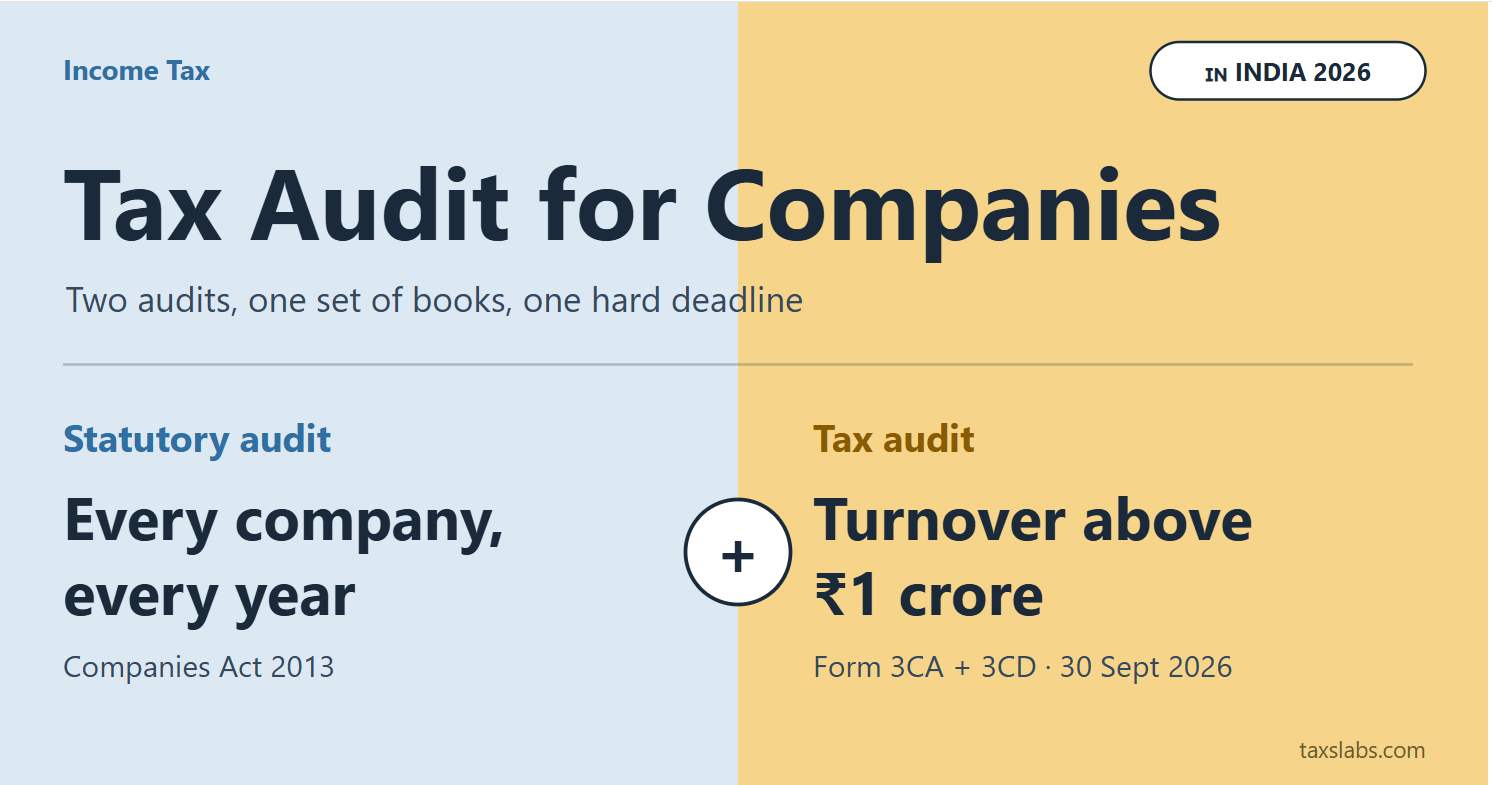
Tax Audit for Companies: A Director’s Complete Guide for 2026
Every September, company directors across India receive the same slightly alarming email from their accountant: “We need to close the tax audit before the 30th.” For many directors, the natural reaction is confusion. The company already has an auditor. The accounts were already audited. So why is there a second audit, a second report and a second deadline?
This guide answers that question in plain language. Tax audit for companies is a separate obligation under income-tax law, and it applies only when your company crosses specific turnover limits. However, when it applies, the board carries the responsibility for getting it done on time. In the sections below, you will learn exactly when tax audit for companies becomes mandatory, how it differs from your statutory audit, why every company files Form 3CA rather than Form 3CB, which reporting clauses cause the most trouble, what the 30 September 2026 deadline means for your AGM, and how the new Income-tax Act 2025 changes the report from next year onward.
What Tax Audit for Companies Actually Means (and What It Is Not)
A tax audit is an examination of your company’s books by a practising chartered accountant from an income-tax point of view. The accountant then reports a long list of prescribed particulars to the Income Tax Department. For the financial year 2025-26, this requirement comes from Section 44AB of the Income-tax Act, 1961. From Tax Year 2026-27, the same requirement moves to Section 63 of the Income-tax Act, 2025.
In simple terms, the department wants verified, standardised information about how your company computed its taxable business income. Rather than examining every company itself, it asks an independent accountant to certify that information in a fixed format. As a result, the report becomes a data source the department uses later for risk assessment and, in some cases, scrutiny selection.
Because the word “audit” worries people, it helps to be clear about three things tax audit for companies is not.
- It is not an investigation. Your company appoints the tax auditor. The department has not selected you for anything, and a tax audit is entirely different from a scrutiny assessment, survey or search.
- It is not a replacement for the statutory audit. Every company must still be audited under the Companies Act, 2013. The tax audit is an additional layer, not a substitute.
- It does not create tax on its own. The audit verifies and discloses. That said, what the auditor reports, such as a disallowance or a TDS default, can directly affect the tax your company pays.
For directors, the practical point is this: tax audit for companies is a board-level compliance item with a hard date. Consequently, it belongs on the same calendar as your AGM and your annual MCA filings.
Pro Tip: If your company deals only with the general mechanics of Section 44AB, such as how the five applicability gates work for proprietors and firms, our detailed guide to tax audit under Section 44AB covers that ground. This article focuses only on what is different for companies.
Statutory Audit vs Tax Audit: Two Laws, One Set of Books
To understand tax audit for companies, start with the audit every company already has. Every company in India, whether a one-person startup or a listed giant, needs a statutory audit every year. There is no turnover exemption and no exemption for dormant or loss-making companies. The statutory auditor examines whether the financial statements give a true and fair view, and the report goes to shareholders.
Tax audit for companies, on the other hand, looks at the same books through a different lens. The tax auditor asks questions such as: Was TDS deducted on every payment that needed it? Were payments to related parties reasonable? Did the company pay its MSME suppliers on time? Were any expenses personal or penal in nature? In other words, the statutory auditor tests the accounts, while the tax auditor tests the tax position built on those accounts.

| Point of difference | Statutory audit | Tax audit |
|---|---|---|
| Law | Companies Act, 2013 (Sections 139 to 143) | Income-tax Act, 1961, Section 44AB (Section 63 of the 2025 Act from Tax Year 2026-27) |
| Applies to | Every company, regardless of size | Only companies above the turnover limits |
| Purpose | True and fair view of financial statements | Correct computation of taxable income and tax compliance |
| Appointment | First auditor by the board; later auditors by shareholders at the AGM | Board of directors or management |
| Report | Independent auditor’s report addressed to members | Form 3CA with Form 3CD for FY 2025-26 |
| Where filed | With financial statements in Form AOC-4 on the MCA portal | Income-tax e-filing portal, then accepted by the company |
Why every company files Form 3CA, never Form 3CB
The tax audit report comes in two versions. Form 3CA is used where the accounts are already audited under another law. Form 3CB is used where they are not. Since the Companies Act requires every company’s accounts to be audited, a company always falls into the first category. Accordingly, a company’s tax audit report is Form 3CA plus Form 3CD, with Form 3CD carrying the detailed statement of particulars.
This link has a practical consequence. The third proviso to Section 44AB treats the statutory audit as sufficient compliance with the audit requirement, provided the company also furnishes the tax audit report in the prescribed form by the specified date. Put differently, the law does not ask your company to audit its books twice from scratch. Instead, the tax auditor relies on the statutory audit and adds the income-tax reporting layer on top.
For the same reason, tax audit for companies cannot really begin until the statutory audit is complete. If your statutory audit is late, your tax audit will almost certainly be late too.
Can the statutory auditor also be the tax auditor?
Yes. Many companies appoint the same chartered accountant firm for both audits, and the law permits it. In fact, it often saves time because the firm already knows the books. However, a few limits apply under the Institute of Chartered Accountants of India’s guidelines. For example, a CA who is the company’s internal auditor, or an employee, cannot act as its tax auditor. Similarly, each CA can sign only a limited number of tax audit reports in a year, currently 60, which is why firms become stretched in September.
Unlike the statutory auditor, the tax auditor is not appointed by shareholders. The board, or management acting under board authority, engages the tax auditor. Ideally, you should record the appointment in board minutes and sign an engagement letter well before the busy season begins.
When Is Tax Audit for Companies Mandatory? The Turnover Test
Here is the single most important fact for directors: profit does not decide tax audit for companies; turnover does. A loss-making company can need a tax audit, and a highly profitable one may not.
For the financial year 2025-26, a company carrying on business needs a tax audit when its total sales, turnover or gross receipts exceed ₹1 crore. However, the limit rises to ₹10 crore when both of these conditions are met:
- Aggregate cash receipts during the year do not exceed 5% of total receipts, and
- Aggregate cash payments during the year do not exceed 5% of total payments.
Both tests must pass independently. In addition, receipts and payments made by a cheque or draft that is not account-payee count as cash for these tests. That detail matters more than people expect.

Is tax audit mandatory for a private limited company with turnover below ₹1 crore?
No. This is one of the most widespread misconceptions online. Some forum answers claim that because a company is audited under the Companies Act, it must always file Form 3CA. That reading is incorrect. The proviso on audits under other laws only explains how a company complies when a tax audit is required. It does not create a tax audit requirement where none exists.
So, a private limited company with turnover of ₹80 lakh needs a statutory audit, must file its financial statements with the Registrar of Companies, and must file ITR-6. However, it does not need a tax audit report. Its ITR-6 is still due by 31 October 2026, because the return deadline for companies does not depend on whether a tax audit applies.
Why companies have no presumptive escape route
Proprietors and partnership firms sometimes avoid a tax audit by declaring income under the presumptive scheme of Section 44AD. Companies cannot do this. Section 44AD is available only to resident individuals, Hindu undivided families and partnership firms other than LLPs. As a result, the presumptive-scheme triggers that catch small businesses, such as the five-year lock-in, simply never apply to a company. If you want to understand how those rules work for other entities, see our guide to presumptive taxation under Sections 44AD and 44ADA.
The ₹10 crore digital threshold: why the payment side trips companies
Most growing companies collect almost everything through banking channels, so the receipts test is usually easy. The payment side is where the trouble starts. Cash wages to casual workers, cash purchases from local vendors, petty cash expenses at factories and cash freight payments can quietly push cash payments above 5%.
Consider a company with total payments of ₹6.5 crore. The 5% limit is ₹32.5 lakh. If site expenses, casual labour and petty cash together reach ₹35 lakh, the company loses the ₹10 crore limit, and the ordinary ₹1 crore limit applies instead. Therefore, if your turnover sits between ₹1 crore and ₹10 crore, ask your finance team for a monthly cash-payment report, not just a year-end number.
What counts as turnover for a company
For tax audit for companies, turnover generally means the revenue from operations shown in your audited statement of profit and loss. The Institute of Chartered Accountants of India’s Guidance Note on Tax Audit is the usual reference for grey areas. A few common points:
- Sale of goods and services from the business counts. Trade discounts shown on the invoice are excluded.
- GST collected is generally excluded where the company follows the exclusive method of accounting and shows revenue net of tax.
- Sale of fixed assets or investments is not turnover of the business.
- Interest and dividend income of a non-finance company is usually other income, not turnover. However, for a company whose business is lending, interest is its turnover.
- Derivative trading by a company is measured on the absolute-profit method prescribed by the Guidance Note, not on contract value.
Expert Insight: When a company is close to the ₹1 crore or ₹10 crore line, do not rely on a management trial balance. Wait for the final, audited revenue figure, because year-end adjustments such as cut-off corrections and credit notes can move the number either way.
The Company Tax Audit Timeline for 2026
Tax audit for companies does not stand alone. Instead, it sits inside a chain of Companies Act events. If one link slips, the whole chain slips. Here is how the sequence runs for FY 2025-26.

- 31 March 2026: the financial year closes.
- April to August: books are closed, the statutory auditor completes fieldwork, and the tax auditor starts collecting schedules.
- Board meeting: the board approves the financial statements under Section 134 of the Companies Act, and the statutory auditor signs the audit report.
- By 30 September 2026: the tax auditor uploads Form 3CA and Form 3CD, and the company accepts the report on the e-filing portal.
- By 30 September 2026: the company holds its AGM, as Section 96 requires an AGM within six months of the year end. One person companies are exempt from holding an AGM.
- By 31 October 2026: the company files ITR-6.
- After the AGM: Form AOC-4 within 30 days and Form MGT-7 within 60 days on the MCA portal.
The 30 September pile-up: tax audit report and AGM
Notice that the tax audit deadline and the AGM deadline fall on the same day. This is not a coincidence you can ignore. The statutory audit report must exist before the AGM, and the tax audit relies on that statutory audit. Consequently, the practical deadline for your statutory audit is well before 30 September, often by the middle of the month, if your tax auditor is to finish on time.
Deadline extensions have happened in some past years. For instance, the tax audit date for AY 2025-26 was extended beyond 30 September 2025. However, an extension is never guaranteed, and at the time of writing the Central Board of Direct Taxes had not notified any extension for AY 2026-27 despite representations from professional bodies. Plan for 30 September, and treat any relief as a bonus.
Transfer pricing companies: 31 October and 30 November
Companies with international transactions, or specified domestic transactions, with associated enterprises follow a different calendar. They must furnish the transfer pricing report in Form 3CEB under Section 92E. For these companies, both the tax audit report and Form 3CEB are due by 31 October 2026, and ITR-6 is due by 30 November 2026. Indian subsidiaries of foreign groups, and companies that pay royalties or management fees to a foreign parent, usually fall in this category.
Inside Form 3CD: The Clauses That Matter Most for Companies
Form 3CD for FY 2025-26 has 44 clauses. Many are routine, such as the company’s PAN, address and method of accounting. However, in tax audit for companies, a handful regularly produce disallowances, qualifications or follow-up notices for companies. Directors do not need to master every clause. Still, you should know where the risk sits so that your team prepares the right documents early.
Tax regime disclosure: Section 115BAA
Many domestic companies have opted for the concessional regime under Section 115BAA, which taxes income at a base rate of 22% in exchange for giving up most deductions and incentives. Form 3CD asks whether the company has opted for such a regime. Once exercised, the option cannot be withdrawn for later years. Therefore, the auditor checks that the company has not claimed deductions that the regime disallows, such as certain additional depreciation or Chapter VI-A deductions other than the permitted ones.
MSME payments and Section 43B(h)
Since AY 2024-25, a company cannot deduct an amount owed to a micro or small enterprise until it actually pays, if payment is delayed beyond the time allowed under the MSMED Act. That limit is 45 days where there is a written agreement, and 15 days otherwise. The auditor reports such amounts, as well as interest payable to MSMEs under the MSMED Act, which is itself not deductible.
In tax audit for companies, this clause catches many businesses because the accounts team must know which suppliers are registered as micro or small enterprises. Ask your vendors for their Udyam registration details, and keep the list updated through the year rather than scrambling in September.
Related-party payments and loans from directors
Under Section 40A(2)(b), payments to related persons, such as directors, their relatives, and entities in which they hold substantial interest, can be disallowed to the extent they are excessive or unreasonable. Form 3CD requires particulars of these payments. Director remuneration, rent paid to a director for office premises, and purchases from a group entity all appear here.
Loans also need care. Clause 31 reports loans and deposits taken or accepted, and repaid, including whether they moved through banking channels. A director who hands the company ₹5 lakh in cash to meet a salary shortfall creates a Section 269SS problem, because loans of ₹20,000 or more must be accepted by account-payee cheque, draft or electronic transfer. Separately, if a closely held company lends money to a shareholder with substantial voting power, the loan can be treated as a deemed dividend under Section 2(22)(e) in the shareholder’s hands, which also has TDS consequences for the company.
Carried-forward losses and Section 79
If your company carries forward business losses, Form 3CD asks whether its shareholding has changed. For a company in which the public is not substantially interested, Section 79 generally disallows the set-off of past losses unless shares carrying at least 51% of the voting power are beneficially held by the same persons on the last day of both the loss year and the set-off year. Eligible startups have a separate relaxation.
This clause matters most in funding rounds, founder exits and group restructurings. A single share transfer can wipe out years of accumulated losses, so involve your tax advisor before the transaction, not after.
TDS and TCS compliance
Clause 34 asks the auditor to report whether the company deducted or collected tax where required, whether it deposited the tax, and whether it filed TDS and TCS returns on time with complete information. It also reports any interest payable for late deduction or payment. Any failure to deduct TDS can lead to a disallowance of the related expense under Section 40(a), so this clause often has a direct tax cost.
The fix is simple but tedious: reconcile your ledgers with the quarterly returns before the auditor arrives. If your team prepares returns in-house, our free TDS return filing tool for Forms 24Q, 26Q and 27Q helps you build clean, validated statements, which makes this clause far easier to close.
Free tool: Prepare error-free quarterly TDS statements before your tax audit with the TaxSlabs TDS Return Filing Tool (24Q, 26Q, 27Q).
Other clauses that often trip companies
- CSR expenditure: spending under Section 135 of the Companies Act is not deductible as a business expense, so it appears among inadmissible amounts.
- Penalties and fines: expenses for offences or prohibited purposes are disallowed and must be reported.
- Depreciation: the auditor reconciles block-wise depreciation under income-tax rules, which differs from Companies Act depreciation.
- GST break-up of expenditure: clause 44 asks for expenditure split between registered and unregistered suppliers.
- Ratios: clause 40 reports turnover, gross profit and net profit ratios for the current and previous year, so a sharp fall can attract questions.
Tax Audit for Companies Under the Income-tax Act 2025: Section 63 and Form 26
The Income-tax Act, 2025 came into force on 1 April 2026. For tax audit for companies, the transition works on a clean year-based split, which the Income Tax Department has confirmed in its official Form 26 FAQs.
| Item | FY 2025-26 (AY 2026-27) | Tax Year 2026-27 onward |
|---|---|---|
| Governing law | Income-tax Act, 1961 | Income-tax Act, 2025 |
| Audit section | Section 44AB | Section 63 |
| Rule | Rule 6G, Income-tax Rules 1962 | Rule 47, Income-tax Rules 2026 |
| Report for companies | Form 3CA + Form 3CD | Form No. 26: Part A, Part B and Part C |
| Turnover limits | ₹1 crore / ₹10 crore | Unchanged: ₹1 crore / ₹10 crore |
| Due date (non-TP company) | 30 September 2026 | 30 September 2027 |
| Signing accountant | Chartered accountant under Section 288 | Accountant under Section 515(3)(b), with UDIN |
In short, the audit your CA signs this September is still the old-law audit. The new form applies to the year that started on 1 April 2026, so your first Form 26 will be due in 2027.
Part C replaces Form 3CA
Form No. 26 has four parts. Part A holds the assessee’s particulars, and Part B holds the statement of particulars, broadly replacing Form 3CD. Part C is the audit report where accounts are audited under any other law, corresponding to Form 3CA, while Part D replaces Form 3CB. Because every company is audited under the Companies Act, companies will use Parts A, B and C. Part B is also trigger-based: each clause needs a Yes or No, and detailed schedules are needed only when the answer is Yes.
New disclosures directors should prepare for now
Although the thresholds for tax audit for companies stay the same, Form 26 asks for several things that directors should start preparing during the current year, not next September.
- Impact of statutory audit remarks: the tax auditor must state the impact, if any, of qualifications, adverse remarks, disclaimers or emphasis of matter in the statutory audit on the company’s profit, loss or book profit. This ties the two audits together more tightly than ever.
- Categorised audit observations: each observation must be tagged as based on test checks, management representation, or unable to verify. An “unable to verify” tag may draw attention, so documentation quality matters.
- Accounting server location: where books are kept electronically, the form asks for the IP address and country of the server and the address of the India-located backup server, in line with the rule requiring daily backups on servers in India.
- TDS transaction counts: instead of a simple Yes or No on return filing, the auditor reports the number of transactions reported and not reported in TDS and TCS returns, with the value of unreported amounts.
- Depreciation simplification: the depreciation clause separates assets used for less than 180 days from others without needing exact dates.
- Lighter GST reporting: total expenditure no longer needs reconciliation with every GST reporting entry, which should ease the burden compared with clause 44 today.
Pro Tip: If your company uses cloud accounting software hosted outside India, check now whether a daily backup exists on an India-located server. It is far easier to fix this in October 2026 than to explain it in the first Form 26 in 2027.
How Tax Audit for Companies Works: A Step-by-Step Process for Directors
In tax audit for companies, the chartered accountant does the audit, but the company owns the outcome. The following sequence keeps the process calm and predictable.
- Confirm applicability early. By May, compute provisional turnover and the two cash ratios. If turnover is between ₹1 crore and ₹10 crore, test both 5% conditions separately.
- Appoint the tax auditor by board resolution. Record the appointment, agree the fee and timeline in an engagement letter, and confirm the auditor has capacity within the annual limit on tax audits.
- Finalise the statutory audit. Close the books, get board approval of the financial statements, and obtain the signed statutory audit report. The tax audit rests on this.
- Prepare the supporting schedules. These include the fixed asset register, related-party list, MSME payables ageing, loans and deposits summary, TDS reconciliation, GST expenditure split and details of any shareholding change.
- Assign the form on the e-filing portal. The company logs in, adds the chartered accountant, and assigns Form 3CA-3CD for the assessment year.
- Review the draft before upload. Ask the auditor for the draft Form 3CD. Directors or the CFO should read every qualification and disallowance and understand why it appears.
- Accept the report and file ITR-6. After the CA uploads the report with a digital signature and UDIN, the company must accept it on the portal. Then carry the audited figures into ITR-6 by 31 October 2026.
The Income Tax Department’s own video walks through the portal part of this workflow: assigning the form to the auditor, the auditor’s submission, and the taxpayer’s acceptance.
Important: A report uploaded by the CA is not complete until the company accepts it. Every year, some companies miss the deadline even though their auditor uploaded on time, simply because nobody logged in to accept.
Three Companies, Three Outcomes: Case Studies
The following examples use illustrative figures to show how the rules on tax audit for companies play out in practice.
Case 1: Suvarna Packaging Pvt Ltd loses the ₹10 crore limit
Suvarna Packaging manufactures corrugated boxes in Pune. For FY 2025-26, its turnover is ₹7.4 crore. Almost all customers pay by bank transfer, so cash receipts are only ₹18 lakh, about 2.4% of total receipts. The directors therefore assumed the ₹10 crore limit applied.
However, total payments were ₹6.9 crore, and cash payments for casual labour, local scrap purchases and transport came to ₹52 lakh, roughly 7.5%. Because the payment test failed, the ₹1 crore limit applied, and the company needed a tax audit. Fortunately, the finance head spotted this in July, so the tax audit finished on time. Next year, the company plans to move casual wages to bank transfers.
Case 2: Kavach Softlabs Pvt Ltd, a loss-making startup
Kavach Softlabs is a two-year-old software company in Bengaluru. Its FY 2025-26 revenue is ₹84 lakh, and it reported a loss after heavy product spending. One founder had heard that “all companies need Form 3CA” and asked the accountant to arrange a tax audit.
In reality, tax audit for companies turns on turnover, and revenue below ₹1 crore meant no tax audit was required. The company still needed its statutory audit, board approval of accounts, an AGM by 30 September, AOC-4 and MGT-7 filings, and ITR-6 by 31 October 2026. The founders also learned that an upcoming funding round could affect the carry-forward of their losses under Section 79, so they took advice on the startup relaxation before signing the term sheet.
Case 3: Meridian Auto Components Ltd, a foreign subsidiary
Meridian Auto Components is the Indian subsidiary of a European group, with turnover of ₹46 crore. It buys tooling from its parent and pays a technical services fee to a group company. These are international transactions with associated enterprises.
As a result, Meridian needs both a tax audit and a transfer pricing report in Form 3CEB. Both are due by 31 October 2026, and ITR-6 is due by 30 November 2026. Its tax auditor and transfer pricing advisor coordinate closely, because the related-party figures in Form 3CD must match those in Form 3CEB.
7 Costly Mistakes Companies Make in Tax Audit
In tax audit for companies, the same errors come up every September. Avoiding them saves money, stress and future notices.
- Testing only cash receipts. Directors often check the receipts side and forget the payments side. As Case 1 shows, the payments test is usually the one that fails.
- Assuming a loss means no audit. Tax audit for companies depends on turnover, not profit. A company with ₹3 crore turnover and a loss still needs a tax audit if it does not qualify for the ₹10 crore limit.
- Doing a tax audit that the law does not require. The reverse mistake is also common. A small company below ₹1 crore does not need Form 3CA, and filing one unnecessarily adds cost without benefit.
- Letting the statutory audit run late. Since the tax audit depends on the statutory audit, a late board meeting pushes both audits against the 30 September wall.
- Ignoring MSME supplier status. Without an up-to-date list of micro and small suppliers, the company cannot compute the Section 43B(h) disallowance, and the auditor may have to qualify the report.
- Taking cash loans from directors. Emergency cash from a director of ₹20,000 or more breaches the banking-channel rule and gets reported. Always route director funding through the bank.
- Forgetting to accept the uploaded report. The company’s acceptance on the portal completes the filing. Assign a named person to log in the same day the CA uploads.

Penalty and Consequences of a Missed Company Tax Audit
If a company that must get a tax audit fails to do so, or fails to furnish the report by the due date, Section 271B allows a penalty of 0.5% of turnover or ₹1.5 lakh, whichever is lower. For Suvarna Packaging, 0.5% of ₹7.4 crore is ₹3.7 lakh, so the penalty would be capped at ₹1.5 lakh. For most companies above ₹3 crore turnover, the cap is what matters.
Section 273B provides relief where the company proves a reasonable cause, such as the auditor’s sudden resignation, a natural calamity, or a genuine portal failure. However, reasonable cause is a defence you must document, not a right. Keep emails, portal screenshots and board records showing what went wrong and when. The Income-tax Act, 2025 carries forward an equivalent penalty and a similar reasonable-cause defence for Tax Year 2026-27 onward.
Beyond the penalty, a missed tax audit for companies can also mean:
- the ITR-6 filed without the audit report may be treated as defective, with the company asked to correct it;
- a separate penalty of ₹1 lakh under Section 271BA where a required Form 3CEB is not furnished;
- loss of credibility with lenders and investors, who increasingly ask for the tax audit report during due diligence; and
- a weaker position in any later scrutiny, since the report is the department’s first reference point.
For the full penalty framework, see the Income Tax Department’s official penalties page.
Key Takeaways
- Every company needs a statutory audit, but tax audit for companies applies only when turnover exceeds ₹1 crore, or ₹10 crore where both cash receipts and cash payments stay within 5%.
- Companies always use Form 3CA with Form 3CD, because their accounts are already audited under the Companies Act.
- Companies cannot use Section 44AD, so profit level and presumptive schemes do not affect their audit requirement.
- For FY 2025-26, the tax audit report is due by 30 September 2026, or 31 October 2026 for transfer pricing companies; ITR-6 follows by 31 October or 30 November.
- The clauses that most often cost companies money involve TDS, MSME payments, related-party transactions, cash loans and shareholding changes.
- From Tax Year 2026-27, Section 63 and Form No. 26 (Parts A, B and C for companies) replace Section 44AB and Forms 3CA and 3CD, with unchanged thresholds.
- The penalty for a missed audit is 0.5% of turnover capped at ₹1.5 lakh, with relief only for a documented reasonable cause.
Frequently Asked Questions
Is tax audit mandatory for every private limited company?
No. Every private limited company needs a statutory audit under the Companies Act, 2013, but a tax audit is required only when turnover exceeds ₹1 crore, or ₹10 crore where cash receipts and cash payments each stay within 5%.
What is the tax audit limit for companies for FY 2025-26?
The limit is ₹1 crore of turnover. It rises to ₹10 crore when aggregate cash receipts do not exceed 5% of total receipts and aggregate cash payments do not exceed 5% of total payments. Both conditions must be met.
Which form does a company use for its tax audit report?
For FY 2025-26, a company uses Form 3CA along with Form 3CD, because its accounts are already audited under the Companies Act. From Tax Year 2026-27, companies will use Form No. 26, with Part C replacing Form 3CA and Part B replacing Form 3CD.
What is the due date of tax audit for companies in 2026?
For FY 2025-26, the tax audit report is due by 30 September 2026. Companies that must file a transfer pricing report in Form 3CEB have until 31 October 2026. Always check incometax.gov.in for any extension notified by the CBDT.
Can the statutory auditor of a company also be its tax auditor?
Yes. The same chartered accountant or firm can conduct both audits, and many companies prefer this. However, the company’s internal auditor or an employee cannot act as its tax auditor under ICAI guidelines.
Does a loss-making company need a tax audit?
It depends on turnover, not profit. A loss-making company with turnover above the applicable limit needs a tax audit, while a loss-making company below ₹1 crore turnover does not.
Can a company use presumptive taxation to avoid a tax audit?
No. Section 44AD presumptive taxation is available only to resident individuals, Hindu undivided families and partnership firms other than LLPs. A company must maintain full books and follow the normal turnover limits.
What is the penalty if a company misses its tax audit?
Under Section 271B, the penalty is 0.5% of turnover or ₹1.5 lakh, whichever is lower. The penalty can be avoided only if the company proves a reasonable cause for the failure under Section 273B.
What changes for company tax audits under the Income-tax Act 2025?
From Tax Year 2026-27, Section 63 replaces Section 44AB and Form No. 26 replaces Forms 3CA, 3CB and 3CD. The turnover limits stay the same, but reporting becomes schedule-based, with new disclosures on statutory audit remarks, server location and TDS transaction counts.
Conclusion: Treat Tax Audit for Companies as a Board Calendar Item
Tax audit for companies is not complicated once you separate it from the statutory audit. The statutory audit is universal. The tax audit depends on turnover and on two cash tests, and when it applies, it follows the statutory audit on a tight timeline that ends on 30 September 2026 for most companies.
The directors who find September easy are those who act early: they test the cash ratios in summer, keep MSME and related-party data clean, reconcile TDS every quarter, and put the tax audit on the same board calendar as the AGM. Meanwhile, the move to Section 63 and Form No. 26 next year is a good reason to tighten those habits now.
For the wider picture of company taxation, explore our complete Income Tax Guide and the latest articles in our Income Tax topic hub. And before your auditor starts on the TDS clause, prepare clean returns with the free TDS Return Filing Tool.
For official references, see the Income Tax Department’s Form 3CA-3CD user manual, the official Form No. 26 FAQs, and the Ministry of Corporate Affairs portal for your annual filings.
Disclaimer: This content is for information and education only and does not constitute professional, tax, legal, or investment advice. Consult a qualified professional before acting.