

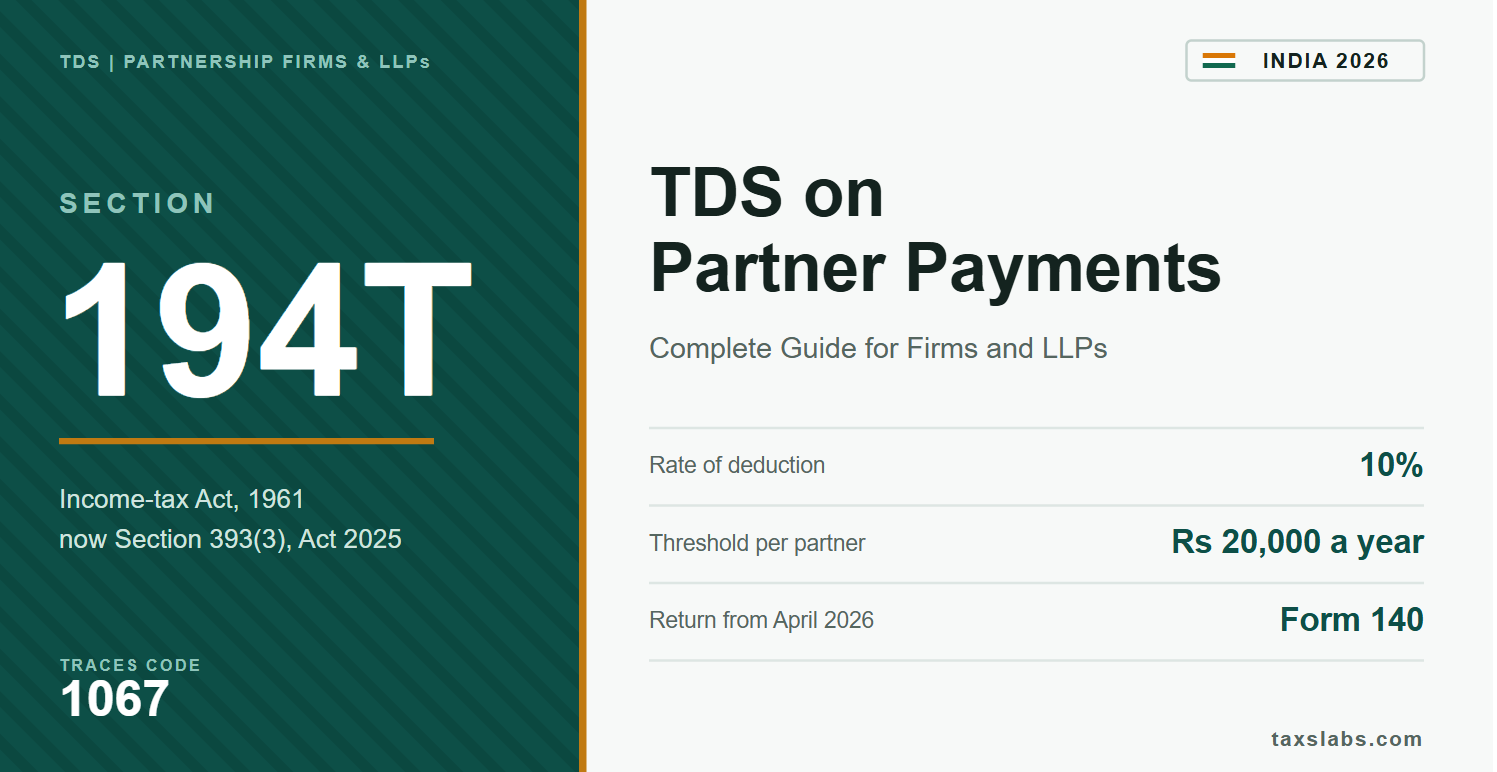
Section 194T: TDS on Partner Payments by Firms and LLPs — The Complete 2026 Guide
For decades, a partnership firm could credit lakhs of rupees to its partners as remuneration and interest without deducting a single rupee of tax. Section 194T ended that. From 1 April 2025, every firm and every LLP in India must deduct 10% TDS on salary, remuneration, commission, bonus and interest paid to its own partners once the yearly total crosses a modest ₹20,000 per partner.
There is no turnover exemption. No audit-based carve-out. A two-partner consultancy in Deoli carries the same obligation as a ₹500-crore manufacturer. And from April 2026, the provision is renumbered under the Income-tax Act, 2025, with a new payment code and new return forms — which means firms that finally got comfortable with the rule now have to relearn how to report it.
This guide covers exactly what Section 194T catches, what it leaves alone, how the ₹20,000 threshold really triggers, the new-Act mapping, the full compliance sequence, and the mistakes that cost firms the most.
Why Section 194T Exists — and What Changed
Before April 2025, the logic ran like this. A firm paid tax on its profits. A partner paid tax on the remuneration and interest received from the firm when filing a personal return. Nothing was withheld in between.
The gap was obvious once you looked at it. Salary to an employee attracted TDS under Section 192. Professional fees attracted TDS under Section 194J. Contractor payments attracted TDS under Section 194C. But a firm crediting ₹40 lakh of remuneration to three partners’ capital accounts withheld nothing, and the department had no contemporaneous record of the payment at all — only whatever the partners chose to disclose months later.
Section 194T, inserted by the Finance (No. 2) Act, 2024, closed that gap. It is the first TDS provision in Indian tax history that operates inside the firm-partner relationship.
The design is deliberately blunt. Any person being a firm, responsible for paying any sum in the nature of salary, remuneration, commission, bonus or interest to a partner, must deduct income tax at ten per cent at the time of credit to the partner’s account — including the capital account — or at the time of payment, whichever is earlier.
Who is caught by it
Everyone, essentially. Section 194T applies to traditional partnership firms under the Indian Partnership Act, 1932 and to LLPs under the Limited Liability Partnership Act, 2008 alike. It binds:
- firms of every size — there is no turnover threshold;
- firms whether or not they are liable to tax audit;
- professional firms — chartered accountants, lawyers, architects, doctors;
- working partners and dormant partners alike, to the extent a covered payment is made.
It does not apply to a sole proprietorship, because a proprietor cannot pay salary to himself. It does not apply to companies either — director remuneration travels down a different route entirely.
Expert Insight: The most under-appreciated consequence is administrative, not financial. Thousands of small firms that have never held a TAN — because they never deducted tax on anything — now need one. Obtaining a TAN, depositing monthly, filing quarterly and issuing certificates is an entirely new operating rhythm for a two-partner firm that previously filed one income-tax return a year and nothing else.
What Section 194T Covers and What It Does Not
This is where most errors originate, and the distinction is genuinely simple once stated: Section 194T catches income-type payments to a partner and ignores capital-type movements.
The five covered categories
- Salary paid to a partner.
- Remuneration — by whatever name the deed calls it.
- Commission — whether on turnover, collection or any other basis.
- Bonus — annual, periodic or one-off.
- Interest on any account — critically, this covers interest on capital as well as interest on a loan given by the partner to the firm.
What stays outside the net
Four categories are excluded, and firms should document each carefully:
- Share of profit. A partner’s profit share is exempt in the partner’s hands, and no TDS attaches to it. This is the single largest exclusion by value for most firms.
- Withdrawal of capital and drawings. Taking back your own money is not income.
- Repayment of a capital account balance. Same logic — a return of contribution, not a payment for services or for the use of money.
- Genuine reimbursement of business expenses. Where a partner pays a vendor on the firm’s behalf and is repaid, that is a reimbursement, not income — provided you hold the bills to prove it.
Amounts credited or paid before 1 April 2025 also sit outside the provision entirely, regardless of when they are eventually withdrawn.

Watch out: Do not relabel remuneration as “drawings” to sidestep deduction. The character of a payment is determined by the partnership deed and the books, not by the narration in a voucher. A firm that pays a working partner a fixed monthly sum authorised by the deed as remuneration has made a covered payment, whatever the ledger calls it.
The ₹20,000 Threshold: How It Actually Triggers
The threshold here is deceptively small, and the way it operates trips up firms that are otherwise careful.
No deduction is required where the sum, or the aggregate of sums, credited or paid to a partner does not exceed ₹20,000 during the financial year. Three words in that sentence do all the work:
- Aggregate — you add together all five covered categories. Remuneration plus interest plus commission, not each tested separately.
- Partner — the test runs partner by partner, not firm-wide. A four-partner firm runs four separate tests.
- Financial year — the counter resets each 1 April and runs to 31 March.
The catch-up deduction most firms get wrong
Here is the mechanic that causes the most demand notices. Once the aggregate crosses ₹20,000, TDS applies to the whole amount — not merely to the slice that exceeds the threshold.
Work through it. A firm credits Partner A ₹10,000 of remuneration in April. No deduction — the running total is ₹10,000, below the line. In May it credits ₹12,000 of interest on capital. The running total is now ₹22,000, so the threshold is crossed. The firm must deduct 10% on ₹22,000, that is ₹2,200 — catching up on the April amount that escaped deduction because the threshold had not then been reached. It does not deduct ₹200 on the ₹2,000 of excess.
From June onward, every covered credit attracts deduction from the first rupee, because the threshold is already behind you for that partner for that year.

Pro Tip: Build a running per-partner ledger that sums all five categories from 1 April, and set an alert at ₹15,000 rather than ₹20,000. The alert at ₹15,000 gives you time to prepare the deduction and the challan before the crossing entry is passed, instead of discovering the breach when you reconcile in October.
When to Deduct: Credit, Capital Account or Payment
The timing rule is the second great source of error, and it catches firms that think of TDS as something triggered by a bank transfer.
Deduction arises at the earlier of two events: credit of the sum to the partner’s account, or actual payment. The provision then removes the obvious escape route by stating expressly that credit to the capital account counts as credit.
The practical meaning is stark. A firm that passes a single year-end journal entry crediting ₹6,00,000 of remuneration to each partner’s capital account on 31 March — with no cash moving at all — has triggered the deduction obligation on 31 March. The tax must be deposited by 30 April. Many firms discover this only when the auditor asks why no challan exists.
| Situation | Does Section 194T apply? | Trigger date |
|---|---|---|
| Monthly remuneration paid by bank transfer | Yes, once aggregate crosses ₹20,000 | Date of payment |
| Year-end credit to capital account, no cash paid | Yes | Date of the credit entry |
| Interest on capital credited annually on 31 March | Yes | 31 March |
| Advance against future remuneration | Yes, treated as a covered payment | Date of payment |
| Partner withdraws ₹2,00,000 from capital | No — capital withdrawal | Not applicable |
| Profit share credited after finalisation | No — exempt profit share | Not applicable |
Expert Insight: Firms that decide remuneration only at year-end, after seeing the book profit, face a genuine practical difficulty — ad-hoc withdrawals happen through the year while the remuneration figure is fixed in March. The pragmatic approach most practitioners have settled on is to treat ad-hoc withdrawals as capital drawings during the year, then deduct on the full remuneration and interest at the date of the year-end credit. Document the treatment in the deed or a partners’ resolution so the characterisation is not argued later.
Section 194T Under the Income-tax Act 2025: New Code, New Forms
Here is the part that will generate the most confusion during the current year, because two different rule-books apply to two adjacent periods.
The Income-tax Act, 2025 took effect from 1 April 2026 and restructured the entire TDS architecture. The old 194-series section numbers are gone, replaced by three parent sections — 392 for salary, 393 for other payments, and 394 for TCS — with each payment type identified by a four-digit numeric payment code rather than a section number.
Partner payments moved to Section 393(3), carrying TRACES payment code 1067. The substance did not change at all: still 10%, still ₹20,000 aggregate per partner per financial year, still the earlier of credit or payment.
| Element | Up to 31 March 2026 | From 1 April 2026 |
|---|---|---|
| Statute | Income-tax Act, 1961 | Income-tax Act, 2025 |
| Provision | Section 194T | Section 393(3) |
| Identifier on return and challan | Section reference “194T” | Payment code 1067 |
| Quarterly TDS return | Form 26Q | Form 140 |
| TDS certificate to partner | Form 16A | Form 131 |
| Rate | 10% | 10% |
| Threshold | ₹20,000 aggregate per partner | ₹20,000 aggregate per partner |
The operational warning is simple: quoting an old section number such as “194T” on a return for a period from April 2026 will fail validation. The code 1067 is what the system now recognises. If your accounting software still carries a 194T section master, it needs a mapping layer before your next quarterly filing.

For the complete code list and the rate position across every payment type, our TDS rates under the new Income-tax Act 2025 reference sets out all the mappings side by side, and the guide to TDS forms for FY 2026-27 explains the new return and certificate numbering in detail.
Preparing partner-payment deductions for the quarter? Use the free TDS return preparation tool on TaxSlabs to build and validate your quarterly statement before you upload it.
Step-by-Step Compliance for a Firm or LLP
For a firm meeting Section 194T for the first time, this is the full sequence, in order.
- Obtain a TAN. Apply for a Tax Deduction and Collection Account Number if the firm does not already hold one. Without it, tax cannot be deposited and no return can be filed.
- Collect PAN for every partner. A missing PAN pushes the deduction rate from 10% to 20%, regardless of the amount involved.
- Build the per-partner running total. Aggregate salary, remuneration, commission, bonus and interest from 1 April for each partner separately.
- Deduct at the trigger. On the first credit or payment that takes a partner past ₹20,000, deduct 10% on the full aggregate to that date, then on every covered amount thereafter.
- Deposit the tax. By the 7th of the following month, except for March deductions, which are due by 30 April.
- File the quarterly return. Form 26Q for periods up to March 2026; Form 140 from April 2026, quoting payment code 1067.
- Issue the certificate. Form 16A for the older periods, Form 131 from April 2026, so each partner can claim the credit in their own return.
- Reconcile before year-end. Match the deduction ledger to the partner capital accounts and to the returns filed, so nothing surfaces for the first time during assessment.

The Section 40(b) Trap Nobody Warns You About
This is the nuance that separates a competent adviser from a checklist follower, and it produces a genuinely uncomfortable result.
Section 40(b) caps how much partner remuneration a firm may claim as a business deduction. Following the enhancement by the Finance (No. 2) Act, 2024, the ceiling for working-partner remuneration is the higher of ₹3,00,000 or 90% of book profit on the first ₹6,00,000 of book profit, and 60% of the balance.
Now put the two provisions side by side. The withholding provision requires deduction on the sum credited or paid. Section 40(b) limits what the firm can deduct as expenditure. These tests are independent of each other.
The consequence: if a firm credits remuneration above the 40(b) ceiling, it must still withhold 10% on the entire amount, including the excess portion that will be disallowed in its own computation. Tax is withheld on money the firm cannot claim as an expense. The partner, meanwhile, is taxed only on the allowable portion, with the disallowed excess not taxable in the partner’s hands — yet TDS has been deducted on the whole.
Worked example: A firm with a book profit of ₹10,00,000 credits ₹9,00,000 of remuneration to its two working partners. The 40(b) ceiling works out to 90% of the first ₹6,00,000 (₹5,40,000) plus 60% of the remaining ₹4,00,000 (₹2,40,000) — ₹7,80,000. The firm may claim ₹7,80,000; the excess ₹1,20,000 is disallowed. But Section 194T operates on the full ₹9,00,000, so the firm withholds ₹90,000, not ₹78,000. The extra ₹12,000 of withholding sits against income the partners are not taxed on, and works its way out only through the partners’ returns.
Pro Tip: Fix the remuneration clause in the deed to track the 40(b) formula rather than naming a flat figure. A deed that says “remuneration as permissible under Section 40(b)” avoids both the disallowance and the over-withholding, and does not need re-execution every time book profit moves.
No Form 15G, No Section 197 Certificate
Partners frequently ask whether the deduction can be avoided where their total income is below the taxable limit, or reduced where their effective rate is lower than 10%. The answer, uncomfortably, is no on both counts.
- No lower-deduction certificate. The facility under Section 197 is not available for payments covered by Section 194T, because the provision was not among those listed in Section 197(1).
- No self-declaration. Forms 15G and 15H cannot be used to stop deduction on partner payments.
- No relief for non-filers testing. The higher-rate regime for return non-filers has been withdrawn under the new Act, so there is no need to verify a partner’s filing status.
- No PAN, higher rate. Without PAN, deduction runs at 20%.
One small mercy: the 10% rate is not increased by surcharge or health and education cess for a resident partner. Ten per cent means ten per cent.
Where a partner’s actual liability is genuinely lower, the excess is recovered as a refund when the partner files a return. The cost is cash-flow timing, not tax — but for a partner in a small firm drawing modest sums, that timing difference is real money held for the better part of a year.
What Non-Compliance Actually Costs
The consequences stack, and they stack quickly.
| Default | Consequence |
|---|---|
| Failure to deduct | Interest at 1% per month from the date deduction was due to the date it is made; the firm is treated as an assessee-in-default for the tax itself |
| Deducted but not deposited | Interest at 1.5% per month from deduction to deposit |
| Failure to deduct (penalty) | Penalty broadly equal to the tax not deducted |
| Late filing of the quarterly return | Fee of ₹200 per day of delay |
| Expense disallowance | 30% of the partner payment disallowed in the firm’s own computation |
| Wilful default | Prosecution provisions may be invoked in serious cases |
Note the compounding effect in the fifth row. A firm that fails to deduct on ₹9,00,000 of remuneration does not merely owe the ₹90,000 of tax plus interest — it also loses 30% of ₹9,00,000 as a deduction, adding ₹2,70,000 to its taxable income. The tax cost of the disallowance frequently exceeds the TDS that was avoided in the first place.
If you need to compute interest exposure on a delayed deduction or deposit, the TDS interest calculator guide walks through the arithmetic.
Real Scenarios: Section 194T in Practice
Scenario 1 — the small LLP that thought it was too small. A two-partner design LLP bills about ₹18 lakh a year and pays each partner ₹45,000 a month as remuneration. The partners assumed Section 194T applied only to firms under tax audit. It does not — there is no turnover or audit filter. Each partner crosses ₹20,000 in the first month, so the LLP deducts ₹4,500 per partner per month, roughly ₹1,08,000 across the year for both. Having never held a TAN, the LLP had to obtain one and start a monthly deposit and quarterly filing routine from a standing start.
Scenario 2 — the year-end journal entry. A trading firm in Delhi finalises accounts in September and passes a back-dated 31 March entry crediting ₹4,00,000 of interest on capital across four partners. Because credit to the capital account is itself the trigger, the deduction obligation arose on 31 March and the tax was due by 30 April. By the time the entry was passed in September, roughly five months of interest at 1.5% per month had accrued on the late deposit — about ₹3,000 on ₹40,000 of tax — before any question of late-filing fees. The lesson is that the accounting date, not the posting date, governs.
Scenario 3 — the partner without a PAN. A family firm admitted an elderly partner who had never obtained a PAN. The firm credited ₹3,00,000 of remuneration and deducted at 10%. On review the deduction should have been 20% — ₹60,000, not ₹30,000. The shortfall carried interest at 1% per month for the period of under-deduction, and the partner could not claim credit cleanly without PAN in any case. Collecting PAN from every partner before the first credit of the year is a five-minute task that prevents this entirely.
Seven Mistakes Firms Keep Making
- Testing the threshold per payment. It is an annual aggregate per partner, not a per-transaction limit.
- Testing the threshold firm-wide. Four partners means four independent ₹20,000 tests.
- Deducting only on the excess. Once ₹20,000 is crossed, deduction runs on the whole amount, with a catch-up on earlier credits.
- Ignoring book entries. A capital-account credit triggers deduction even where no cash moves.
- Forgetting interest on partner loans. Interest on any account is covered, not just interest on capital.
- Assuming an exemption for small or professional firms. There is none — no turnover test, no audit test, no MSME carve-out.
- Still quoting “194T” on returns for periods from April 2026. The identifier is now payment code 1067 under Section 393(3).
Key Takeaways
- Section 194T applies from 1 April 2025 and requires a firm or LLP to deduct 10% TDS on salary, remuneration, commission, bonus and interest paid to a partner.
- The ₹20,000 threshold is an aggregate, tested per partner, per financial year — not per payment and not firm-wide.
- Once the threshold is crossed, deduction applies to the entire amount, including a catch-up on earlier credits that escaped deduction.
- Deduction is triggered at credit or payment, whichever is earlier — and a credit to the capital account counts.
- Share of profit, capital withdrawals, repayment of capital and genuine expense reimbursements are outside the provision.
- There is no turnover exemption and no audit-based exemption — every firm and LLP is covered.
- From 1 April 2026, the provision sits in Section 393(3) of the Income-tax Act, 2025 with payment code 1067; returns move from Form 26Q to Form 140 and certificates from Form 16A to Form 131.
- No Section 197 lower-deduction certificate and no Form 15G or 15H are available; without PAN the rate is 20%.
- Section 40(b) limits what the firm can claim, but Section 194T requires withholding on the full amount credited — the two tests are independent.
- Non-compliance costs interest at 1% or 1.5% a month, a ₹200-per-day filing fee, and a 30% disallowance of the partner expense.
Frequently Asked Questions
What is Section 194T of the Income Tax Act?
Section 194T requires a partnership firm or LLP to deduct tax at source at 10% on any sum in the nature of salary, remuneration, commission, bonus or interest paid or credited to a partner. It was inserted by the Finance (No. 2) Act, 2024 and applies from 1 April 2025. No deduction is required where the aggregate of such sums to a partner does not exceed ₹20,000 in a financial year.
Does Section 194T apply to small firms and LLPs?
Yes. There is no turnover threshold, no exemption based on tax audit applicability, and no carve-out for MSMEs or professional firms. A two-partner LLP billing ₹15 lakh a year carries exactly the same obligation as a large manufacturing firm. The only filter is the ₹20,000 aggregate per partner.
Is TDS deducted on a partner’s share of profit?
No. A partner’s share of profit is exempt in the partner’s hands and is not covered by Section 194T. Only salary, remuneration, commission, bonus and interest are covered. Capital withdrawals, repayment of capital balances and genuine reimbursements of business expenses are also outside the provision.
Is TDS applicable if the amount is only credited and not paid?
Yes. Deduction is triggered at the earlier of credit to the partner’s account or actual payment, and the provision expressly includes credit to the capital account. A year-end journal entry crediting remuneration or interest to capital accounts triggers the obligation on the date of that entry, even though no cash has moved.
If a partner crosses ₹20,000, is TDS deducted on the full amount or only the excess?
On the full amount. Once the aggregate of covered payments to that partner exceeds ₹20,000 in the financial year, tax is deducted on the entire sum, which means catching up on earlier amounts that were credited before the threshold was reached. Deducting only on the excess over ₹20,000 is a common and costly error.
Can a partner submit Form 15G or obtain a lower TDS certificate?
No. The facility of a nil or lower deduction certificate under Section 197 is not available for payments covered by Section 194T, and Forms 15G and 15H cannot be used either. Where a partner’s actual tax liability is lower than the amount withheld, the excess is recovered as a refund when the partner files their income-tax return.
What happens if a partner does not have a PAN?
The deduction rate rises from 10% to 20%. This applies regardless of the amount involved, so collecting PAN details from every partner before the first covered credit of the financial year is a basic control worth enforcing.
What replaced Section 194T under the Income-tax Act 2025?
From 1 April 2026, partner payments are covered by Section 393(3) of the Income-tax Act, 2025 and are identified on returns and challans by TRACES payment code 1067. The rate remains 10% and the threshold remains ₹20,000 aggregate per partner per financial year. The quarterly return becomes Form 140 in place of Form 26Q, and the certificate becomes Form 131 in place of Form 16A.
What are the penalties for not deducting TDS under Section 194T?
Interest runs at 1% per month for failure to deduct and 1.5% per month where tax is deducted but deposited late. A penalty broadly equal to the tax not deducted may be levied, late filing of the quarterly return attracts a fee of ₹200 per day, and 30% of the partner payment is disallowed in the firm’s own computation. The disallowance frequently costs more than the tax that was not withheld.
Does a firm need a TAN to comply with Section 194T?
Yes. A Tax Deduction and Collection Account Number is required to deposit the tax and to file the quarterly TDS return. Many small firms have never needed a TAN before, so obtaining one is often the first practical step toward compliance.
Conclusion
Section 194T is not a complicated provision. The rate is flat, the threshold is small, the covered categories are listed plainly, and the exclusions are intuitive once you hold on to the distinction between income-type payments and capital-type movements.
What makes it demanding is that it applies to a population of taxpayers who were never in the TDS system at all. A firm that previously filed one return a year now has a monthly deposit, a quarterly return and an annual certificate obligation — and a 30% disallowance waiting if it gets any of that wrong. Layer the April 2026 renumbering on top, and the same firm has to file under a code it has never used, on a form it has never seen.
The practical answer is unexciting and effective: obtain the TAN, collect every partner’s PAN, run a per-partner running total from 1 April, and treat the year-end journal entry with the same seriousness as a bank transfer. Do that, and Section 194T becomes routine rather than risky.
For the wider framework, our complete TDS guide covers deduction, deposit and filing across every provision, while the deep-dives on TDS on contractor payments under Section 194C and Section 194J on professional and technical fees cover the two provisions firms most often apply alongside this one. You can browse everything we publish on withholding in the TDS and TCS topic hub, or model your numbers with our free tax calculators. Questions about your own firm’s position? Get in touch.
Always verify the current position against official sources before acting: the income tax e-filing portal carries the notified forms and utilities, TRACES is the authoritative source for payment codes and certificates, and the Press Information Bureau publishes official announcements on tax changes.
Disclaimer: This content is for information and education only and does not constitute professional, tax, legal, or investment advice. Consult a qualified professional before acting. Rates, thresholds, forms and payment codes change through notifications and circulars — verify the position applicable to your firm against the official portal before you deduct, deposit or file.
