

Belated Return for AY 2026-27: The Salaried Taxpayer’s Guide to Filing Late and Fixing Mistakes
The 31 July deadline came and went. Perhaps Form 16 arrived late, perhaps you assumed that no tax was due because your employer deducted enough, or perhaps you filed on time and have now spotted interest income you forgot to report. Either way, the question is the same: what can you still do?
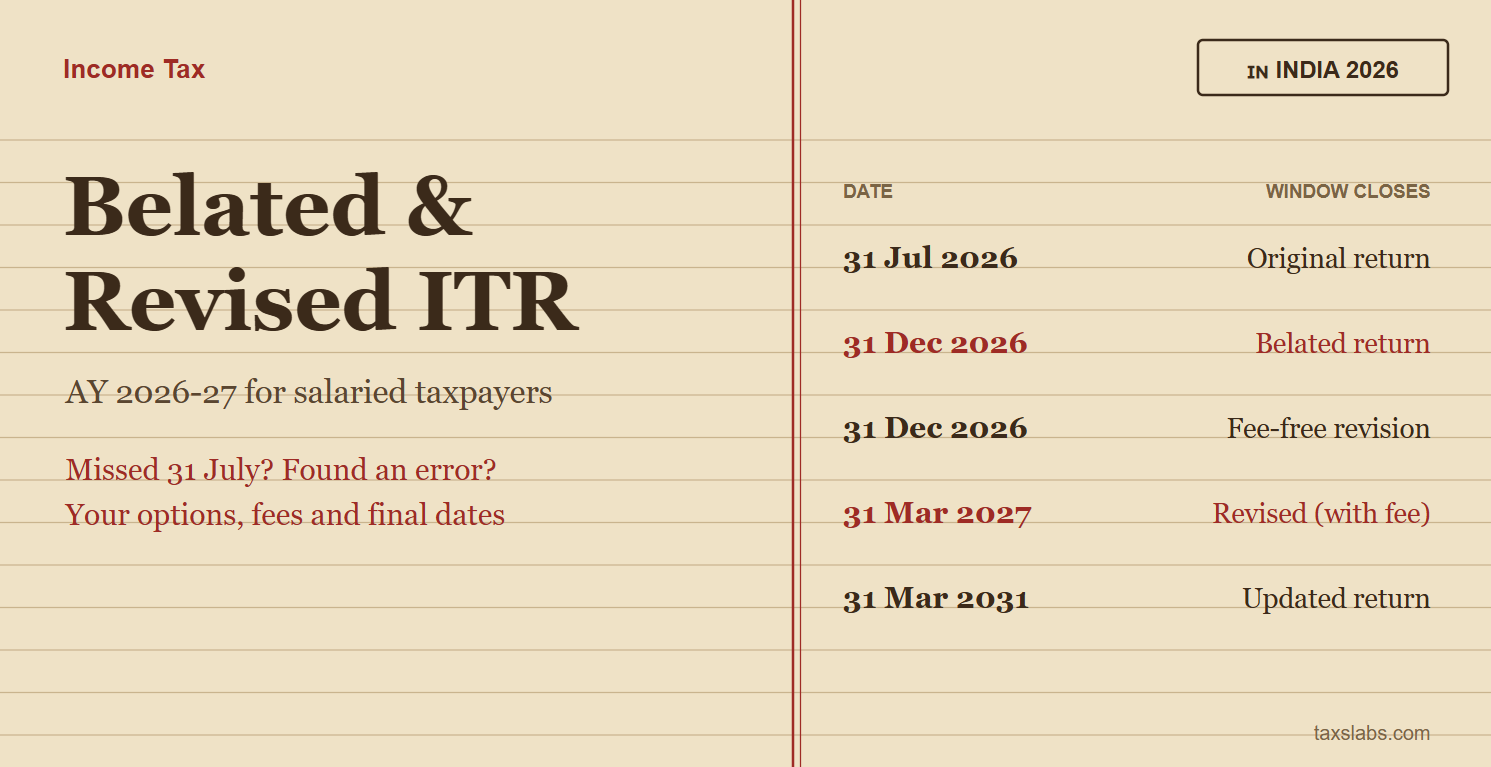
For AY 2026-27, the answer is a belated return if you never filed, and a revised return if you filed but got something wrong. A belated return must reach the department by 31 December 2026. Revised returns now have more time: after the Finance Act, 2026, they stay open until 31 March 2027, with a new fee after 31 December. In this guide, you will learn what a belated return costs a salaried taxpayer, why filing late can lock you out of the old tax regime, how to file a belated return or a revised return step by step, and what options remain once these windows close.
Belated, Revised and Updated Returns: Three Different Tools
People often use these three terms as if they mean the same thing. They do not. Each one solves a different problem, has its own deadline and carries its own price. So the first step is to identify which situation you are in.
| Feature | Belated return | Revised return | Updated return (ITR-U) |
|---|---|---|---|
| Section (AY 2026-27) | 139(4) | 139(5) | 139(8A) |
| Use it when | You missed the original due date | You filed but made a mistake | Both windows have closed and income was missed |
| Last date | 31 December 2026 | 31 March 2027 | 31 March 2031 |
| Cost | Late fee under Section 234F plus interest | Free until 31 Dec 2026; fee under Section 234I after that | Additional tax of 25% to 70% plus interest |
| Can claim or raise a refund? | Yes | Yes | No |
| Can choose old regime (salaried)? | No | Only if the original was on time (see below) | No change to regime |
In short, a belated return is the late version of your first filing, a revised return corrects a filing you already made, and ITR-U is a last resort for adding income after both windows close. This guide focuses on the first two, because that is where salaried taxpayers can still save the most. For the third, see our detailed guide to ITR-U and the 48-month window.
Belated Return Deadlines for AY 2026-27
AY 2026-27 covers income earned in FY 2025-26, from 1 April 2025 to 31 March 2026. Although the Income-tax Act, 2025 came into force on 1 April 2026, the Income Tax Department’s transition FAQs confirm that this return is still filed under the Income-tax Act, 1961.

| Event | Date for AY 2026-27 |
|---|---|
| Original due date for salaried taxpayers (ITR-1, ITR-2) | 31 July 2026 |
| Original due date for non-audit business cases (ITR-3, ITR-4) | 31 August 2026 |
| Last date for a belated return | 31 December 2026 |
| Last date for a revised return without a fee | 31 December 2026 |
| Last date for a revised return with the Section 234I fee | 31 March 2027 |
| Last date for an updated return (ITR-U) | 31 March 2031 |
In every case, the belated or revised return must also be filed before the assessment is completed, if that happens first. For most salaried taxpayers, no assessment beyond routine processing takes place in this period, so the calendar dates are what matter.
The new 31 March 2027 window for revised returns
Until last year, both the belated and the revised return closed on 31 December. The Finance Act, 2026 extended the time for a revised return to the end of the assessment year, which for AY 2026-27 is 31 March 2027. At the same time, it introduced a fee under the new Section 234I for revisions filed after 31 December: ₹1,000 if total income does not exceed ₹5 lakh, and ₹5,000 otherwise.
This change has a useful side-effect. Previously, a belated return filed on 30 December could practically never be corrected, because the revision window closed the next day. Now, a belated return can itself be revised until 31 March 2027, although the fee applies to any revision made after 31 December 2026.
The 30-day e-verification trap
A return is not complete until you verify it. You have 30 days from uploading to e-verify, for example through Aadhaar OTP or net banking. If you verify later, the date of verification is treated as the date of filing. Consequently, a return uploaded on 25 July 2026 but verified on 10 September 2026 is treated as filed on 10 September, which makes it a belated return, with the late fee and every other consequence that follows. If you are unsure, log in and check the status under your filed returns before assuming you filed on time.
Important: An unverified return is treated as never filed. If you uploaded a return in July but never verified it, and more than 30 days have passed, you may need to verify it with a condonation request or file a belated return. Check this before December, not after.
What a Belated Return Really Costs a Salaried Taxpayer
Many salaried people assume that a belated return costs nothing if the employer has already deducted enough TDS. That is rarely true. A belated return can cost you in five separate ways, and some of them are larger than the late fee.
1. The late fee under Section 234F
The fee is ₹5,000, reduced to ₹1,000 where total income does not exceed ₹5 lakh. It is payable before you file, and the utility will not accept the belated return until it is paid. The fee does not depend on whether you owe tax. Even a taxpayer claiming a refund pays it, provided they were required to file in the first place.
2. Interest on unpaid tax
If any tax remains unpaid after TDS, interest under Section 234A runs at 1% per month from 1 August 2026 until you file. In addition, if TDS and advance tax together covered less than 90% of your final tax, Section 234B interest runs at 1% per month from 1 April 2026. A part of a month counts as a full month for both. For salaried people whose only income is salary, this is often small, because TDS covers most of the tax. However, interest, rent or capital gains that were not subject to enough TDS can change that quickly.
3. Losing the old tax regime
This is the cost most salaried taxpayers overlook. For FY 2025-26, the new tax regime is the default. A taxpayer without business income can choose the old regime, but only in a return filed on or before the due date under Section 139(1). A belated return is, by definition, filed after that date, so it must use the new regime.
For most people, this makes no difference, because the new regime, with its ₹75,000 standard deduction and a rebate that removes tax on income up to ₹12 lakh, is already cheaper. However, if you have large deductions, such as a big HRA exemption plus Section 80C, 80D and NPS contributions, the old regime can still win, and a belated return takes that away permanently for the year. Before deciding how much a late filing will cost, run your figures through the old vs new tax regime calculator for FY 2025-26.

4. Losses that cannot be carried forward
If you sold shares or mutual funds at a loss during FY 2025-26, that capital loss can be carried forward to set off against future gains only if the return for the loss year was filed by the due date. A belated return keeps the loss on record for the current year, but it cannot carry it forward. The main exception relevant to salaried people is loss from house property, which can still be carried forward from a belated return, subject to the regime rules.
5. Slower refunds and less refund interest
When you file on time, interest on a refund under Section 244A runs at 0.5% per month from 1 April of the assessment year. When you file a belated return, interest runs only from the date of filing. Moreover, belated returns are often processed later in the cycle, so the money reaches your account later as well.
Is a belated return still worth filing?
Almost always, yes. Once the fee is unavoidable, the remaining reasons to file are strong. A belated return stops Section 234A interest from growing, it closes the gap that the department’s matching systems would otherwise flag from your AIS, and it creates the return you will need for a visa application, a home loan or a credit card limit review. Lenders and embassies commonly ask for two or three years of acknowledgements, and a missing year is harder to explain than a late one.
Moreover, not filing does not make the tax disappear. If income appears in AIS and no return is filed, the department can issue a notice asking you to file, and the consequences of responding to a notice are usually worse than filing voluntarily.
Expert Insight: The rebate under Section 87A remains available in a belated return. So a salaried taxpayer with income up to ₹12 lakh under the new regime still pays no tax. The main cost for them is the late fee, which is why filing early even when “nothing is due” is worth the effort.
Belated Return Situations Salaried Taxpayers Often Face
Some salaried taxpayers miss the due date because their year was more complicated than usual. The following situations deserve extra care when you prepare a belated return, because they are also where mistakes are most common.
You changed jobs during the year
If you worked for two employers in FY 2025-26, each one issued its own Form 16 and each one probably gave you the full standard deduction and applied the slab rates as if its salary were your only income. Consequently, TDS is often short, and the belated return shows a balance payable. Add both salaries, claim the standard deduction only once, and pay the balance with interest before filing. This is one of the most common reasons salaried people discover, too late, that they did owe tax.
You hold foreign shares, RSUs or ESOPs
Employees of multinational companies often hold restricted stock units or shares of a foreign parent company. Holding foreign assets at any time during the year means you need ITR-2, not ITR-1, and you must complete the foreign asset schedule, even if you sold nothing. Leaving foreign assets out of a return can attract serious consequences under the black money law, separately from income tax, so if you are filing a belated return for this reason, complete the schedule carefully.
You received salary arrears
Arrears of salary relating to earlier years are taxed in the year you receive them, which can push you into a higher slab. Relief under Section 89 spreads the tax back over the earlier years, but it requires Form 10E to be filed on the portal before you file the return. The relief remains available in a belated return, so file Form 10E first and then claim the relief.
You moved abroad during the year
If you left India for employment during FY 2025-26, your residential status may have changed, which affects what income is taxable in India and which form you use. Check your days of stay in India, report only the income taxable for your status, and claim credit for any TDS deducted in India. Because residential status is a common source of disputes, keep your travel records with your belated return papers.
Belated Return, Revised Return or ITR-U: Choosing the Right Route
Once you know your situation, the route becomes clear. The flowchart below captures the decision, and the notes that follow cover the grey areas.

If you never filed
File a belated return as soon as possible and in any case by 31 December 2026. Every month of delay can add interest, and a refund only starts earning interest from the date you file. If you miss 31 December too, the next options are much narrower.
Before you start, confirm that you were actually required to file. Under the new regime, a resident individual must file if total income before any deductions and the rebate exceeds ₹4 lakh. Certain other triggers also make filing compulsory regardless of income, such as depositing more than ₹1 crore in current accounts, spending more than ₹2 lakh on foreign travel, or paying electricity bills above ₹1 lakh in the year. If none of these apply and your income is below the limit, you may still file voluntarily, for example to claim a TDS refund, and no late fee applies in that case.
If you filed on time but made a mistake
File a revised return. Common reasons include missed interest income, a capital gain not reported, a wrong bank account for refunds, a deduction claimed twice, or income from a previous employer left out. If you revise by 31 December 2026, it is free. Between 1 January and 31 March 2027, the Section 234I fee applies.
A harder question is whether a revised return can change the tax regime. Because the revised return replaces an original filed on time, many practitioners take the view that a salaried taxpayer can switch regime in it. However, the position is not entirely free from doubt, so if the tax difference is large, take professional advice before relying on it.
If you filed a belated return and then found a mistake
A belated return can be revised. After the Finance Act, 2026 change, you have until 31 March 2027 to do so, with the Section 234I fee for any revision after 31 December 2026. The revised return still cannot move you to the old regime, because the original was not filed on time.
If you received a defective return notice
A notice under Section 139(9) is different from all of the above. It asks you to fix a specific defect in a return you already filed, usually within 15 days. Our guide to responding to a notice under Section 139(9) explains how to respond without triggering a late-filing situation.
How to File a Belated Return, Step by Step
The process of filing a belated return is almost identical to filing on time. The differences lie in the filing section you select and the fee you pay first.
- Collect your documents. Keep Form 16 from each employer, Form 26AS, your Annual Information Statement (AIS), bank interest certificates, capital gains statements from your broker or mutual fund, and rent receipts if you claim HRA.
- Reconcile with AIS and Form 26AS. Check that every item of income shown in AIS, such as savings interest, fixed deposit interest, dividends and share sales, appears in your computation. Most notices for salaried people start with a mismatch here.
- Compute tax under the new regime. Because a belated return must use the new regime, compute your tax on that basis. Deduct TDS and any advance tax paid to find the balance.
- Pay the late fee and any tax. Pay the Section 234F fee, any balance tax, and interest under Sections 234A and 234B through the e-Pay Tax service, using challan type self-assessment tax. Keep the challan details.
- Open the return on the portal. Log in to incometax.gov.in, choose e-File, then Income Tax Returns, then File Income Tax Return. Select AY 2026-27 and the online or offline mode.
- Select the belated filing section. Choose the return form, usually ITR-1 or ITR-2 for salaried people, and select Section 139(4) as the filing section. Fill or confirm the pre-filled schedules and enter the challan details in the tax-paid schedule.
- Submit and e-verify the same day. Review the computation, submit, and e-verify immediately through Aadhaar OTP, net banking or another available mode. Download the acknowledgement for your records.
The following video walks through filing an ITR after the due date for AY 2026-27. Portal screens change during the season, so use it as a guide to the flow rather than a click-by-click manual.
Pro Tip: Choosing between ITR-1 and a longer form is the same for a belated return as for an on-time one. If you had capital gains beyond the limited long-term equity gains ITR-1 now allows, or more than two house properties, you need ITR-2. Our comparison of ITR-1 vs ITR-4 also explains which simple forms fit which income.
How to File a Revised Return and When It Makes Sense
A revised return replaces your earlier return completely. It is not an addendum. So you must report your entire income again, correctly this time, not just the item you missed.
Steps specific to a revised return
The process follows the belated return steps above, with three differences. First, you select Section 139(5) as the filing section. Second, the form asks for the acknowledgement number and date of filing of the original return, which you can find in your filed returns list. Third, if you revise after 31 December 2026, you pay the Section 234I fee before submitting.
You can revise more than once. Each new revision replaces the previous one, and the last valid return filed within the time limit is the one that counts. However, avoid revising repeatedly for small changes, because every revision restarts processing and can delay a refund.
If your original return has already been processed
Many taxpayers worry that once they receive an intimation under Section 143(1), revision is no longer possible. In practice, the portal continues to accept revised returns after routine processing, because processing is not the completion of a full assessment. The revised return is then processed afresh, and any extra refund or demand is worked out on the corrected figures. If, however, you have received a scrutiny notice for the year, speak to a professional before revising, because the rules differ once an assessment is under way.
When a revision is worth it
- Missed income. Fixed deposit or savings interest, dividends, or a capital gain that appears in AIS but not in your return. Correcting it yourself costs only the tax and interest; waiting for a notice can cost more.
- Missed refund. A deduction or TDS credit you forgot to claim. A revision is the only way to claim it, because ITR-U cannot increase a refund.
- Wrong bank account. If the refund account in the return is wrong, update the pre-validated bank account on the portal first; revise the return only if the error is in the return data itself.
- Wrong schedule or form. For example, reporting a capital gain as other income, or using ITR-1 when ITR-2 was required.
Four Salaried Taxpayers, Four Outcomes
These examples use illustrative names and figures to show how the belated return rules play out in real situations.
Case 1: Neha, no tax due, still pays a fee
Neha earns a salary of ₹14 lakh and follows the new regime. After the ₹75,000 standard deduction, her taxable income is ₹13.25 lakh and her tax, including cess, is ₹81,900. Her employer deducted exactly that as TDS, so she assumed filing did not matter and missed 31 July.
When she files a belated return in October, she owes no extra tax and no interest. Nevertheless, she must pay the ₹5,000 late fee, because her income exceeds ₹5 lakh and she was required to file. She now keeps a reminder for 15 July every year.
Case 2: Priya, a refund mostly eaten by the fee
Priya earns ₹10 lakh and has fixed deposit interest of ₹60,000, on which the bank deducted TDS of ₹6,000. Under the new regime, her taxable income is ₹9.85 lakh, which is below ₹12 lakh, so the rebate makes her tax nil. She is owed a refund of ₹6,000.
Because she files a belated return in November, she first pays the ₹5,000 fee. Her refund of ₹6,000 then arrives with interest only from the date of filing. Effectively, she recovers about ₹1,000 net. Had she filed by 31 July, she would have received the full ₹6,000 plus interest from April.
Case 3: Arjun, locked out of the old regime
Arjun earns ₹15 lakh, has an HRA exemption of ₹3.6 lakh, and claims ₹2.5 lakh under Sections 80C, 80D and 80CCD(1B). Under the old regime, his tax is ₹83,720, and his employer deducted TDS on that basis. He files a belated return on 20 November 2026.
Since the belated return must use the new regime, his tax becomes ₹97,500. He pays the ₹13,780 difference, a ₹5,000 fee and about ₹1,644 of interest under Sections 234A and 234B, a total avoidable cost of ₹20,424. For him, the regime loss cost almost three times the late fee.
Case 4: Kiran, a revision just in time
Kiran filed on 25 July and received her refund. In December, she notices that her AIS shows a short-term capital gain of ₹60,000 from an equity mutual fund that she did not report. The tax on it at 20%, plus cess, is ₹12,480.
She files a revised return on 20 December 2026, reports the gain, and pays the tax with the interest the utility computes. Because she revised before 31 December, she pays no revision fee. Had she waited until January 2027, she would also have paid ₹5,000 under Section 234I, since her income exceeds ₹5 lakh.
7 Mistakes People Make With a Belated Return
The same belated return errors repeat every year. Check your situation against this list before you file.
- Assuming you filed. Returns uploaded but never verified count as not filed. Check the status on the portal.
- Thinking “no tax due” means “no filing needed”. If your income exceeds the basic exemption limit before the rebate, you must file, and the late fee applies.
- Choosing the old regime in a belated return. The utility may let you try, but the law does not allow it for salaried taxpayers filing late.
- Ignoring AIS. Interest and capital gains missing from your return are the most common source of notices.
- Filing without paying the fee and tax first. The return will not validate, or it will show a demand that grows with interest.
- Revising in January for no reason. A revision after 31 December costs up to ₹5,000. If you are going to revise, do it in December.
- Waiting past 31 March 2027 to claim a refund. ITR-U cannot increase a refund, so a missed refund may be lost unless a condonation request succeeds.

After 31 March 2027: ITR-U and Condonation
Once the belated window closes on 31 December 2026 and the revision window closes on 31 March 2027, two narrower routes remain.
The first is the updated return (ITR-U). It lets you add income you missed, for up to 48 months from the end of the assessment year, which for AY 2026-27 means until 31 March 2031. However, you pay additional tax of 25%, 50%, 60% or 70% of the extra tax and interest, depending on how late you are, and you cannot use ITR-U to claim or increase a refund. It is designed to regularise income, not to recover money.
The second is a condonation request under Section 119(2)(b). If you missed filing for a genuine reason and are owed a refund, you can ask the tax authorities to condone the delay. CBDT guidelines allow such requests, generally within five years from the end of the relevant assessment year, subject to monetary limits and proof of genuine hardship. Approval is not automatic, so this route is best treated as a safety net rather than a plan.
Pro Tip: If you are owed a refund and are reading this before 31 December 2026, file a belated return now. After that date, recovering a refund becomes a discretionary request rather than a right.
What Changes From Tax Year 2026-27 Under the New Act
Income you earn from 1 April 2026 falls under the Income-tax Act, 2025, and the return you file in 2027 will be for Tax Year 2026-27. The concept of a separate assessment year disappears, and returns are furnished under Section 263 of the new Act.
The good news is that the tools stay familiar. Belated, revised and updated returns all continue in Section 263. According to the department’s transition FAQs, revised returns under the new Act can be filed within 12 months from the end of the tax year, mirroring the extension now available for AY 2026-27, and updated returns remain available for 48 months. The fee for late revisions also continues under the new Act. So the habits you build this year, such as filing by 31 July and checking AIS before you file, will carry straight over.
Key Takeaways
- For AY 2026-27, a belated return under Section 139(4) must be filed by 31 December 2026.
- After the Finance Act, 2026, a revised return can be filed until 31 March 2027, but a Section 234I fee of ₹1,000 or ₹5,000 applies from 1 January 2027.
- A belated return costs a late fee of ₹5,000 (₹1,000 if income is up to ₹5 lakh), interest on unpaid tax, and less interest on refunds.
- Salaried taxpayers filing a belated return must use the new tax regime; the old regime is available only in a return filed by the due date.
- Capital losses cannot be carried forward from a belated return, although house property loss can.
- Returns not e-verified within 30 days are treated as filed on the date of verification.
- After 31 March 2027, only ITR-U remains for adding income, and it cannot claim a refund.
Frequently Asked Questions
What is the last date to file a belated return for AY 2026-27?
The last date to file a belated return for AY 2026-27 is 31 December 2026, or before the assessment is completed, whichever is earlier. After that date, the only way to report missed income is an updated return in ITR-U.
What is the last date to file a revised return for AY 2026-27?
A revised return for AY 2026-27 can be filed until 31 March 2027, or before completion of assessment if earlier. Revisions filed after 31 December 2026 attract a fee under Section 234I of ₹1,000 if total income does not exceed ₹5 lakh, and ₹5,000 otherwise.
What is the penalty for filing a belated return?
The late fee under Section 234F is ₹5,000, or ₹1,000 if total income does not exceed ₹5 lakh. In addition, interest under Section 234A applies at 1% per month on any tax unpaid after the due date, and Section 234B interest may apply if advance tax and TDS were short.
Can I choose the old tax regime in a belated return?
No. For a taxpayer without business income, the option to choose the old regime must be exercised in a return filed on or before the due date. A belated return must therefore be filed under the new tax regime.
Can I get a refund if I file a belated return?
Yes. A belated return can claim a refund. However, interest on the refund under Section 244A runs only from the date you file, not from 1 April, and you must pay the late fee before filing.
Can a belated return be revised?
Yes. A belated return can be revised until 31 March 2027 for AY 2026-27. Any revision filed after 31 December 2026 attracts the Section 234I fee.
Do I need to file a belated return if my employer deducted all the tax?
Yes, if your income before the rebate exceeds the basic exemption limit, you are required to file. The late fee applies even if no additional tax is due, so filing is still worthwhile to stay compliant and avoid notices.
What happens if I miss the 31 December 2026 deadline?
You can no longer file a belated return for AY 2026-27. You can file an updated return in ITR-U to report income, paying additional tax, but you cannot use it to claim a refund. For a refund, you would need to seek condonation of delay under Section 119(2)(b).
Can I carry forward losses in a belated return?
Capital losses and business losses cannot be carried forward from a belated return. Loss from house property is the main exception, because it can still be carried forward even when the return is filed late.
Conclusion: File the Belated Return Now, Revise Before 31 December
If you missed 31 July, a belated return is still a straightforward fix, but the clock matters. Every month adds interest on unpaid tax, reduces interest on refunds and brings the 31 December cut-off closer. For salaried taxpayers with large deductions, the belated return also carries a hidden cost in the lost old regime, so it is worth running the numbers before you file.
If you filed on time but spotted a mistake, the new 31 March 2027 window gives you breathing room, yet revising in December remains the cheapest option because it avoids the Section 234I fee. In both cases, the lesson for next year is the same: reconcile AIS early, file by 31 July, and e-verify on the same day.
For the full picture of how salaried income is taxed, explore our complete Income Tax Guide and the latest updates in our Income Tax topic hub. Before you file your belated return, compare both regimes with the free Old vs New Tax Regime Calculator.
Free tool: Check what the new regime will cost you before filing late with the TaxSlabs Old vs New Tax Regime Calculator (FY 2025-26).
For official references, see the Income Tax Department’s FAQs on the transition to the Income-tax Act, 2025, the e-filing portal’s income tax returns help page, and the e-filing portal itself to file and verify.
Disclaimer: This content is for information and education only and does not constitute professional, tax, legal, or investment advice. Consult a qualified professional before acting.